Two of your trainers can look at the same learner evidence and reach different decisions, and you may not find out until a moderator does. NZQA frames moderation around assessor decisions and consistency "within and across" organisations and assessors. That makes inconsistency a risk to your consent to assess, not a delivery irritant.
Why this lands on your desk
You own assessment quality across every trainer. You also decide how much trainer time internal moderation takes, and whether it catches problems early or only confirms them afterwards.
NZQA says internal moderation must be embedded in a TEO's quality management system. It covers both materials before use and learner work after assessment. The PTE Rules 2026 require a quality management system under the Quality Assurance of Tertiary Education Providers Rules 2026, and NZQA updated a series of Rules from 19 January 2026 to align with the integrated Quality Assurance Framework.
Then there's the people side. Te Pūkenga staffing fell by 855 between 2023 and 2024, according to OIA documents reported by The Spinoff. TEU representatives, quoted by Newsroom and RNZ, have described fewer people stretched thin and bigger class sizes. Stretched assessors make judgement calls with less time to calibrate, and you answer for the variation that results.
The shift of work-based learning from Te Pūkenga to ISBs and providers may also widen your portfolio. More standards, assessed by the same team, means consistency has to hold across more material.
What NZQA actually asks for
The wording matters, because it tells you where to put effort.
- Consistency over time and between people. NZQA says internal moderation helps ensure consistency of assessment within organisations, over time and between assessors.
- Design as well as marking. Internal moderation covers pre-assessment moderation of materials and post-assessment moderation of learner work. Consistency starts before anyone marks anything.
- Judgement guidance is an expectation. NZQA's moderation principles say assessment design and judgement guidance should result in consistent measurement of learning, within and across organisations and assessors.
- The focus is decisions. One Consent and Moderation Requirements (CMR) document, CMR 0226, states that the focus of moderation is on assessor decisions.
Requirements vary by CMR, so read the one for each standard you assess. Don't assume the requirements for one standard set apply to another.
Who moderates what
TEOs need NZQA consent to assess against DASS standards. They must then take part in the applicable national external moderation system. ISBs manage it for industry standards. NZQA runs it for general education subjects, generic standards and Field Māori standards.
A broader assessment portfolio can therefore mean more than one external moderation route. Your internal process needs to be consistent enough to satisfy all of them.
What we don't know
No public NZ data measures how often trainers actually judge the same evidence differently. We also found no authoritative figures on inter-assessor variability, or on trainer burnout and vacancy rates in PTEs.
The workforce strain is reported, not measured. That cuts both ways. Nobody can tell you your variation is normal, and nobody can tell you it's fine. The only way to know is to measure your own.
Designing consistency in before the moderator sees the work
This is the practical part. None of it needs new spend, just a decision about where trainer hours go.
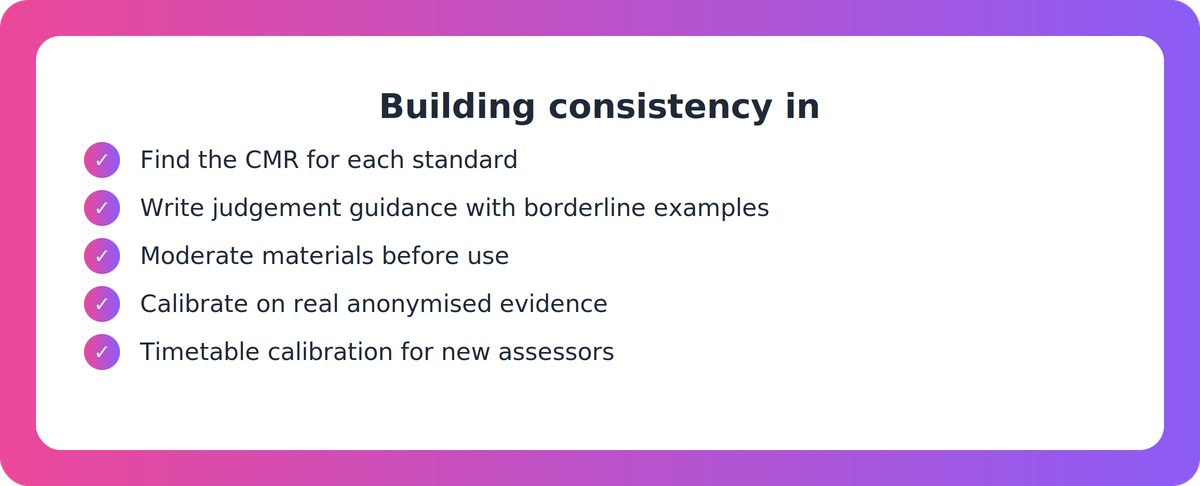
Start with the CMR for each standard
List the standards you assess and find the CMR for each. Note what it requires of you, who runs the external moderation, and what happens if outcomes are questioned. This is a one-off job that keeps paying off.
Write judgement guidance that settles borderline cases
An assessor guide that restates the standard doesn't help at the margin. Add worked examples of evidence that clearly meets the standard, evidence that clearly doesn't, and the borderline cases where your trainers have disagreed. The borderline cases are where drift lives.
Moderate materials before use
If the task is ambiguous, two assessors will read it two ways. Pre-assessment moderation is the cheapest place to catch that. Fixing a task costs far less than re-assessing a cohort.
Calibrate on real evidence
Have assessors judge the same anonymised piece of learner work independently, then compare. Record where they split and why, and feed it back into the guidance. Do it each time you add a standard or a new assessor, not once a year.
Protect calibration time for new and stretched assessors
If calibration depends on goodwill, it will be the first thing dropped in a heavy term. Put it in the timetable. A new assessor's first few decisions deserve a second pair of eyes.
What's at stake
Consequences can be serious. One CMR, for a different standard set (NZQA CMR 0100), says that in cases of repeated non-compliance the QAB will take action that can ultimately lead to withdrawal of consent to assess. Check the CMR for your own standards to see what applies to you.
The point isn't to scare anyone. It's that repeated problems carry a different weight from one-off errors, and unexamined variation is how problems repeat.
Key takeaways
- NZQA focuses moderation on assessor decisions and expects consistency within and across organisations and assessors.
- Internal moderation must be embedded in your quality management system and covers both materials before use and learner work after assessment.
- Judgement guidance is an NZQA expectation, not an optional extra.
- Requirements differ by CMR, so check the CMR for every standard you assess.
- No public NZ data measures assessor variation, so measure your own rather than assuming it's low.
Our take
Most providers treat consistency as a property of experienced trainers. Hire good people, trust their judgement, and let the external moderator spot-check. That model worked when teams were stable. It's fragile when staff turn over, classes grow and portfolios widen.
We think consistency should be a property of the system. Experience still matters, but it shouldn't be the only thing holding the line. If your consistency would disappear when two senior assessors left, you have a dependency, not a quality system.
The uncomfortable part is that you can't prove consistency without looking for inconsistency. A calibration session that finds disagreement isn't a failure. It's the process working before the external moderator does it for you.
FAQ
What does NZQA expect on assessor consistency?
NZQA's moderation principles say assessment design and judgement guidance should result in consistent measurement of learning, within and across organisations and assessors. It also says internal moderation helps ensure consistency over time and between assessors.
Is internal moderation just about checking marked work?
No. NZQA describes internal moderation as covering both pre-assessment moderation of materials and post-assessment moderation of learner work. Catching an ambiguous task before use is part of consistency, not separate from it.
How do I know which moderation requirements apply to us?
Check the Consent and Moderation Requirements (CMR) for each standard you assess. Requirements vary by CMR. Who runs external moderation depends on the standard: ISBs for industry standards, NZQA for general education subjects, generic standards and Field Māori standards.
How often do trainers actually disagree on the same evidence?
Nobody knows at a national level. We found no public NZ data on inter-assessor variability. Run your own calibration on real evidence and you'll have an answer that's specific to your organisation.
A useful first step this week: pick one high-volume standard, give three assessors the same anonymised evidence, and compare their decisions. What you find will tell you where to look next.