NZQA external evaluation and review preparation, as PTEs knew it, is over. NZQA stopped starting new External Evaluation and Reviews on 1 January 2026, so there is no four-yearly visitor to prepare for. The exposure hasn't gone away. It now sits inside your organisation, where you write your own report card every year.
Why this lands on your desk
For years, "audit season" gave compliance work a shape. You knew roughly when the panel was coming, you ran the pre-visit sprint, and you fixed what you found. The pressure was intense, but it was bounded.
Under the Quality Assurance of Tertiary Education Providers Rules 2026, that bounded event is gone. Each provider reports on its own self-review to NZQA every calendar year. The report identifies areas for improvement, sets out a plan to address them, and confirms compliance with the Act, NZQA rules and the Code.
Someone has to stand behind that confirmation. In most PTEs, that is you.
What replaced the audit visit
The rules were made on 19 December 2025 and commenced on 19 January 2026. NZQA says the PTE Rules 2026, which came into force on the same date, were re-issued to reflect the removal of EER and its replacement with self-review and monitoring.
Monitoring is the second half of the picture. NZQA may notify a provider that it will monitor particular qualifications, programmes, micro-credentials or management, and that may include site visits. There is no fixed calendar slot for that.
So the old rhythm of long quiet stretches and then a sprint no longer fits. A scramble before the annual report means assembling your own evidence from scattered sources. A scramble after a monitoring notice means doing it with less warning.
One evidence base, three demands
The self-review covers the Education (Pastoral Care of Tertiary and International Learners) Code of Practice 2021, which took effect on 1 January 2022. Pastoral care compliance sits inside the same yearly cycle as your PTE Rules obligations. It is not a separate exercise.
Programme monitoring draws on the same material. If your evidence lives across shared drives, inboxes and spreadsheets, you answer three different demands from one fragmented pile. You also become the bottleneck every time someone needs a document checked.
One familiar external check has also gone. According to the explanatory note in the 2026 Programme Approval Rules, consistency reviews were discontinued from 1 January 2026. NZQA's eQuate (September 2025) had proposed this as part of iQAF. That makes your internal moderation and assurance more important, because fewer outside eyes now test assessment practice.
The ground is moving under the role
The standards landscape is shifting at the same time:
- VET legislation passed in October 2025. Eight Industry Skills Boards and ten regional polytechnics became operational on 1 January 2026.
- ISBs replace Workforce Development Councils and take on standards-setting.
- Te Pūkenga is to be disestablished on or before 31 March 2027. Work-based learning must move from ISBs to polytechnics, PTEs or wānanga by 1 January 2028.
- The PTE Rules 2026 make the annual financial return biennial unless NZQA notifies a particular PTE otherwise. They also move enrolment and academic records rules into the PTE Rules. NZQA approval is now required for ownership changes before they happen, and for a new permanent site.
None of this is dramatic on its own. Together, it means your policies, programme documents and evidence must stay aligned to a moving target, with no external visit to tell you when you've drifted.
Be careful with secondary advice
A lot of commentary has appeared quickly. The Technical Institute, for example, says the first annual self-review is due from July 2026 through the MyNZQA portal. It also says the Code self-review must be published on the provider's website, that the first thematic question is generative AI in delivery and assessment, and that new quality descriptors are expected from July 2027.
Those claims were not confirmed in the NZQA rule text we reviewed. They may well be right. Check them against NZQA's own rules and guidance before you build a plan around them.
The same goes for any quality management system deadline you hear quoted, or how long Immigration NZ will keep using old EER ratings. We found no authoritative confirmation of either.
What year-round readiness looks like
You don't need a bigger sprint. You need a different test: can you show, on any given Tuesday, that compliance is current, owned and evidenced?
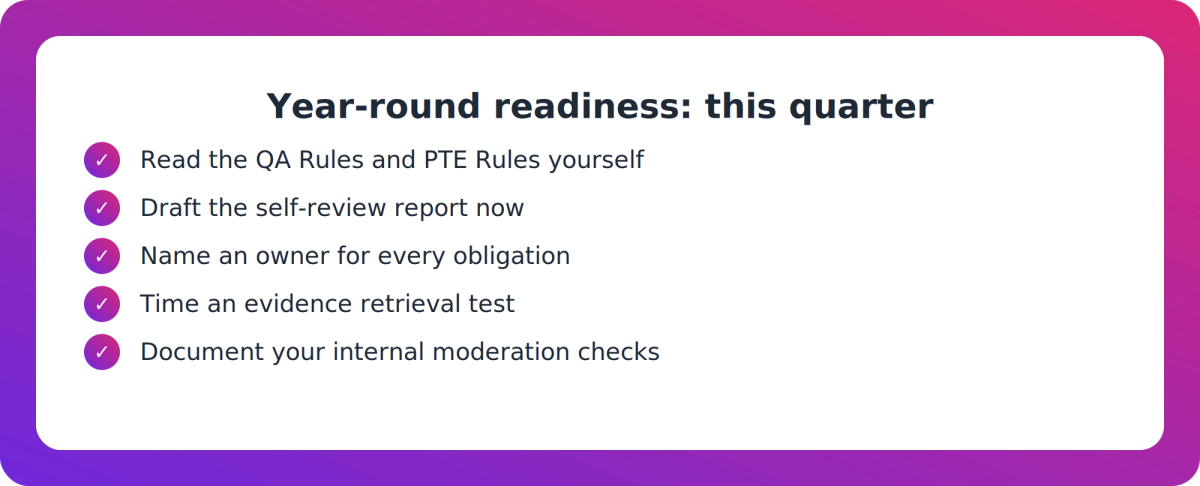
Try this quarter
- Read the QA Rules 2026 and PTE Rules 2026 yourself. Make your own list of obligations rather than inheriting someone's summary.
- Draft the self-review report now. Write the confirmation statements and see which ones you can't back with evidence.
- Name an owner for every obligation. "Compliance" is not an owner.
- Run a retrieval test. Pick one programme and time how long it takes to produce its evidence for monitoring. The answer is your real readiness.
- Strengthen internal moderation. With consistency reviews gone, document how you test assessment quality yourself.
Key takeaways
- EER is no longer started by NZQA from 1 January 2026. It has been replaced by annual self-review and NZQA monitoring.
- The QA Rules 2026 require an annual report confirming compliance with the Act, NZQA rules and the Code, plus an improvement plan.
- Monitoring has no fixed slot, so readiness has to be continuous.
- Code, PTE Rules and programme monitoring draw on the same evidence. Scattered evidence is the core risk.
- Verify secondary-source details, such as portal timing and thematic questions, against NZQA before acting.
Our take
The lazy reading of EER's removal is relief. It looks like less scrutiny. We think it is more accountability, because the provider now authors the claim and has to defend it.
The Compliance Managers who handle this well will stop measuring readiness by how well they perform at an inspection. They will measure it by how quickly anyone in the organisation can find the proof. The test is retrieval time, not report quality.
We can't point to authoritative data on compliance-team workloads, so we won't pretend to know how stretched your team is. But if you are the only person who can assemble the evidence, that is a design flaw, not a resourcing problem.
FAQ
Has NZQA really stopped External Evaluation and Review?
NZQA stopped starting new External Evaluation and Reviews from 1 January 2026. It has replaced EER with provider self-review and NZQA monitoring. The PTE Rules 2026, in force from 19 January 2026, were re-issued to reflect this.
What does the annual self-review report have to cover?
Under the Quality Assurance of Tertiary Education Providers Rules 2026, it identifies areas for improvement and sets out a plan to address them. It also confirms compliance with the Act, NZQA rules and the Code. The Code's scope includes the Pastoral Care Code of Practice 2021.
Can NZQA still visit my PTE?
Yes. NZQA may notify a provider that it will monitor particular qualifications, programmes, micro-credentials or management. That may include site visits. There is no fixed calendar slot.
What should I do first?
Draft your own self-review report before you are asked for it. Where you can't back a confirmation with evidence, you have found the first gap to close. Then confirm submission timing and format directly with NZQA, because secondary sources differ on the details.