Your delivery plan schedules every class, room and assessment event. It almost certainly doesn't schedule a single hour of your trainers' own industry currency. Under the Standards for RTOs 2025, that gap is yours, and no amount of paperwork at audit time can close it.
Why trainer currency lands on your desk
You own allocation, workload and timetables. Currency activity (time in industry, relevant accredited training, networking, reading) competes for the same hours as delivery and assessment. When the term is full, currency is the first thing to slip, because nobody is chasing it.
ASQA's 2025 Standards FAQs (version 3) ask directly whether the industry currency requirement has disappeared. The answer is "No". Everyone delivering training and assessment must maintain an understanding of current industry practices relevant to what they deliver.
That is a statement about the whole trainer pool, not about onboarding day. If you answer for consistent delivery and assessment quality, you answer for how currency is maintained after the induction folder is closed.
What the 2025 Standards say, and what they don't
The Standards for RTOs 2025 took effect on 1 July 2025. ASQA describes the Outcome Standards as being for delivering high-quality training, and the Compliance Standards as being for protecting the integrity of the VET sector. A separate Credential Policy covers trainer, assessor and validator credentials, and it must be read alongside the Outcome Standards.
ASQA lists ways to demonstrate currency:
- volunteering or working in industry
- accredited training relevant to the industry area
- industry association membership
- networking events
- reading industry journals and subscriptions
It also says the frequency depends on the training product being delivered or assessed.
Secondary reporting from VET Resources quotes the performance indicator as requiring industry competencies relevant to, and at least to the level of, the training product, plus an understanding of current industry practices. It also reports that ASQA's Practice Guide names not regularly reviewing trainers' and assessors' industry competencies and currency after onboarding as a known risk. That is secondary reporting, so check the primary ASQA text before you quote it to your board.
Why a fixed annual checklist is the wrong tool
Most RTOs handle currency with one template: every trainer, one declaration, once a year. It is tidy, and it doesn't match ASQA's wording.
If frequency depends on the training product, then a trainer delivering a fast-moving, technology-heavy unit needs a different rhythm from one delivering a stable foundation unit. Industry Skills Australia's transport and supply chain findings, which cover one industry area only, report that digital transformation and rapid technological change are increasing the time and cost for trainers and assessors to maintain vocational currency. Your own portfolio will have its fast-moving corners. Find them.
A uniform checklist also hides the real question. It records that something happened. It doesn't tell you whether a trainer's understanding of the workplace is still good enough to teach from.
The workforce reality: the trainers you can't see
Currency would be easier if you had spare trainers. You don't, and the sector doesn't either.
The DEWR VET Workforce Blueprint, quoted in Skills Insight's 2025 report, says the number of positions is growing but supply is not keeping up with demand, especially for VET teachers, trainers and assessors. Jobs and Skills Australia (October 2024) found 48.5% of the VET workforce is in Teach, Train and Assess roles (2021 Census), and that the workforce is older and ageing, more so in those roles. NCVER (2021) lists ageing practitioners, high casualisation, the need to maintain industry currency and the need to increase trainer capacity among the sector's workforce issues.
Put those together. Casual and long-serving trainers are often the people whose currency is hardest to see. Casuals are on site for a few hours and gone. Long-serving trainers have credibility that can mask a decade-old picture of the industry. Both groups are carrying your assessment consistency.
There is a burnout angle too. If currency is something trainers do on their own time, you are quietly adding unpaid hours to a role that is already stretched.
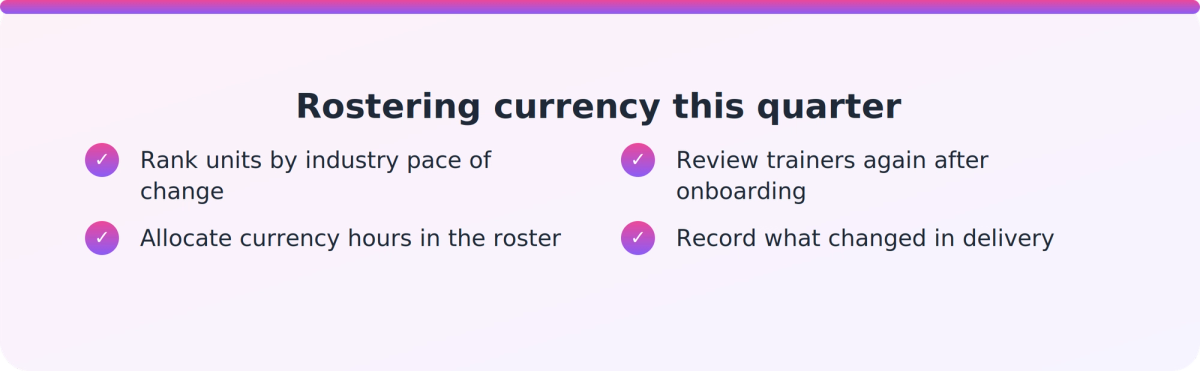
Four ways to put currency into the roster this quarter
None of this needs new systems. It needs a different conversation at planning time.
- Rank units by how fast their industry moves. Use that to set a review rhythm per training product, not per trainer.
- Allocate the hours. Treat industry time, relevant training and networking as rostered workload, with the same standing as marking.
- Review after onboarding. Revisit each trainer's industry competencies and currency on a schedule, particularly for casuals.
- Record what changed, not just what happened. A line on what a trainer saw in industry and what it altered in their delivery says more than an attendance certificate.
Currency and version control are the same problem
A current trainer still delivers poorly if the materials or assessment tools reflect a superseded unit of competency. You own delivery and assessment quality end to end, so you own both failures.
A practical caution, not a regulatory claim: if a trainer's delivery, the learner materials and the assessment tool each point at a different version of a unit, an auditor comparing what was delivered against documented evidence has something to find. Check which version each of your trainers is actually teaching from, as well as what their LinkedIn says about their industry experience.
Completion data is context here, not proof. NCVER reports the four-year completion rate for qualifications commencing in 2020 was 49.0%, up from 47.5% for 2019 commencers. The research doesn't show a causal link between trainer currency and completion. It does show how much is at stake in delivery quality.
Our take
Currency is a capacity problem wearing a compliance costume. RTOs that treat it as a records exercise will keep producing neat files and uneven delivery, and they will be exposed the first time someone asks what a trainer actually did to stay current.
The Head of Training is the only person who controls the hours. If currency isn't in the roster, it isn't happening, whatever the folder says.
A first step for this week: pick your three fastest-moving units, name the trainers delivering them, and ask when each last spent time in that industry. The answers will tell you where your plan is blind.
Key takeaways
- ASQA's 2025 Standards FAQs (v3) confirm the industry currency requirement has not disappeared, and it applies to everyone delivering training and assessment.
- ASQA says currency frequency depends on the training product, so a single annual checklist for every trainer doesn't fit the wording.
- Currency competes with delivery for the same hours. If it isn't rostered, it is unpaid or it doesn't happen.
- Casual and ageing trainers are the hardest to see, and workforce reports describe demand outpacing supply.
- Review currency after onboarding, and check unit versions in delivery and assessment materials alongside it.
FAQ
Has trainer currency been removed from the Standards for RTOs 2025?
No. ASQA's 2025 Standards FAQs (version 3) answer "No" to that question. All persons delivering training and assessment must maintain an understanding of current industry practices relevant to what they deliver.
How often must trainers do currency activities?
ASQA says the frequency depends on the training product being delivered or assessed. It doesn't set one fixed interval for every trainer, so base your rhythm on how quickly each industry area changes.
What activities can demonstrate currency?
ASQA lists volunteering or working in industry, accredited training relevant to the industry area, industry association membership, networking events, and reading industry journals and subscriptions.
Does currency stop at onboarding?
No. Secondary reporting from VET Resources says ASQA's Practice Guide names not regularly reviewing trainers' and assessors' industry competencies and currency after onboarding as a known risk. Check the primary ASQA text before quoting it.