Trainer burnout is usually filed under delivery: too many classes, too many cohorts, too little prep time. That may be the wrong drawer. The work that is regulated, evidenced, validated and now independently reviewed is assessment, and it's where a Head of Training should look first, before adding headcount and before another trainer resigns.
Why this lands on your desk
You decide how scarce trainer hours are split between the classroom or workshop and everything that happens after it. Nobody else in the RTO owns that trade-off. There's also very little slack to absorb a bad split.
Jobs and Skills Australia (JSA) reports that VET teachers have been in shortage nationally, and in every state and territory, for the last two years. Almost 50% are over 50, against 30% of the wider workforce. The workforce is highly casualised and paid less than teachers in other education sectors. JSA also found VET teacher numbers have shrunk by 11-18% over the last decade.
Put those together and every hour of avoidable marking, file upkeep or evidence rework comes out of a smaller pool. You're also judged on completion and progress, often with a late view of how learners are actually going.
What the public data doesn't tell you
Here's the honest gap. No authoritative public source we could find quantifies trainer burnout in Australian VET. None says how much trainer time goes to assessment and paperwork versus delivery.
So what follows is a hypothesis to test, not a sector finding. The strain on the workforce is documented. Where your trainers' hours go is not, and you can't wait for someone else to publish it.
Why assessment is the place to look
Three things are converging on assessment.
- It's the regulated core. The revised Standards for RTOs came into full regulatory effect on 1 July 2025. Standard 3.2 requires training and assessment to be delivered by credentialled people with current skills and knowledge in training and assessment.
- Scrutiny is rising. ASQA's revised Regulatory Assessment and Monitoring Approach, released on 26 June 2026, includes a four-category approach to performance assessments, tiered pathways for compliance resolution and independent student assessment validation activities.
- Currency adds load. Industry Skills Australia found, in transport and logistics specifically, that rapid technological change is increasing the time and cost for trainers to maintain vocational currency. That's one industry, not a national finding, but it's a useful prompt for your own trainers.
Delivery hours are visible on a timetable. Assessment hours are not. They leak into evenings, weekends and the gaps between classes, which makes them easy to under-count and easy to blame on "a busy term".
Audit assessment load trainer by trainer
You already hold the raw material: timesheets, marking records, LMS activity and validation schedules. Use them before you commission anything.
Step 1: Map where each trainer's week goes
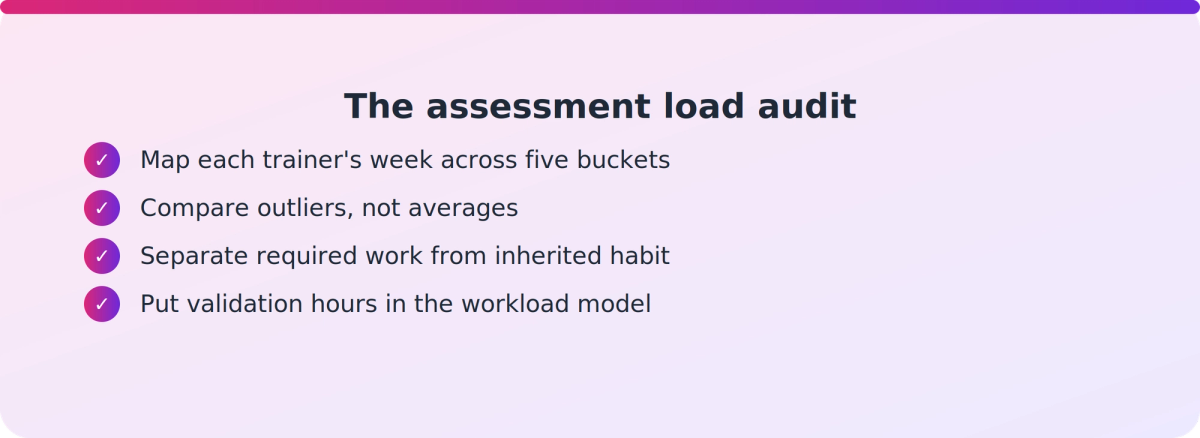
For each trainer, estimate hours across five buckets: face-to-face delivery, marking and feedback, evidence and file upkeep, validation and moderation prep, and currency activity. Rough is fine. What you're looking for is the spread between trainers, not decimal places.
Step 2: Look for outliers, not averages
Two trainers with the same cohort size can carry very different assessment loads. The cause might be unit design, assessment tool quality, resubmission rates or personal habit. An average hides all of it, and so does a headcount ratio.
Step 3: Separate what's required from what's inherited
Some of your burden may be a local design choice. ASQA's 2025 Standards FAQs (version 3) say there is no prescribed way of retaining trainer and assessor evidence. They also say currency can be shown through additional credentials or other professional development activities.
So ask whether your trainer-file process is heavier than the regulator requires. If it is, you've found hours you can return without touching compliance.
Step 4: Treat validation as a workload, not an event
Some secondary sources describe Standard 1.5 as requiring each training product to be validated at least once every five years by credentialled people independent of the design or delivery being validated. Check that wording against the Standards on asqa.gov.au before you build a schedule around it. Whatever the exact rule, validation takes someone's hours, so put it in the workload model.
What to do with what you find
If assessment load is concentrated in a few trainers, rebalance before you recruit. If it's spread evenly and heavy, look at the assessment tools and evidence processes themselves. If it's light, your burnout driver is somewhere else, and that's worth knowing too.
Be careful with completion data. NCVER says completion rates vary widely by qualification, student group and jurisdiction. An older NSW benchmark put completion at 47.1% and 47.3% after four years for 2018 and 2019 commencers. That's context only. Nothing here shows assessment burden causes non-completion. But a weak cohort result is much easier to explain when you know where the trainer time went.
Key takeaways
- Public data shows a shrinking, ageing, casualised VET teacher workforce, but nothing published shows where trainers' hours actually go.
- Assessment is the most regulated and, from ASQA's 26 June 2026 approach, increasingly reviewed part of the job, so test it first as a burnout driver.
- Audit assessment load trainer by trainer using timesheet and marking data before adding headcount.
- ASQA says there is no prescribed way to retain trainer and assessor evidence, so your own file process may be heavier than required.
- Verify validation requirements (Standard 1.5) against the Standards themselves before scheduling around them.
Our take
We think burnout conversations in RTOs start in the wrong place. Delivery is what people see, so delivery gets the blame and the hiring request. But delivery is the part of the job most trainers chose. The unplanned, unmeasured, repeatedly reviewed assessment work is more likely to be what wears them down.
We can't prove that, and neither can anyone else yet. That's the point. A Head of Training who runs the audit is working from evidence. One who waits for sector data is working from a gap.
FAQ
Is there national data on RTO trainer burnout?
Not that we could find. JSA documents shortage, ageing, casualisation, lower pay and a decade-long decline of 11-18% in VET teacher numbers. None of the public sources we reviewed quantifies burnout or the share of trainer time spent on assessment versus delivery.
Does the Standards for RTOs 2025 require a specific trainer file format?
No. ASQA's 2025 Standards FAQs (version 3) say there is no prescribed way of retaining trainer and assessor evidence. Currency can be shown through additional credentials or other professional development activities. Check whether your process asks for more than that.
What changed in ASQA's monitoring approach in June 2026?
ASQA's revised Regulatory Assessment and Monitoring Approach, released on 26 June 2026, includes a four-category approach to performance assessments, tiered pathways for compliance resolution and independent student assessment validation activities. It complements changes to ASQA's cost recovery model from 1 July 2026.
Should I hire before auditing assessment load?
Audit first. With VET teachers in national shortage, hiring is slow and uncertain. An audit may show the load sits with a few trainers, or in processes heavier than the regulator requires, and both can be fixed faster than a recruitment round.
One question to sit with this week: if you had to say, trainer by trainer, how many hours last term went to assessment rather than delivery, how many names could you fill in with confidence?