The Standards for RTOs 2025 don't reward a compliance manager who reviews everything. They reward one who can show, on any given day, that outcomes are being achieved. The self-assurance trap is mistaking practice-guide checklists and a pre-audit push for assurance, while you remain the single point of review.
Why this lands on your desk
You answer for registration. ASQA's position is that providers must demonstrate compliance against the Standards in effect at the time a decision is made. "We were ready last year" doesn't survive that sentence.
The Standards are also outcome-focused, and ASQA has said to expect more regulatory engagement. That makes the questions you face less predictable than a fixed checklist. An audit-prep sprint prepares you for the questions you already know.
Then there's the practical bit. Someone has to turn ASQA's guidance into owned, traceable tasks. In most RTOs, that someone is you. So you become the bottleneck, and the evidence sits in drives, inboxes and spreadsheets until somebody panics.
What the 2025 Standards changed
The 2025 Standards for RTOs came into effect on 1 July 2025 under the National Vocational Education and Training Regulator Act 2011. They have three components: the Outcome Standards, the Compliance Requirements (including the Fit and Proper Person Requirements) and the Credential Policy.
ASQA describes them as focused on outcomes for students and employers, with more flexibility and room to innovate for providers. That flexibility is real. It also moves the burden of judgement onto the provider. Nobody hands you a rule saying "this is enough". You have to decide what enough looks like, and defend it.
That is the heart of the self-assurance model under the Standards for RTOs 2025. Compliance is a continuous state, not an event you pass.
Where the trap closes
Practice guides are prompts, not tick-lists
ASQA's practice guides pair key concepts and example compliance activities with risks to avoid and self-assurance questions. That's useful material. But the questions are prompts for judgement, not a form to complete.
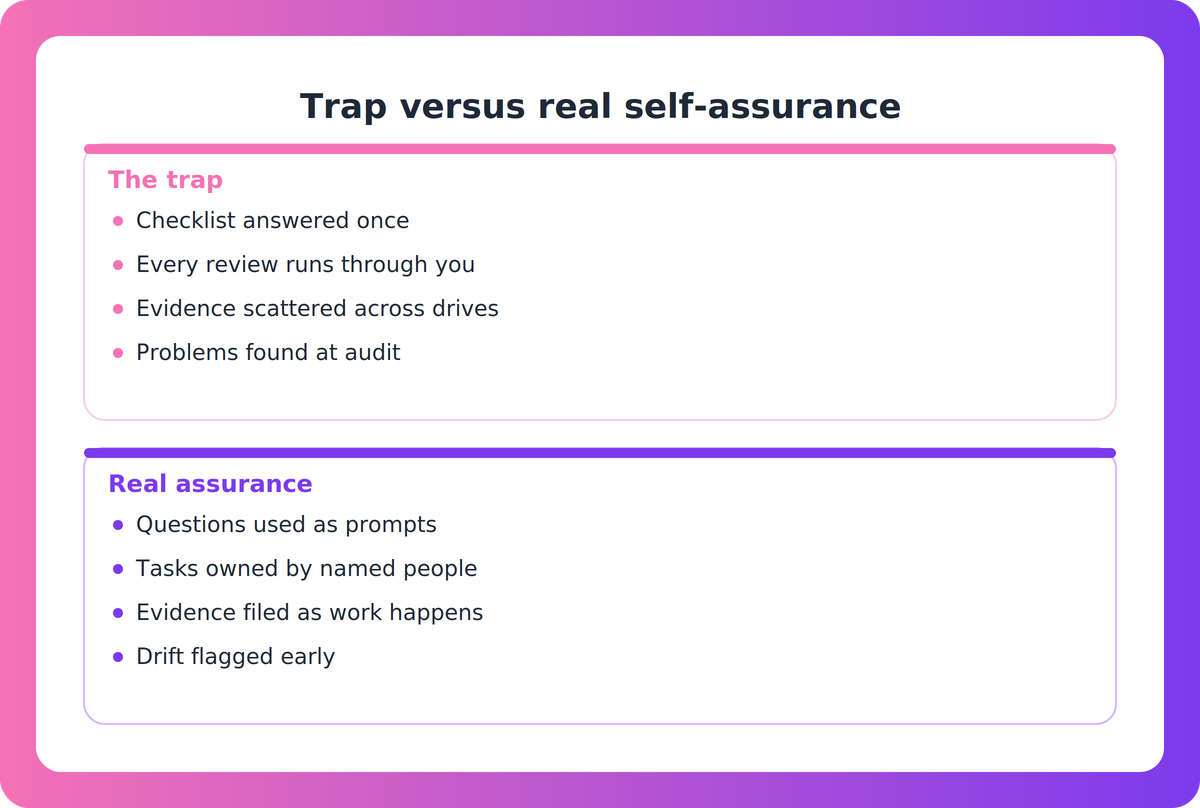
Answering them once, or only in the weeks before an audit, produces a tidy document that describes a single moment. It tells you nothing about how the organisation behaved in March.
The one-person review queue
The more subtle version of the trap is structural. If every policy change, assessment tool and piece of evidence has to pass across your desk to count as "assured", assurance scales only as far as your hours do. A busy week for you becomes a gap in coverage.
It also hides risk. When you are the only reviewer, nobody else is looking for drift, so the first signal of a problem is often an external one.
Reading the sector's confidence carefully
After more than 20 ASQA information sessions in May and June 2025, the sector self-reported preparedness at 4.0 out of 5. Take that for what it is: a self-rating. It is not an audit outcome, and the research behind this post found no ASQA audit outcome data to set against it.
The consequences of weak assurance, meanwhile, are visible. ASQA's homepage lists the cancellation of critically non-compliant providers and qualification-cancellation notices. High confidence and public enforcement can both be true at once.
What distributed self-assurance looks like
The alternative isn't more checking by you. It's three things working together: owned tasks, living evidence and early warning.
- Owned tasks. Every self-assurance question maps to a named person and a review rhythm. Trainers own assessment currency. Operations owns data. You own the framework and the exceptions.
- Living evidence. Evidence is filed as work happens, in one findable place, not reconstructed from inboxes later. If you can't retrieve it in minutes, it isn't evidence yet.
- Early warning. Overdue reviews, expired tasks and unresolved actions surface to you before they surface to a regulator.
Trap versus assurance
The difference shows up in what you can answer on a random Tuesday.
A secondary view worth testing
Some consultants argue self-assurance should run through the year. VET Advisory Group says ASQA's Continuous Improvement Practice Guide names compliance calendars or assurance programs as examples. Several vendors also describe an Annual Declaration on Compliance that lets RTOs disclose non-compliance with rectification steps.
These are secondary sources. Verify both claims on asqa.gov.au before building anything around them. The logic of a year-round rhythm holds either way, but you should cite the regulator, not a blog.
Plan for moving ground
Change keeps arriving. Skills Ministers agreed a phased reform of VET qualifications, with new templates from 1 July 2025 (Queensland DTET). The National Skills Plan 2025–26 update lists VET data streamlining, a new National VET Data System and stronger sector cyber security (DEWR).
No confirmed national release dates for reformed qualifications turned up in the research. So build for uncertainty: a process that absorbs a change in one place, rather than a project that needs rerunning each time.
A first step for this quarter
Pick one practice guide and list its self-assurance questions. Next to each, write three things: who owns it, where the current evidence lives, and how you'd find out if it slipped.
Wherever the answer is "me", "I'm not sure" or "somewhere in the shared drive", you've found your trap. Fix that gap first.
Key takeaways
- The 2025 Standards for RTOs (in effect from 1 July 2025) are outcome-focused. Compliance is a continuous state, judged against the Standards in effect when a decision is made.
- ASQA's practice guides supply self-assurance questions, risks to avoid and example activities. They prompt judgement. They are not a tick-list.
- A one-person review queue caps your assurance at your own capacity and delays warning signs.
- Real self-assurance needs distributed task ownership, current evidence and early warning signals.
- Treat claims about annual declarations and ASQA's 2026–27 priorities as unverified until confirmed on asqa.gov.au.
Our take
The sector's instinct is to answer flexibility with volume: more documents, more checklists, more sign-offs through the compliance manager. We think that's backwards. Flexibility asks for judgement, and judgement can't be centralised in one person without becoming the weakest link.
The compliance manager's job under these Standards looks less like chief reviewer and more like designer of an assurance system others operate. That's a harder job and a better one. It is also the only version that holds up when ASQA's questions don't match your preparation.
If you were out for a fortnight, what would tell the organisation it was drifting?
FAQ
What is the self-assurance model under the Standards for RTOs 2025?
It is the expectation that a provider can show, at any point, that it is meeting the Standards, rather than only at audit time. ASQA's practice guides support this with key concepts, example compliance activities, risks to avoid and self-assurance questions. ASQA describes the Standards as outcome-focused, giving providers flexibility.
Do the practice guides work as a compliance checklist?
No. They are prompts for judgement. Answering their self-assurance questions once, or only before an audit, records a moment in time. It doesn't show that practice is consistent across the year.
How often should we review our compliance?
ASQA says providers must demonstrate compliance against the Standards in effect when a decision is made, so the safer posture is year-round. VET Advisory Group suggests compliance calendars or assurance programs, citing ASQA's Continuous Improvement Practice Guide. That is a secondary source, so confirm it on asqa.gov.au.
Is there an annual declaration on compliance?
Several vendors describe an Annual Declaration on Compliance that lets RTOs disclose non-compliance with rectification steps. The research found this only in secondary sources. Check asqa.gov.au before relying on it.