ASQA doesn't appear to list assessor guides as their own audit evidence category. Yet they sit underneath what auditors do examine: consistent judgements, full unit coverage and, now, accountable AI use. The gap is our inference from ASQA guidance, not an ASQA finding. It's still worth closing before someone asks.
Does ASQA treat the assessor guide as audit evidence?
Not by name. We found no ASQA publication that singles out assessor guides as a distinct audit evidence category, so treat "silent gap" as an interpretation.
What ASQA does stress is the outcome a good guide produces:
- Assessors judge evidence against the standard, not their own opinion.
- Outcomes are comparable whoever conducts the assessment.
- Every requirement of the unit of competency is met.
The guide is the practical artefact that makes those three things demonstrable. If it's vague, the evidence behind them is thin.
A caveat on sources: much of the practitioner commentary here comes from vendors with a commercial interest, Supahuman included. Check anything important against asqa.gov.au.
Why would an auditor care about an assessor guide?
Because it's where consistency becomes visible. One provider's notes from the ASQA March 2026 update (a secondary source, Skills Education) record ASQA indicating that fairness and reliability between assessors suffer when they rely on their own judgement instead of the standard, such as a marking guide. The same notes say providers must ensure all of the unit requirements are met.
That's the closest regulator-sourced support we found for treating marking and assessor guides as an audit issue. It's still a provider's summary, not ASQA's own text.
Supahuman's own writing relays ASQA's Assessment Practice Guide to similar effect: evidence must be interpreted consistently, and outcomes must be comparable irrespective of who assesses. It's vendor commentary, so verify it.
What do weak guides look like?
Compliant Learning Resources, a resource vendor, lists common gaps. This is practitioner opinion, not regulator findings, but it will sound familiar:
- Benchmarks that are unclear, so two assessors could reasonably mark the same response differently.
- Generic observation checklists that don't reflect the unit's performance evidence.
- Assessment tools that aren't clearly mapped back to the unit.
None of these is exotic. They're what happens when a guide is written once, filed, and never revisited.
Where does AI-generated content fit in?
ASQA's August 2026 IQ covers its newly released Principles for the Responsible Use of AI in VET. According to Supahuman's summary of the five principles, they add no new regulatory requirements. That's a secondary reading, so check the primary text.
Skills Education's notes record ASQA saying AI cannot be used to make assessment decisions. Accountability for an AI-assisted assessor guide stays with the RTO.
We also found no published ASQA rule that bans or approves AI-generated assessor guides. A Supahuman post argues that a guide holds up when the RTO reviews it before use, contextualises it to the cohort, and keeps evidence of both. That's vendor content, but the logic is sound whoever wrote the first draft, human or machine.
Revised practice guides on AI were flagged for mid-year. We couldn't confirm whether they've been published, so look before you assume.
What evidence should sit behind the guide?
The audit gap, then, is probably not the guide itself. It's the trail around it. A practical set of questions:
A quick review-trail check
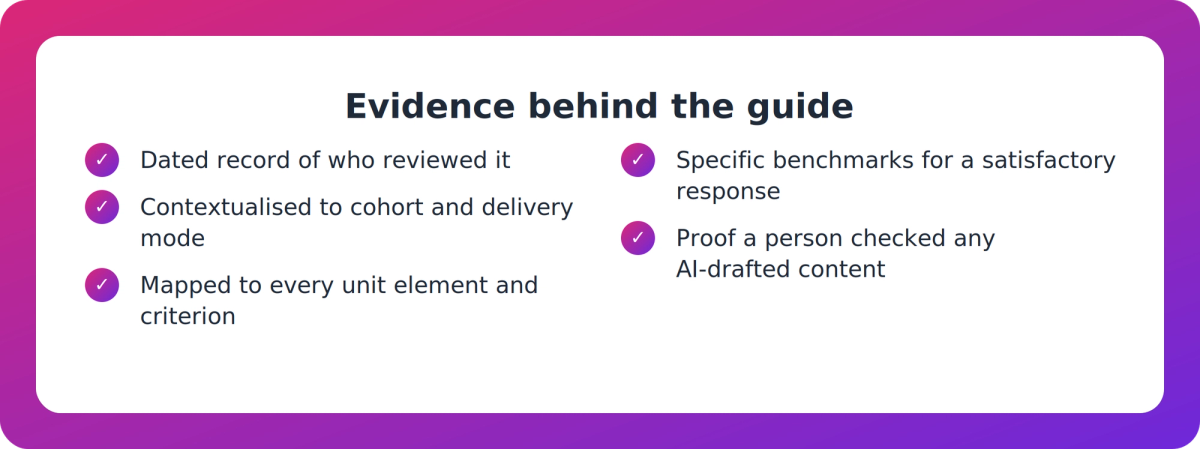
- Is there a dated record of who reviewed the guide, and when?
- Is it contextualised to the actual cohort and delivery mode?
- Does it map back to every element and performance criterion of the unit?
- Does it say what a satisfactory response looks like, specifically?
- If AI helped draft it, is there evidence a person checked and changed it?
One more prompt from Supahuman's commentary: track units whose assessment tools haven't been reviewed since the delivery mode, cohort or training package version changed. Those are the likeliest places for a guide to have quietly drifted from reality.
What do the audit numbers say?
Handle with care. Supahuman's reading of ASQA data puts non-compliance at 45 of 116 performance assessments (39%) completed between July 2025 and March 2026. That sits against 78% in 2024-25.
Those figures aren't directly comparable, and ASQA's published material doesn't explain the difference. Don't read it as a trend.
The governing framework is ASQA's revised Regulatory Assessment and Monitoring Approach (26 June 2026). It sets a four-category approach to performance assessments and tiered pathways for compliance resolution. Knowing how a finding gets classified helps you judge how much a weak guide could cost you.
Key takeaways
- ASQA doesn't appear to name assessor guides as a separate audit evidence category. The "silent gap" is an inference.
- Consistency between assessors and full unit coverage are the real audit concerns, and the guide is how you prove both.
- AI-assisted guides carry no special approval or ban, but accountability stays with the RTO.
- Evidence of review and contextualisation matters as much as the guide document.
- Verify vendor commentary, ours included, against asqa.gov.au.
Our take
Most RTOs treat the assessor guide as an attachment to the assessment tool. We think it's the document an auditor would most naturally reach for to test whether your assessors share one standard. Whether you draft it by hand or with AI, the defensible position is the same: a guide that's mapped, reviewed, contextualised and dated. Pick one unit this week and see how quickly you can show all four.
FAQ
Does ASQA require an assessor guide for every unit of competency?
We found no ASQA publication that states this as a standalone requirement. ASQA guidance does expect consistent judgements against the standard and full unit coverage, and an assessor guide is the practical way to show both. Confirm the specifics on asqa.gov.au.
Can an RTO use AI to generate assessor guides?
We found no published ASQA rule banning or approving AI-generated assessor guides. According to secondary summaries, ASQA's responsible AI principles add no new requirements, and AI cannot be used to make assessment decisions. The RTO remains accountable for the guide.
What evidence shows an assessor guide is audit-ready?
An auditor is likely to look for the guide plus the trail around it: mapping to the unit, review records, contextualisation to the cohort and delivery mode, and clear benchmarks. If AI helped draft it, keep evidence that a person reviewed and adjusted it.
Is the 39% non-compliance figure a sign audits are getting easier?
No. The 39% (45 of 116 performance assessments, July 2025 to March 2026) isn't directly comparable with 78% in 2024-25, and ASQA's published material doesn't explain the difference. It shouldn't be read as a trend.