Every resource, assessment tool and learning activity your RTO owns is a depreciating asset, and most instructional designers manage them without a balance sheet. Training package reform, the Standards for RTOs 2025 and shifting industry practice all lower an asset's value. A simple ledger turns that churn from an audit-day surprise into planned maintenance.
Why this lands on your desk
You own the mapping and the rework cycle. When a Jobs and Skills Council releases updated units or qualifications, you absorb the change. The timing depends on which council owns your training packages, so two designers in the same RTO can have very different years.
The Standards for RTOs 2025 took effect on 1 July 2025 and are outcome-focused. That shifts the question from "did we tick the clause?" to "can we show our learning design is consistent with the training product and informed by industry?" You are the person who has to show that.
Then there is capacity. The JSA VET Workforce Study (October 2024) describes a workforce that is older, highly casualised and lower paid than its teaching counterparts. Almost half are over 50, and the average age is 47 against 41 for the Australian workforce. Industry Skills Australia, writing about transport and supply chain, reports that digital transformation increases the time and cost for trainers to maintain currency. Fewer hands are available, and every unmanaged asset competes for them.
What goes on the ledger
A content debt ledger is a spreadsheet, not a system. One row per asset, whether that is a unit resource, an assessment tool, a learner guide or a simulation. Five columns do most of the work:
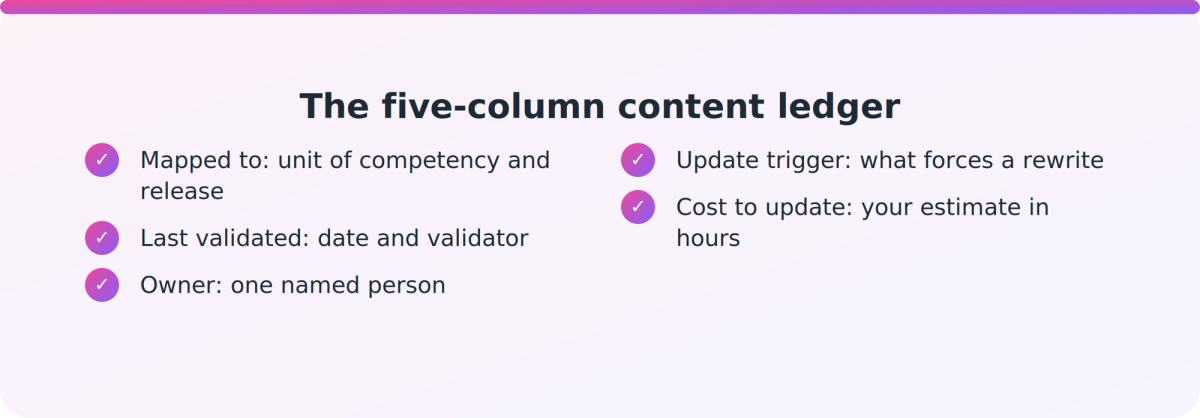
| Column | What you record | |---|---| | Mapped to | The unit of competency and release, plus any Standards clause it was built to evidence | | Last validated | Date and who validated it | | Owner | A named person, not a team | | Update trigger | What would force a rewrite: a package release, a Standards change, an industry shift | | Cost to update | Your own estimate in hours, split into rewrite, re-map and re-validate |
The cost column is the one people skip, and it is the one that makes the ledger useful to a manager. "This unit is stale" is a complaint. "This unit is stale and will take about 40 hours to fix before the next intake" is a budget line. Those hours are your estimate. No source gives a benchmark for them.
Treat validation as a recurring entry
ASQA's 2025 Standards FAQ (version 3, December 2025) says that for any AQF qualification or skill set from the TAE Training Package, Standard 1.5 requires validation once the first cohort of VET students with the organisation has completed training and assessment. Log that as a checkpoint on the asset, not a one-off event.
One caution. Knowledge Foundry reports validation at least once every five years, but we could not confirm that on an ASQA page. Read the Standards text before you build a schedule on it.
Reading the reform calendar as a forecast
Skills Ministers agreed in December 2024 on a purpose-led approach to qualification design, aimed at better quality, simpler product design and less complexity. The updated Training Package Organising Framework took effect on 1 July 2025, with Jobs and Skills Councils leading phased implementation.
DEWR's framework sorts training package projects into fast-track, routine or complex categories. It also encourages councils to group products for review where possible, to minimise churn. For you, that means rework arrives in batches, and at different times by industry.
So add a "likely write-down" flag to each row. Then read your councils' quarterly updates as an early-warning feed. The Future Skills Organisation's April 2026 update for finance, business and ICT, for example, says updates will reflect current industry practices, standards, technology and regulations. If your assets map to those packages, you have just been told where the next write-down lands.
Using ASQA's own questions as the audit
You don't need to invent an audit method. ASQA has developed Practice Guides for the 2025 Standards covering key concepts, example compliance activities, risks to avoid and self-assurance questions. The Standards have three parts: the Outcome Standards, the compliance requirements and the Credential Policy. DEWR is custodian of the legislation.
Pick the guides that touch training and assessment and turn their self-assurance questions into a review checklist. Run each asset past them and record the result in the ledger. That gives you a regulator-aligned test, and the paper trail shows you did it.
Secondary commentary also flags purchased or generic resources that are not contextualised to the cohort, the learning environment and the training product. Add a column for "contextualised to" if that is where your debt hides.
Where the sources run out
Some things are worth saying plainly.
- AI and design cost. We found no authoritative Australian data on how AI changes instructional design cost or time, so we won't claim savings. The Sector reports that ASQA's AI principles add no new regulatory requirements but help providers interpret AI use within existing obligations, including the 2025 Standards. SKG Consulting says an assessor may use AI to help, but competency judgement and responsibility stay with the assessor. Check asqa.gov.au for the principles themselves before you cite them.
- Cultural competency. We found no specific 2025 Standards clause or ASQA guidance on cultural competency or cultural safety. Go to the Outcome Standards text and the Practice Guides rather than assuming a requirement.
- LMS rules. We found no LMS-specific regulatory requirement. The Standards are outcome-based, so how your content sits in the LMS is a design decision, not a clause.
- Your own workforce. No public data exists on instructional designer headcount or turnover in VET, so your own capacity numbers are the only ones that count.
Key takeaways
- Training content depreciates when training packages, the Standards for RTOs 2025 or industry practice move.
- A five-column ledger (mapped to, last validated, owner, update trigger, cost to update) turns rework into planned maintenance.
- Reform arrives in fast-track, routine and complex batches by Jobs and Skills Council, so council quarterly updates work as an early-warning feed.
- ASQA's Practice Guide self-assurance questions give you a regulator-aligned way to test each asset.
- Where the sources are silent (validation intervals beyond Standard 1.5 for TAE, cultural competency, LMS rules, AI savings), check the Standards and Practice Guides directly.
Our take
Most content debt is a visibility problem before it is a money problem. Designers know which resources are shaky. Nobody else does, so the work only gets funded after a package release or an audit finding forces it.
The ledger doesn't make the work cheaper. It makes the work visible early enough to be scheduled, and it gives you numbers to argue for capacity in a sector where capacity is thin. We'd also resist the temptation to promise that new tools shrink the bill until there is Australian evidence for it.
A first step for this quarter: list your ten most-delivered units, fill in the five columns, and flag the ones sitting under a council with a batch coming. You'll find out quickly which assets you can't currently account for.
FAQ
How often should I validate training and assessment materials?
ASQA's 2025 Standards FAQ (version 3, December 2025) says Standard 1.5 requires validation for TAE Training Package qualifications and skill sets once the first cohort has completed training and assessment. Knowledge Foundry reports a five-year minimum, but we could not confirm it on an ASQA page. Check the Standards text, then log validation as a recurring ledger entry.
How do I know when a training package change will hit my assets?
DEWR's Training Package Organising Framework classes projects as fast-track, routine or complex and encourages councils to group products for review. Read the quarterly updates from the Jobs and Skills Councils that own your packages. The Future Skills Organisation's April 2026 update is one example of what they publish.
Can I use AI to speed up content design?
The Sector reports that ASQA's AI principles add no new regulatory requirements, and SKG Consulting says competency judgement stays with the assessor. We found no authoritative Australian data quantifying design savings, so treat any figure as unverified. Read the principles on asqa.gov.au before relying on either secondary source.
What do the 2025 Standards say about cultural competency or LMS use?
The research behind this post found no specific clause or ASQA guidance on cultural competency or cultural safety, and no LMS-specific requirement. The Standards are outcome-based. Check the Outcome Standards and the Practice Guides directly.