Your board pack probably tracks enrolments, completions and cash. It almost certainly doesn't track what happens if the one or two people who know how your programmes map to current standards walk out. That is key person risk in vocational training, and in New Zealand in 2026 it is a governance exposure that sits with you.
Why this lands on your desk
You answer to the board or owners for regulatory standing. NZQA already treats "who does what" as a registration matter. Under the Private Training Establishment Rules 2026, application requirements include an organisation chart naming the people in each position, CVs and position descriptions for senior managers, and a copy of the quality management system required under the Quality Assurance of Tertiary Education Providers Rules 2026.
The stakes are financial as well as administrative. According to TEC's FAQs, PTE registration gates TEC funding for providers that are not a university, polytechnic or wānanga. A capability failure can become a funding-eligibility problem.
So dependence on a few individuals is visible to the regulator, even when it never appears in your board report. The question is whether you've looked at it before someone else does.
The standards pipeline is no longer yours to control
Industry Skills Boards (ISBs) were formally established from 1 January 2026, with standard setting as a core role, according to TEC. The Services ISB's 2026–27 operational plan says it sets and maintains standards, endorses programmes, moderates assessments and identifies skills needs. It also says 581 training providers deliver the qualifications and standards it sets, PTEs included.
NZQA's ISB Prescribed Quality Assurance Rules 2026 require ISBs to have arrangements for developing and maintaining skills standards, maintaining unit standards and deciding whether to endorse programmes. Put simply, the standards you build on now move through a pipeline you don't run.
That changes what your programme developer's knowledge is worth. It used to be local expertise. Now it is the thing that lets you respond when upstream standards shift.
A live example: the Services ISB says its Leadership qualifications and standards were finalised in January 2026 and are available for programme endorsement through the ISB. If you deliver in that area, you face re-mapping work. If one person holds that mapping in their head, your timeline is their calendar.
The sector is reshuffling around you
TEC says work-based learning is transitioning during 2026 and 2027. Divisions are moving out of ISBs into polytechnics, wānanga or PTEs, and new polytechnics and PTEs for work-based learning are standing up.
The sources don't say what this does to the labour market for experienced programme developers. It's a fair question to ask yourself, though. When new entrants need development capacity and established players want to expand, are your best people more or less likely to be approached? Treat that as a question, not a finding.
The growth side matters too. If you want to expand into new delivery or compete for it, you need development capacity that scales past two people.
What annual self-review would ask of you
Some secondary sources report that NZQA's new quality framework (iQAF) went live in January 2026, that external evaluative reviews are no longer being started, and that annual organisation self-review applies from July 2026. Treat all of that as needing verification with NZQA directly. One vendor blog also claims providers without a compliant quality management system must build one before 1 January 2027. Check that against the Rules themselves.
If self-review is heading your way, the implication is plain. Your organisation must evidence its own quality management from its own systems. "Ask Sam, she built it" is not evidence.
A board-level test you can run this month
For each programme, ask four questions and record the answers honestly:
- Who developed it?
- Where is the mapping to the standard documented?
- Who could maintain it if that person left?
- When was it last checked against the current standard status?
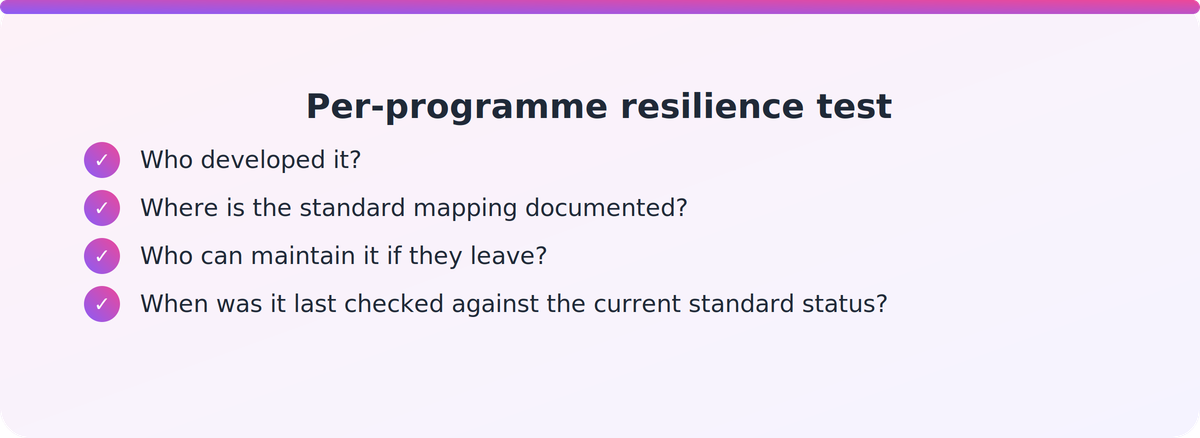
A programme that fails the third question is a single point of failure. One that fails the fourth may already be out of step with the standard. Colour-code the results and bring the red ones to your next board meeting. You don't need invented metrics. You need a list.
Key takeaways
- Key person risk in programme development is a governance and resilience issue the CEO owns, not an HR or compliance-team problem.
- NZQA's PTE Rules 2026 already expect named senior people and a documented quality management system, so reliance on individuals is visible to the regulator.
- With ISBs setting standards and endorsing programmes, programme mapping knowledge must be organisational, because the standards pipeline is outside your control.
- Work-based learning changes through 2026 and 2027 make development capacity a growth question as well as a risk question.
- Verify the reported self-review and iQAF timelines with NZQA before you plan around them.
Our take
Most PTEs treat key person risk as a retention problem. We think that's the wrong frame. You can't fully prevent good people from leaving, and you shouldn't try to hold them hostage with undocumented knowledge. The sounder position is that a programme you can't maintain without one specific person isn't really an organisational asset yet.
Resilience here is mostly dull: written mapping, clear ownership, a recorded check against current standard status. None of it is glamorous. All of it is what lets you answer a regulator, a board or an ISB endorsement process without a scramble.
Here is a first step you can take this week. Ask your head of training to name the two people whose departure would hurt most, then ask them what would break first. Their answer is your risk register.
FAQ
What is key person risk in programme development?
It is the exposure created when knowledge of how programmes are built, mapped to standards and maintained sits with one or two people rather than in documented systems. If they leave, the PTE may struggle to develop, update or defend its programmes.
Does NZQA actually require PTEs to manage this?
Not by that name, based on the sources. The Private Training Establishment Rules 2026 require an organisation chart naming people in each position, CVs and position descriptions for senior managers, and a copy of the quality management system. Those requirements make reliance on individuals visible.
How do Industry Skills Boards change the risk?
ISBs now set and maintain standards and decide on programme endorsement. When standards change, as with the Services ISB's Leadership standards finalised in January 2026, providers must re-map programmes. Whoever holds that mapping knowledge becomes critical.
Is annual self-review confirmed?
Not in the primary sources supplied. Secondary sources report annual organisation self-review from July 2026, but you should confirm timing and requirements directly with NZQA.
What should I report to my board?
For each programme, report who developed it, where the standard mapping is documented, who could maintain it if that person left, and when it was last checked against the current standard status.