Your board can tell you what a trainer costs per hour and what an enrolment earns. It almost certainly can't tell you what it costs to build, validate, maintain and defend a single unit of competency. With volume flat and the 2025 Standards in force, that hidden number is where margin is now won or lost.
Why this lands on your desk
You own the P&L, but you probably see cost at the level of delivery and overheads. The cost of a unit is scattered across trainer time, compliance staff, consultants and whoever fixes things after a validation meeting. No single line item adds it up.
The growth backdrop makes that costly. NCVER reports 5.1 million students in nationally recognised VET in 2025, up by just 1,585 on 2024. The domestic participation rate for 15–64 year olds slipped to 26.4% because population growth outpaced student growth. If volume isn't carrying you, cost discipline has to.
Pricing pressure sits on top. The National Skills Agreement runs for five years from 1 January 2024, and Fee-Free TAFE delivers fee-free places in agreed priority areas over 2023 to 2026. If you compete on price in those areas, you need to know your real unit cost before you decide where to compete.
Regulatory standing adds another layer. ASQA says its compliance and enforcement powers have not changed. It will decide matters against the 2025 Standards for activities spanning 1 July 2025, and it has signalled more regulatory engagement. Weak evidence behind one unit turns into rework and risk, and that lands on you.
What sits inside the cost of a unit
A caution first. The research behind this piece found no verified sector benchmark for the cost of developing, validating or maintaining a unit of competency. So this is a way to ask the question, not a number to compare yourself against.
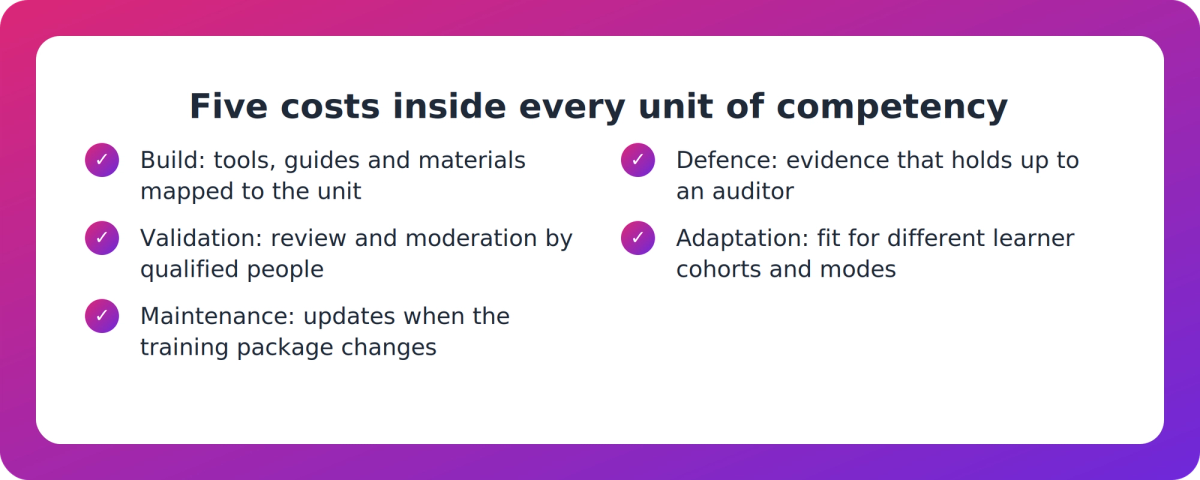
For each unit on your scope, ask for these components:
- Build: the staff and contractor time to develop assessment tools, assessor guides and learner materials, mapped back to the unit.
- Validation: the time to review, moderate and validate, including the qualified people it pulls away from delivery.
- Maintenance: the cost of keeping the unit current when the training package changes.
- Defence: the effort to produce evidence that holds up when ASQA, an auditor or a funder asks.
- Adaptation: the extra work to make the unit fit different learner cohorts and delivery modes.
Most providers can estimate the first one. The rest tend to be invisible, and they recur every year.
Where the cost hides: rework, evidence and people
Rework
Rework is the most expensive hour in the building because it happens twice. A tool that gets built, fails validation, and gets rebuilt carries two build costs and a delay. Ask how many units went back for substantive changes last year, and why.
Evidence quality
ASQA describes the 2025 Standards as outcomes-focused and flexible about how providers demonstrate compliance. In practice, the quality and defensibility of each unit's evidence matters more than the volume of paperwork. That is a cost question, because evidence that is thin or hard to retrieve is expensive to repair under pressure.
ASQA's risk priorities for 2025–26 put non-genuine providers first, including fraudulent qualification issuance, funding fraud and phoenixing. A genuine provider can separate itself from that profile with well-evidenced unit-level quality. Your board should know what that evidence costs to produce and maintain.
Key-person dependency
Here is an inference, not a sourced finding. If how a unit was mapped, validated and kept current lives in the heads of one or two people, the real cost of that unit includes the exposure if they leave. You wouldn't run finance that way. Ask which units depend on a single person, and what a handover would take.
Learner cohorts
NCVER reports growth among younger students (including those in school), regional and remote students, students with a disability and First Nations students. Those cohorts may need different support and assessment adaptation, and so potentially different unit costs. That is also an inference, not an NCVER finding. It is still worth checking whether your cost view assumes one learner when you serve several.
Where AI fits, carefully
AI sits inside existing obligations. Secondary reporting says ASQA's AI principles introduce no new regulatory requirements. Consultancy accounts of ASQA's March 2026 workshops say AI cannot make assessment decisions or complete validation where qualified people are required. Treat those as unverified against primary ASQA documents.
ASQA's published case study describes an RTO that required students to explain their decisions and how they adapted AI-generated content, as evidence of authentic competency. The useful question for you is not whether to use AI. It is which parts of unit development and maintenance can be sped up, and which remain qualified-person work.
A first step this quarter
Pick three units: your highest-enrolment unit, a unit that has caused you trouble, and one that depends on a single person. Ask the team to estimate hours and dollars across the five components. The estimates will be rough. The gaps between them are the point.
Key takeaways
- Revenue per enrolment and trainer cost per hour don't show what it costs to build, validate, maintain and defend each unit of competency.
- With enrolments up only 1,585 to 5.1 million in 2025, margin is more likely to come from unit-level efficiency than from volume.
- Rework, evidence quality, key-person dependency and cohort adaptation are the hidden components of unit cost.
- No verified sector benchmark for this cost was found, so measure your own and compare it over time.
- AI doesn't change the obligations. Qualified people remain responsible for assessment decisions and validation.
Our take
Most RTO leaders treat compliance as a cost of doing business and unit-level work as an operational detail. We think that's backwards. Under outcomes-focused standards, the unit is the place where compliance, quality and margin meet.
The strongest position is a CEO or GM who can say what each unit costs to hold on scope and where the money leaks. That view won't be precise. It will still be better than the current one, which is silence. Your board will ask for it eventually, and it's better to have drawn it up yourself.
FAQ
What is the cost per unit of competency for an RTO?
It is the full cost of building, validating, maintaining and defending one unit on your scope, including rework and the evidence you need to show an auditor. The research found no verified sector benchmark, so the useful comparison is your own units over time.
Why does this matter more under the Standards for RTOs 2025?
ASQA describes the 2025 Standards as outcomes-focused and flexible about how providers demonstrate compliance. That puts the weight on the quality and defensibility of evidence for each unit, rather than the volume of documents.
Does using AI reduce unit cost?
It may reduce some development and maintenance effort, but that is your own measurement to make. Secondary reporting says ASQA's AI principles add no new requirements, and that qualified people must still make assessment decisions and complete validation. Check the primary ASQA guidance before relying on either claim.
How do I start without a benchmark?
Choose three units and estimate hours and dollars across build, validation, maintenance, defence and adaptation. Record who holds the knowledge for each. Repeat the exercise next quarter and track the movement.