No public ASQA data says role-play evidence is an audit hotspot. That isn't comfort. Under the 2025 Standards, every simulated assessment has to be defensible on its own terms: it must replicate the workplace, meet the training package, and sit in an evidence trail you can produce without a scramble.
Why this lands on your desk
You own the question "would this simulated assessment stand up if ASQA asked?" Nobody else in the RTO is accountable for the answer, and nobody else gets the call when the answer is "we think so".
The 2025 Standards for RTOs took effect on 1 July 2025. ASQA describes them as focused on outcomes for students and employers, with more flexibility and room for innovation in delivery. It also says to expect more regulatory engagement. In practice, you're judged less on ticking clauses and more on showing outcomes. ASQA's Corporate Plan 2026–27 calls embedding the Standards its most significant regulatory priority.
The staffing picture adds pressure. Jobs and Skills Australia (October 2024, so older data) reports VET teacher shortages in every state and territory, almost 50% of the workforce over 50, and a highly casualised workforce. More simulation design decisions land with you for review. Without clear criteria, you become the bottleneck.
What we know, and what we don't
Honesty first. We found no ASQA statistics or published findings on how often simulated-environment or role-play evidence causes non-compliance. Anyone telling you auditors are "digging into" role-play as a documented trend is ahead of the evidence.
Here is what is documented:
- The 2025 Standards have three elements: the Outcome Standards, the Compliance Standards (including the Fit and Proper Person Requirements) and the Credential Policy.
- The Outcome and Compliance Standards are legislative instruments. DEWR's policy documents don't impose legal obligations, so anchor your audit preparation in the instruments, not in commentary.
- ASQA's 2026 Environmental Scan names four interconnected risks. Two matter here: the quality, sufficiency and fitness-for-purpose of training, and the integrity of qualifications and competency outcomes.
Simulation isn't named in those priorities. But simulated assessment sits close to both themes, which is reason enough to get ahead of it.
The benchmark: replicate the workplace
The most specific ASQA wording we found comes from the superseded 2015 Users' Guide to the Standards (v2.3). It says that where simulated workplace environments are used, they should fully replicate the resources, environment and any time and productivity pressures of the actual workplace. It also notes that training packages and accredited courses set out assessment requirements, including any specific environments or equipment that must be used.
That is 2015-era guidance, and you should say so if you cite it. Check it against ASQA's current 2025 Practice Guides and the 2025 Standards FAQs (version 3 is on asqa.gov.au). But as a benchmark it's hard to argue with. It tells you what a sceptical reviewer would reasonably expect to see.
Note the phrase "time and productivity pressures". A role-play with no clock, no interruptions and a cooperative "customer" fails that test, however well it's scripted.
A self-assurance check for each simulated assessment
ASQA's Practice Guides for the 2025 Standards are not prescriptive. According to a QCAA memo of 22 July 2025, they include examples of compliance activities and self-assurance questions. Use them as the base for an internal check rather than waiting for an audit.
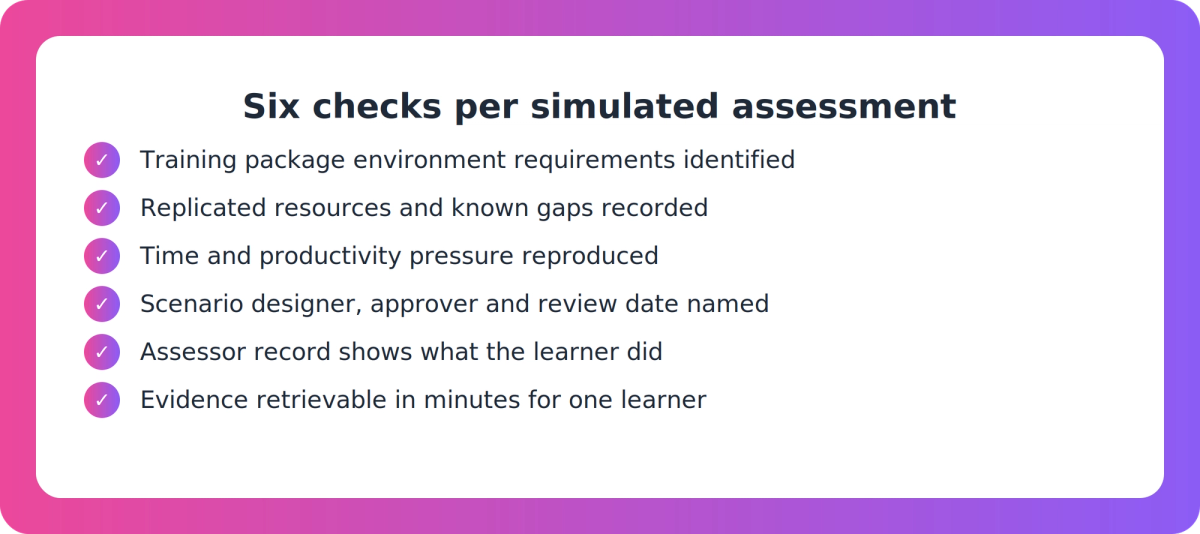
The questions below are our suggested starting point, built from the 2015 wording and the training package requirement. They are not ASQA's list:
- Does the unit of competency's assessment requirement call for a specific environment, equipment or workplace conditions?
- Which workplace resources does the simulation replicate, and which does it not? Is the gap recorded?
- Where does the real workplace impose time, volume or productivity pressure, and where does the simulation reproduce it?
- Who designed the scenario, who approved it, and when was it last reviewed against current industry practice?
- Does the assessor's record show what the learner did, not only that they passed?
- Can you retrieve all of this in minutes, for one named learner?
If question 6 is the one that makes you wince, that's the real finding.
Make the trail traceable
Outcome-based regulation rewards a single, traceable line from the training package requirement, through the simulation design, to the assessor judgement and the validation record. It punishes a trail that lives in someone's inbox, a shared drive nobody trusts and a spreadsheet with three versions.
A workable standard: for any simulated assessment, you should be able to show the requirement, the design rationale, the approval, the learner's evidence and the review date, each with a named owner. Where the review criteria are written down and repeatable, trainers can self-check before work reaches you. That is how you stop being the bottleneck.
Trainer currency belongs in this trail too. The Industry Skills Australia VET Workforce Project (2 June 2026 update) reports that digital transformation and technological change are increasing the time and cost for trainers and assessors to maintain vocational currency. A simulation that was realistic three years ago may not reflect the workplace now.
If AI is part of the simulation
Some providers now use AI-driven role-play or simulation. ASQA has published Principles for the Responsible Use of AI in VET, covered in ASQA IQ. We haven't characterised their detail here, so read them directly on asqa.gov.au.
The practical point is simple. Flexibility in how you deliver doesn't remove the need to evidence that it produces competent graduates. Document how AI is used, who governs it and who reviews what it generates. Treat claims that ASQA accepts a particular format, such as real-time video role-play for remote cohorts, as unverified until you've confirmed them on asqa.gov.au. We only found those claims on vendor blogs.
Key takeaways
- No public ASQA data shows simulation or role-play evidence is a specific audit hotspot. Don't repeat that claim as fact.
- The 2015 Users' Guide wording sets a useful benchmark: fully replicate the resources, environment and time and productivity pressures of the real workplace. Label it as 2015-era guidance.
- Anchor preparation in the legislative instruments (the Outcome and Compliance Standards), and check against ASQA's 2025 Practice Guides and FAQs.
- Build one traceable evidence trail per simulated assessment, with named owners and review dates.
- If AI is involved, read ASQA's Principles for the Responsible Use of AI in VET and document your governance.
Our take
The useful question isn't "is ASQA coming for role-play?" It's "could we defend every simulated assessment we ran last term?" The first question invites anxiety. The second gives you a job you can finish.
We think simulation is a legitimate and often better way to assess skills that can't be safely or reliably observed on the job. But legitimacy has to be demonstrated, assessment by assessment. A quiet quarter doesn't prove you're covered. A traceable trail does.
A first step for this week: pick three simulated assessments at random and run the six questions above. Time how long it takes to assemble the evidence for each. That number tells you how audit-ready you really are.
FAQ
Is ASQA specifically auditing role-play and simulated assessment evidence?
No public ASQA data or published findings we found show that. ASQA's stated risk priorities cover training quality and competency integrity, and simulated assessment evidence sits close to both. Prepare on that basis, without assuming a dedicated focus.
What does ASQA say a simulated workplace environment must do?
The 2015 Users' Guide (v2.3) says simulated workplace environments should fully replicate the resources, environment and any time and productivity pressures of the actual workplace. That guide is superseded, so check current expectations in the 2025 Practice Guides and FAQs.
Where should audit preparation for simulation start under the 2025 Standards?
Start with the legislative instruments: the Outcome Standards and the Compliance Standards. DEWR notes its policy documents don't impose legal obligations. Then use ASQA's non-prescriptive Practice Guides and their self-assurance questions to build your own check.
Does using AI in simulation change the compliance picture?
The training package and Standards requirements still apply. ASQA has published Principles for the Responsible Use of AI in VET. Read them on asqa.gov.au and document how AI use is governed and reviewed in your RTO.