Training Material Generation Software for RTOs: A Buyer's Guide
Look for training material generation software that maps every output to the unit of competency, contextualises it to your learners, and leaves a documented human review and sign-off trail. ASQA holds the RTO accountable for the material whatever drafted it. So judge tools on those criteria, not on speed claims.
Why is "in 2025" the wrong frame for this decision?
The 2025 Standards for RTOs took effect on 1 July 2025. That's more than a year ago. They're enabled by the National Vocational Education and Training Regulator Act 2011 and comprise Outcome Standards, compliance requirements and a Credential Policy. If a vendor is still pitching "get ready for 2025", they're behind.
ASQA has also published its 5 Principles for the Responsible Use of AI in VET. The principles don't add new regulatory requirements. They explain how existing obligations apply to AI. They cover:
- governance
- human oversight and accountability
- secure information handling
- equity and accessibility
- alignment with the training product and industry needs
That gives you a sharper buying question. Not "how fast does it write?" but "does it help us stay compliant and accountable?"
Can an RTO use AI-generated learner guides, assessment tools and assessor guides?
We found no ASQA statement specifically approving or banning AI-generated training materials. What the principles do is keep decisions that affect students with qualified trainers, assessors and staff (Principle 2).
In practice, software that drafts a learner guide or assessment tool still needs a documented human review and sign-off before it reaches a learner. Several consultancies read ASQA's position as meaning AI can't make an assessment decision or complete validation. That's their interpretation, not an ASQA quotation. It's a sensible way to run things either way.
Accountability doesn't move. As Learn for Work notes, off-the-shelf tools don't transfer responsibility away from the provider. AI assists a qualified person. It doesn't replace them.
What should you look for in training material generation software?
Use these criteria to compare tools on your own scope.
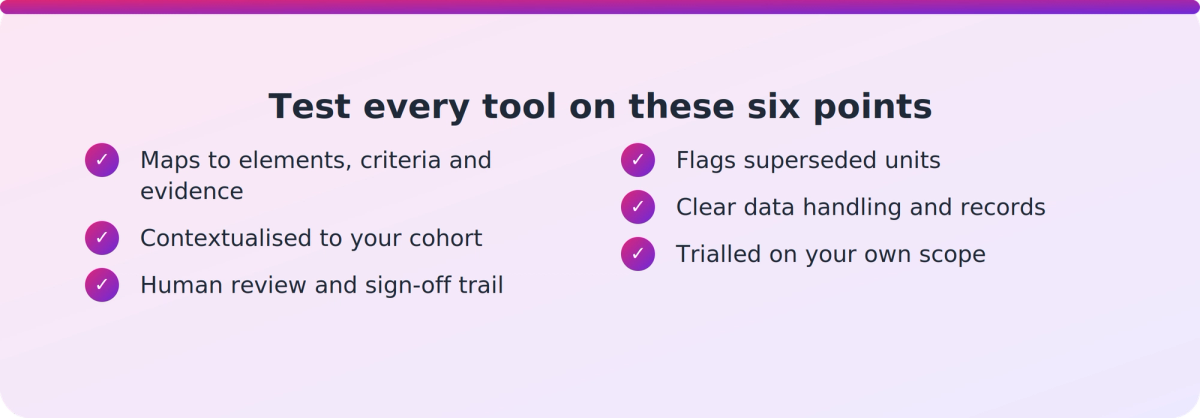
- Mapping depth. Does output map to the unit's elements, performance criteria, performance evidence and knowledge evidence? Can it produce mapping documents a validator can check? This also supports ASQA's principle on alignment with the training product.
- Contextualisation controls. Can you tailor material to your industry, cohort, delivery mode and learner needs, including LLN and ESOL? Or does it return the same fluent, generic text for everyone?
- Human review workflow. Look for author, validator and quality-lead steps, a decision log and version history. You should be able to show who signed off what, and when.
- Material and assessment built together. Are learner guides, session plans and assessments built on the same mapping? If they aren't, what you teach can drift from what you assess.
- Currency. How does the tool detect superseded units or training package updates? Vendor claims here need verifying on your scope, not taking on trust.
- Data handling. Where is data hosted? What privacy and security controls exist, and how are records kept? If it isn't published, ask directly. Your existing privacy, data protection and record-keeping obligations still apply.
- Output formats. Editable Word, InDesign, SCORM or LMS-ready export that fits the systems you already run.
- Evidence for claims. Ask for a trial or demo on your own units, and ask for Australian RTO references.
- Australian scope. If the vendor also serves other markets, confirm which features apply to Australian training packages.
- Governance fit. Does the vendor's approach support your RTO's own AI policy and the five ASQA principles, with the RTO staying accountable?
How do you tell mapped and contextualised output from generic output?
Run a simple test. Give the tool a unit you know well and a cohort you actually deliver to.
- Check whether each element and performance criterion can be traced to a specific task or question.
- Check whether the scenarios reflect your industry and workplace, or could be pasted into any RTO's materials.
- Check whether language and scaffolding change when you specify an LLN or ESOL cohort.
- Look for leftover prompts or boilerplate wording.
The last point matters. SKG Consulting says generated instruments tend to be fluent but generic and detached from the delivery context. Secondary reporting (Octossure) says ASQA has seen uncontextualised generic wording and visible AI prompts in provider submissions. We couldn't verify the ASQA primary text, so treat that as indicative. It's still a cheap thing to check.
Is there an ASQA-approved list or certification for AI training material tools?
We found no ASQA-approved vendor list and no certification scheme for AI tools. That claim appears in a Supahuman blog, and we found no source contradicting it. ASQA tests the RTO's tools and decisions, not the software.
So evaluate vendors the way you'd evaluate any compliance-adjacent supplier:
- Treat speed and percentage claims ("80% faster") as unverified vendor statements until you've tested them.
- Trial the tool on your own scope, with your own validators in the room.
- Ask for written answers on hosting, security and records.
- Check the output against the unit, not against the vendor's demo.
Where does Supahuman VETos fit?
VETos is one option in this category, and you should score it against the same list. Going by the vendor's own site, it generates assessment tools, assessor guides, learner guides, session plans, slides, study guides, SCORM packages and training and assessment strategies. Learner material and assessment are built on the same unit mapping, drawing on units, elements and performance criteria from training.gov.au.
The site describes work being routed between authors, validators and quality leads, with decisions logged and versions kept. That's consistent with AI assisting an accountable human. It also describes support for LLN, ESOL and accessibility, a live view of your scope that flags superseded units, and exports to editable Word and Adobe InDesign (.idml).
These are the vendor's descriptions, so verify them. Be equally careful on evidence. The only named customer outcome in the material we reviewed is from a New Zealand provider, the speed figures are vendor claims, and we didn't find pricing, security certifications or hosting location. Some VETos pages also refer to other markets, so confirm which features apply to Australian scope. The site offers a trial call followed by 14 days on your own training, which is a fair way to test it: vet.supahuman.com.
Key takeaways
- The 2025 Standards for RTOs have applied since 1 July 2025. Buy for how you'll operate now, not for a deadline that has passed.
- ASQA's five AI principles add no new requirements. They explain how existing ones apply, and the RTO stays accountable for every piece of material.
- Prioritise unit-level mapping, real contextualisation, and a human review and sign-off trail over speed.
- No ASQA-approved vendor list or AI-tool certification was found, so test on your own scope and treat speed claims as unverified.
- Ask about data handling, currency tracking and export formats before you commit.
Our take
Most buyers start with "how much time will this save?" It's the wrong first question, because a draft that can't survive validation saves nothing. We'd start with the sign-off trail: if you can't show who reviewed what, the tool hasn't reduced your risk, however quickly it wrote the first draft. Then run your hardest unit and your most specific cohort through it. The tool that handles those honestly is worth more than the one with the biggest percentage on its homepage.
FAQ
What should an RTO look for in training material generation software?
Look for output mapped to elements, performance criteria, performance evidence and knowledge evidence. It should also contextualise to your cohort, keep a human review and sign-off trail, and handle data securely. Check currency tracking and export formats, and test it on your own units.
Who is accountable for AI-generated learner guides and assessment tools?
The RTO. ASQA tests the RTO's tools and decisions, not the software, and off-the-shelf tools don't transfer responsibility away from the provider. Qualified trainers and assessors should review and sign off AI-drafted material, and that review should be documented.
Is there an ASQA-approved list of AI tools for RTOs?
We found no ASQA-approved vendor list or AI-tool certification, and no ASQA statement approving or banning AI-generated training materials. That means you evaluate vendors yourself, using a trial on your own scope and written answers on data handling.
How can I tell if generated material is generic?
Test it on a unit and cohort you know. Check that each element and performance criterion traces to a task, that scenarios fit your industry, and that language adapts for LLN or ESOL learners. Watch for boilerplate wording or leftover AI prompts.
Can software that drafts training materials complete validation for me?
No. Software can assist with drafting and mapping, but validation and sign-off remain with qualified, accountable people in your RTO. Consultancies read ASQA's position as meaning AI can't complete validation. Treat that as their interpretation and build human review into your process.