A unit standard rarely serves just one cohort. The same requirement often has to work for a classroom group and a workplace learner in the same quarter, so many NZ training providers write one version and rework it by hand for the other. That's the same NZQA requirement paid for twice in staff time, and every rewrite is another chance to drift from what the standard asks.
Why does assessment format duplication happen in NZ providers?
It usually starts with a sensible shortcut. Someone drafts a solid assessment for the classroom. Then an employer contract lands, or a distance learner enrols, or an ESOL group needs support. The quickest path looks like adapting what already exists.
The contexts multiply fast:
- Classroom and workplace cohorts running side by side
- Employer contracts that need site-specific assessments
- ESOL and LLN learners who need different support
- Distance learners who can't be observed in person
Different delivery modes call for different evidence. A written question that works in a classroom doesn't show what a learner can do on a worksite. "Write one and hope it stretches" is a weak plan.
What does it cost beyond staff time?
The schedule hit is obvious. The bigger risk is quieter.
Rework done under deadline pressure is where assessments slip away from the standard. A task gets trimmed, a criterion gets reworded, an evidence requirement quietly drops out. Nobody meant to do it. Then it surfaces at moderation, when someone checks the assessment against the unit standard and finds a gap.
So duplication is a quality and moderation risk, not only a productivity drain. It also gets harder to manage as skill standards replace unit standards on the NZQA directory. Every hand-edited copy is another thing to find and update when the source changes.
What does it mean to choose the delivery context first?
The principle is simple. Decide who the assessment is for, and how it will be delivered, before you build it. Don't patch it afterwards.
That changes the question from "how do we convert this?" to "what evidence does this context need?" You start from the standard and the setting together. The assessment is designed for its context from the first draft.
To be clear, this doesn't mean one finished build turns itself into every mode. It means you stop treating the second, third and fourth versions as afterthoughts.
How does VETos build context-first assessments?
VETos puts the Theory/Practical decision at the front of assessment generation. Trainers and instructional designers pick the mode inside the workflow. There's no separate setup step.
The two modes produce different things:
- Theory Mode: conceptual questions, comparisons, definitions and explanations
- Practical Mode: applied tasks, real-world simulations, procedures and skill validations
From there, the delivery format is also part of the build. VETos supports written, oral, practical, blended, digital or paper-based delivery, and can produce multiple versions, including reassessment variants for moderation and fairness. Providers can generate standalone, clustered, grouped or integrated assessment tools, each with mapping and assessor guidance.
Programme and course content covers classroom, workplace and online delivery. Learner study support extends to ESOL and literacy and numeracy.
What stays connected to the assessment?
The materials around the assessment matter as much as the assessment itself. In VETos, the assessment, study guide and training and assessment strategy are linked to one live regulatory source. If a unit changes on the register, the change reaches everything grounded in it.
That directly targets version drift. You aren't hunting through folders of near-identical documents to see which one still matches the standard.
The outputs include assessor guides with rubrics, exemplar responses and moderation instructions. A QA engine checks assessments against the NZQA Principles of Assessment and moderation expectations. VETos can also draft against new skill standards and upgrade existing unit-standard materials as they convert. Output exports to Word and InDesign.
What proof is there, and what are its limits?
Here's what we can say, and what we can't.
Mast Academy, a NZ PTE, is cited on the VETos NZ page for 80% faster content development. The same page describes NZQA-aligned assessment and study-guide creation moving from four to six weeks to minutes, with the content still going through the provider's own moderation. That's a general content-development result. It isn't a measure of rework saved between classroom and workplace versions, and we don't publish one.
The human check stays. AI output needs review by a qualified assessor or moderator against the unit or skill standard before it's used for any learner whose result counts. The assessor remains accountable.
How can you tackle duplication in your own process?
You can start before any tool is involved.
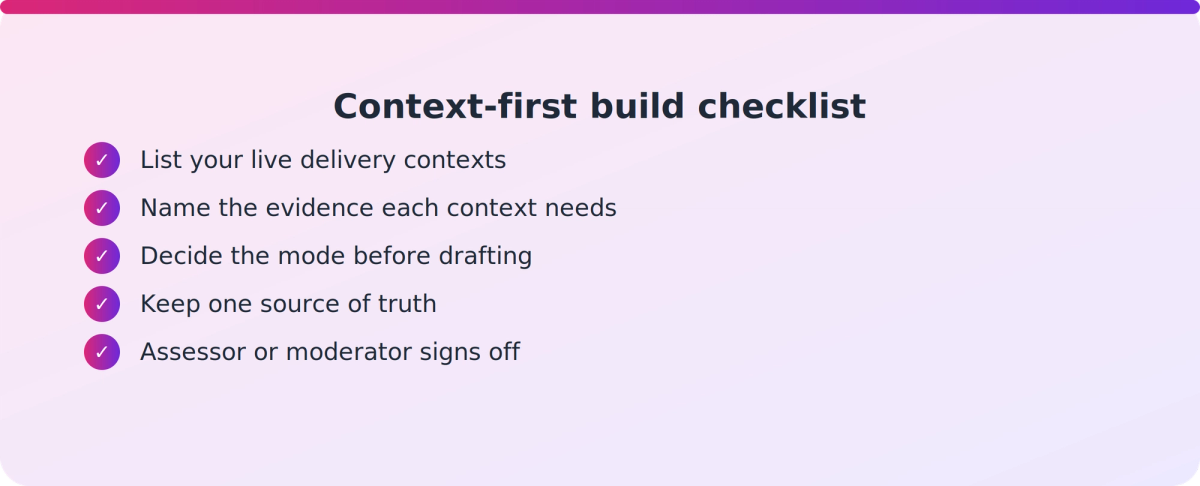
- List your live contexts. Classroom, workplace, distance, ESOL, LLN. Note which units serve more than one.
- Name the evidence each context needs. Observation, simulation, oral questioning, written response.
- Decide the mode at the start of each build. Don't adapt later.
- Keep one source of truth. Tie the assessment, study guide and strategy to the current standard.
- Review before use. An assessor or moderator signs off against the standard.
Key takeaways
- Reworking one assessment by hand for each cohort pays for the same NZQA requirement twice.
- The larger risk is drift from the standard, which shows up as a moderation problem.
- Choosing the delivery context at the start of the build beats patching afterwards.
- VETos sets Theory or Practical mode at the start of generation and keeps assessment, study guide and strategy linked to one live regulatory source.
- It doesn't convert one finished build into every mode, and assessor or moderator review is still essential.
Our take
Most duplication isn't laziness. It's a reasonable shortcut that compounds as contracts and cohorts pile up. The fix is a habit change first: decide the context before the first draft, and treat the standard as the single thing every version answers to. Tools help with that, but they don't replace the assessor who signs it off. With skill standards arriving, providers who can see exactly what's grounded in which standard will have an easier time at moderation.
FAQ
What is assessment format duplication?
It's when a provider writes one assessment for a unit standard, then manually reworks it for other contexts such as workplace, distance, ESOL or LLN learners. The same requirement ends up being handled several times, with more chance of drift.
Does VETos convert one finished assessment into every delivery mode?
No. VETos is built around choosing the context at the start of generation, including Theory or Practical mode and the delivery format. It reduces after-the-fact rework. It doesn't claim to convert a completed build automatically.
Do assessments still need moderation?
Yes. AI output needs review by a qualified assessor or moderator against the unit or skill standard before it's used for a learner whose result counts. The provider's own moderation process still applies.
How does this help when unit standards change?
In VETos, the assessment, study guide and training and assessment strategy are linked to one live regulatory source. A change to a unit on the register reaches everything grounded in it, which cuts down version drift.
What delivery formats are supported?
Written, oral, practical, blended, digital or paper-based delivery, with multiple versions including reassessment variants for moderation and fairness.
If you're weighing how to handle multi-context delivery, take a closer look at VETos or ask for a walkthrough using one of your own unit standards.