The quality-versus-cost trade-off in PTE delivery was never a law of nature. It came from how practice-based learning got built: more instructors, slow content rebuilds, heavy compliance admin. The 2026 reset makes you demonstrate quality yourself, so the cost model behind it is now a strategic question, not an operating one.
Why this lands on your desk
You answer to the board for margin and regulatory standing. Both are now harder to defend with the old assumption.
Under the move to annual self-review, quality assurance sits inside your own management system. NZQA's Private Training Establishment Rules 2026 already require a copy of your quality management system at registration, as set out under the Quality Assurance of Tertiary Education Providers Rules 2026. Quality is something you document and own. An external reviewer is no longer the main check.
Funding is the other pressure. RNZ reports that TEC has warned of insufficient funding for all domestic enrolments, the third consecutive year of shortfall. Budget 2025 added $212.5 million over four years to lift subsidies by 3% from 1 January 2026 for targeted priority provision, and $111.4 million to fund 99% of forecast enrolments in 2025 and 2026. Check TEC for the current position. Delivery and compliance costs aren't waiting for clarity.
What the 2026 settings change
The brief for your strategy has shifted in four ways:
- Rules consolidated. The PTE Rules 2026 replace the PTE Registration Rules 2025 and the PTE Enrolment and Academic Records Rules 2022, and remove the annual fee. Non-funded PTEs file annual financial returns biennially unless NZQA directs otherwise.
- Self-review replaces external review. Secondary sources report that iQAF went live in January 2026, that NZQA has stopped starting new EER reviews, and that from July 2026 non-university tertiary providers complete an annual self-review. Treat that as reported, and confirm it on nzqa.govt.nz. The same sources say Immigration New Zealand keeps using existing EER ratings for visa conditions in 2026, which matters if you recruit internationally.
- Standards have a new owner. Eight Industry Skills Boards formally began on 1 January 2026 with a core standard-setting role. The six Workforce Development Councils are gone.
- Quality assurance may cost more. A TEC consultation notice describes the boards as strongly focused on standard setting with a lower level of government funding. Food and Fibre ISB says they will likely charge providers for some quality assurance functions. No fee schedule has been found, so budget for uncertainty.
Where cost per student actually hides
Most CEOs know their headline cost per student. Fewer can say how much of it is the price of keeping quality *current*.
Look in three places. First, instructor hours spent on practice: role plays, simulations, coached feedback. This is the most effective part of vocational learning and the hardest to scale, because it scales with headcount. Second, the rebuild cycle. When a standard or industry practice shifts, how many weeks and how many dollars does it take to update what learners actually experience? Third, evidence assembly. If self-review is only as good as the evidence behind it, how much staff time goes into chasing it?
If quality is something you must show annually, and standards keep moving, slow rebuilds and expensive practice are the weak points. They are where the old trade-off lives.
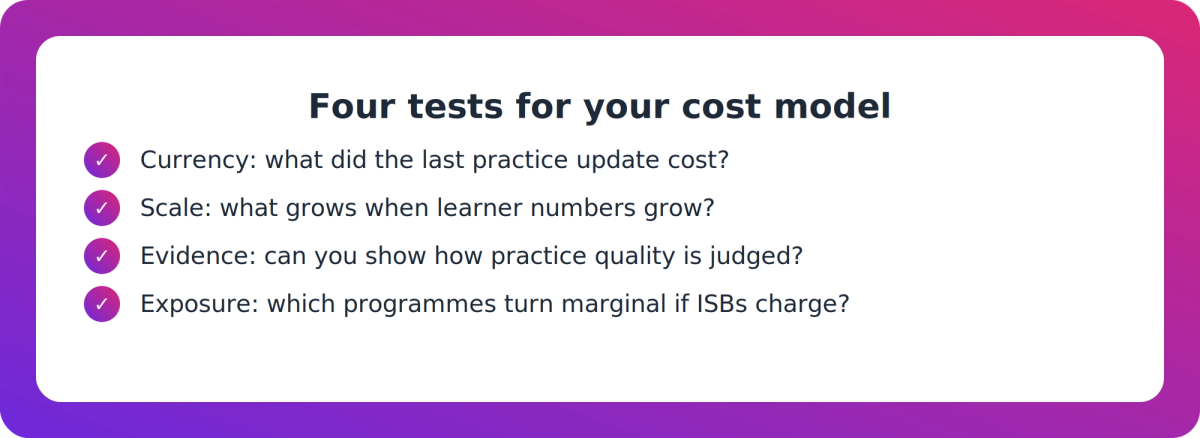
Four tests for your own cost model
Run these before your next board paper:
- Currency test. Pick one programme. When did its practice content last change, and what did the change cost?
- Scale test. If you took on more learners, what would grow in step: instructors, assessors, admin?
- Evidence test. Could you show a reviewer, this week, how learner practice quality is judged, not just that it happened?
- Exposure test. If an ISB charged for some quality assurance functions, which programmes would turn marginal?
The answers show whether cost and quality are still locked together in your business, or only in your assumptions.
The growth angle: delivering quality without proportional headcount
The work-based learning transition makes this concrete. NZIST's work-based learning divisions began moving to new or existing PTEs, polytechnics and wānanga after 1 January 2026, with all expected to have moved by 31 December 2027, according to the TEC FAQ. A small network of funded PTEs can keep enrolling and delivering existing provision.
That is an opening, but only if you can add learners without adding staff at the same rate. Whether you can is a CEO call, not a delivery manager's.
The AI question comes with governance attached
NZQA already has generative AI on its agenda. It recommends that providers support staff to understand how generative AI can be used in teaching, learning and assessment. Its academic integrity guidelines recommend policies that uphold, prevent, detect and respond to misconduct, and that address generative AI.
Two things follow. The cost-quality question is now partly a technology question, since some of what used to need a person in the room may not any more. And any move you make needs governance around it: a policy, a staff capability plan, and a way to show NZQA and your board how it protects quality. Efficiency with no evidence trail is a new risk, not a saving.
Key takeaways
- The quality-cost trade-off is an assumption about how provision is built, and the 2026 settings give you reason to test it.
- Self-review moves the burden of proving quality onto your own management system. Verify the iQAF timing with NZQA directly.
- ISBs are likely to charge for some quality assurance functions, but no fee schedule exists yet. Plan for a range.
- Funding pressure raises the value of every funded learner's experience, so cost per student and quality need to be read together.
- Any AI use should come with policy, staff capability and evidence, in line with NZQA's guidance.
Our take
The sector treated quality and cost as a permanent trade-off because, for a long time, it was one. Authentic practice needed people, and people cost money. We think that premise is weakening, and the CEOs who test it first will have the stronger position when funding tightens and self-review asks for evidence.
We aren't saying technology is the answer. Governance, standards currency and staff buy-in matter as much. But a provider that can't say what keeping quality current costs per student is guessing, and the board will eventually ask.
FAQ
What does the 2026 reset mean for training provider cost per student in NZ?
It shifts costs and responsibilities. Quality assurance moves towards annual self-review, ISBs are likely to charge for some quality assurance functions, and TEC has warned funding may not cover all domestic enrolments. Cost per student now needs reading alongside the quality evidence you can produce.
Has NZQA confirmed that EER is replaced by annual self-review?
The brief's sources for this are secondary. They report iQAF live in January 2026, no new EER reviews started, and annual self-review for non-university tertiary providers from July 2026. Confirm the details on nzqa.govt.nz before you change plans or board reporting.
Will Industry Skills Boards charge PTEs fees?
Food and Fibre ISB says the boards will likely charge providers for some quality assurance functions, and TEC describes them as operating with a lower level of government funding. No fee schedule has been found, so model scenarios rather than a single figure.
Does NZQA allow generative AI in teaching and assessment?
NZQA recommends providers help staff understand how generative AI can be used in teaching, learning and assessment. Its academic integrity guidelines recommend policies that uphold, prevent, detect and respond to misconduct and that address generative AI. Strategic use carries governance expectations alongside efficiency benefits.
Pick one programme this week and cost the last time its practice content was updated. If the answer surprises you, that's your first piece of evidence.