Most RTOs don't need separate ESOL, LLN and workplace versions of every assessment. Under the Standards for RTOs 2025, the competency standard in the unit of competency stays fixed. What should flex is the support, language level and format around it, guided by each unit's ACSF demand and each learner's foundation-skills profile.
This is a practice argument, not a regulatory announcement. We found no new ASQA statement on ESOL or LLN assessment in the last 90 days. What has changed is the framework RTOs are interpreting, and that's where the opportunity sits.
Why do RTOs end up with three versions of one assessment?
It usually starts with good intentions. A cohort arrives with English as an additional language, so someone rewrites the assessment in plainer English. A workplace group gets a version with workplace scenarios. A classroom group keeps the original.
Three years later, the same unit has three tools, three sets of assessor guides and three things to validate. Every update to the training package means touching all of them.
The cost isn't only time. Each version is another chance for coverage to drift from the unit. The more copies you maintain, the harder it is to show that each one still assesses the same thing.
What do the Standards for RTOs 2025 expect?
The Standards for RTOs 2025 took effect on 1 July 2025. Secondary explainers report that Performance Indicator 2.2.2a requires a pre-enrolment review of a learner's language, literacy, numeracy and digital (LLND) capability. That review is matched against what the *specific training product* demands.
Three points from practitioner commentary matter here:
- No single mandated tool. VET Advisory Group's 2026 compliance guide says ASQA does not prescribe one universal LLN assessment. Each RTO needs an approach that suits its courses, delivery model and learner cohort.
- Broader than a test. The same guide says Standard 2.2 expects a wider skills review than an LLN test alone, expressly including digital literacy. A generic test may not show whether a learner can take part in a particular course.
- Timing and mapping. Cloudassess and RTO Resources Australia report that the review must happen before enrolment is finalised. Results are typically mapped to the Australian Core Skills Framework (ACSF) and the Australian Digital Capability Framework (ADCF).
These are consultancy and vendor explainers, not regulator text. Check ASQA's own Standard 2.2 and 2.3 practice guides before you change anything.
How do you anchor on ACSF demand instead of multiplying versions?
The 2025 Training Package Organising Framework now has developers state the required ACSF level for each of the five core skills, with digital literacy optional (as reported by On Target Workskills, July 2025). That gives every unit a published demand profile.
That changes the maths. You no longer need to guess how hard a unit is on language. You can read it, set it once and compare it to each learner's profile.
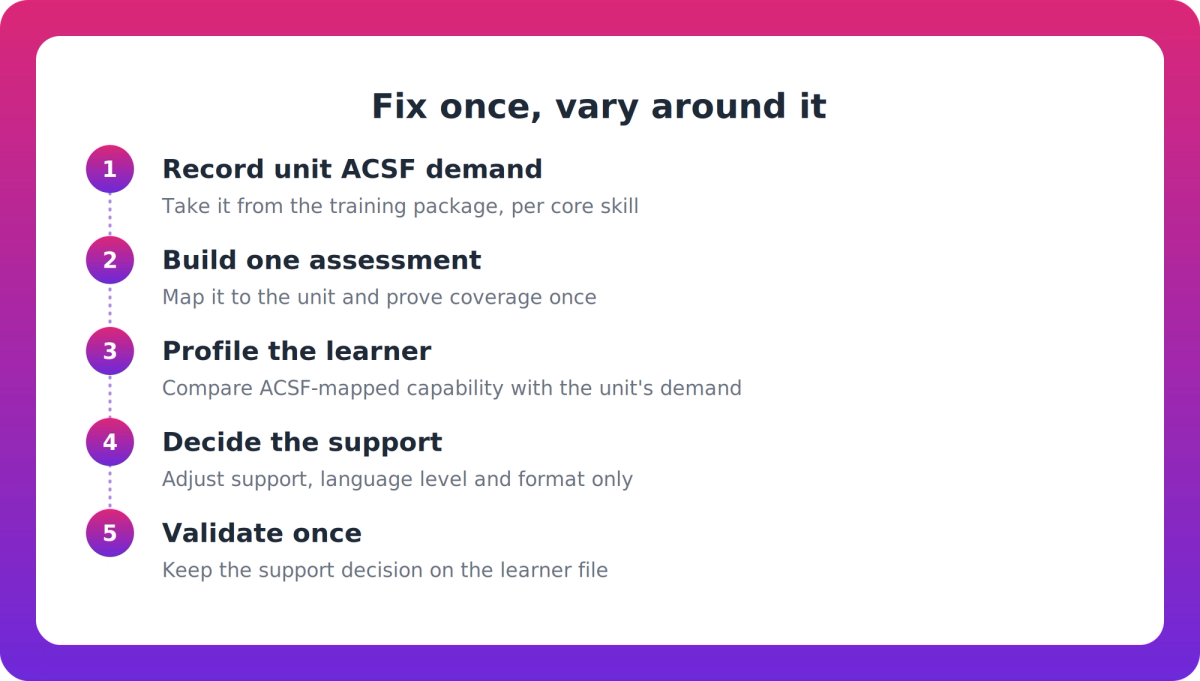
A workable sequence:
- Record the unit's ACSF demand. Take it from the training package, per core skill, and store it with the unit.
- Build one assessment to the competency standard. Map it back to the unit's elements, performance criteria, performance evidence and knowledge evidence. Prove coverage once.
- Profile the learner at pre-enrolment. Compare their ACSF-mapped capability, including digital, against the unit's demand.
- Decide the support around the assessment. Use the gap between demand and capability to choose support, language level and format.
- Record and validate. Keep the support decision with the learner file. Validate the single assessment, not a family of copies.
What can vary, and what can't?
The line is simple. Adjustments change how a learner accesses learning and shows competence. They never change what the qualification certifies. CAQA makes this point, citing ASQA's 2025 Training Support practice guide.
Fixed per unit:
- The competency standard and the evidence required
- The conditions and criteria used to judge competence
- The assessor's decision rules
Flexible per learner or cohort:
- Plain-English phrasing within the demand of the unit
- Supports such as glossaries, worked examples or extra time
- Delivery format: classroom, workplace, distance or LMS
- Mode of response, where the unit allows (oral, written, observed)
Hawkeye Consultancy's guide (current to March 2026) describes the flexibility principle as letting assessors adjust approaches for the diverse needs of all learners. That supports one assessment decision per unit with variation around it.
Where's the trap with Standard 2.4?
Standard 2.4 concerns students with disability. ESOL needs sit under the flexibility principle and learner diversity, not that clause. Don't cite 2.4 as the authority for every language-based adjustment. Name the right basis in your procedures.
What does this mean for validation and audit?
One assessment tool per unit is easier to defend. You can show the mapping once. You can validate it once. You can show an auditor a clear line from unit demand, to learner profile, to the support provided.
Three versions force you to show equivalence between them. That's a much harder argument to win.
There's a wider push behind this too. The Jobs and Skills Australia Foundation Skills Study administrative data report (October 2025) draws together data on pre-enrolment foundation skills assessments by RTOs. The National Skills Plan 2025–26 update references the National Foundation Skills Strategy 2025–35 and a 'no wrong door' approach to assessment and referral. Foundation skills are getting more attention, not less, so documented, consistent practice will matter.
What's still uncertain?
Plenty. Most of the commentary we reviewed comes from consultancies and vendors. We couldn't verify the exact wording of the performance indicators against ASQA's own pages.
Expect auditors to look at whether your approach fits your learners and courses. There's no single approved model to copy. Write down your reasoning, because the reasoning is what you'll be asked for.
If your portfolio has several versions of the same unit, it's worth asking a quiet question: which differences are about learner support, and which have crept into the standard itself?
Key takeaways
- The Standards for RTOs 2025 (effective 1 July 2025) expect a pre-enrolment review matched to the demands of the specific training product, including digital literacy.
- ASQA doesn't prescribe one LLN tool, so your approach must fit your courses, delivery model and cohorts.
- Training packages now state ACSF demand per unit, so you can set LLN demand once and compare it to each learner.
- Adjust access and support, never the competency standard. Don't use Standard 2.4 (disability) as the basis for ESOL adjustments.
- This is an interpretation argument, not a regulatory change. Check ASQA's practice guides first.
Our take
Assessment multiplication is mostly a maintenance habit dressed up as compliance. The framework now gives RTOs a published demand per unit, and the sensible response is to stop rewriting the standard for each cohort. We think the RTOs that document one strong assessment and a clear support decision per learner will find validation lighter and audits easier. The caveat is real: until ASQA's own guidance is in hand, treat all of this as well-reasoned interpretation.