RTO audit readiness isn't a spring sprint before ASQA knocks. Under the 2025 Standards for RTOs, ASQA tests whether you can show quality being managed continuously, with a named owner and a traceable record. The calendar that does this is a rhythm of small, owned, evidenced checks, not a pre-audit scramble.
Why this lands on your desk
You answer for registration. That makes the odds worth knowing.
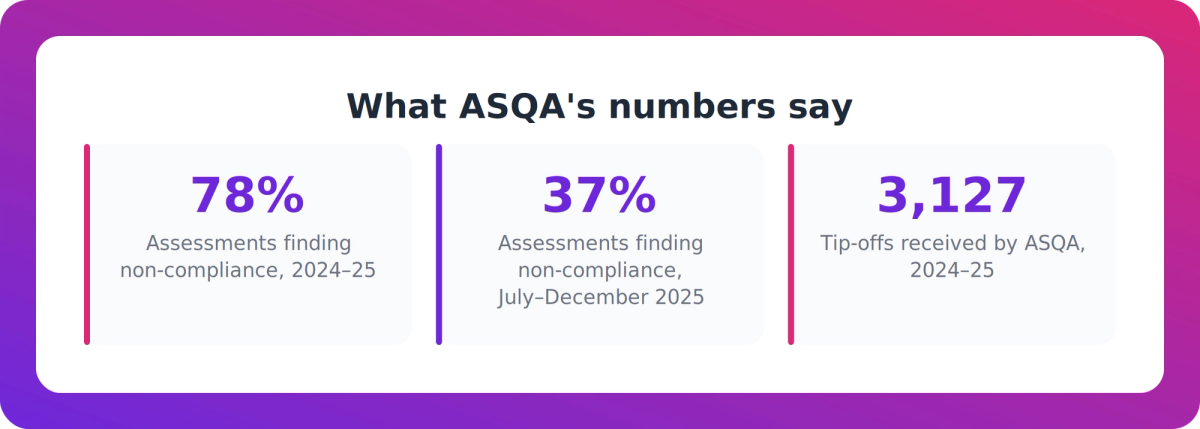
ASQA's 2024–25 performance assessments, selected on provider risk indicators, found non-compliance in 221 of 284 cases (78%). The July–December 2025 Regulation Report put it at 30 of 82 (37%). The two figures differ a lot, but a risk-targeted assessment is still more likely than not to find something in the first, and a bit over one in three in the second. That makes continuous readiness a risk-management decision, not a tidiness preference.
The ground also moves. The 2025 Standards commenced on 1 July 2025, and ASQA has released practice guides, FAQs, podcasts and a webinar progressively since. You are assessed against the Standards in force when a decision is made, so you are deciding, repeatedly, when to refresh policies, training and assessment strategies (TAS) and evidence.
Why scrutiny doesn't wait for your audit date
It is tempting to plan around the scheduled audit. The enforcement numbers argue against that.
ASQA's Integrity Unit is backed by $33.3 million. Since November 2024 it has cancelled seven critically non-compliant providers for systematically issuing fraudulent qualifications. It rejected 32 registration applications in 2024–25, over three times the 2023–24 figure, and it received 3,127 tip-offs (ASQA Annual Report 2024–25).
That last number matters most to you. A tip-off means a problem can reach ASQA without any audit on your calendar. If your evidence only gets organised when an audit notice arrives, you are exposed in the months between.
Why an outcomes focus rewards a rhythm
ASQA describes the 2025 Standards as focused on quality outcomes for students and employers, with more flexibility and an expectation of more regulatory engagement. The Outcome Standards and Compliance Requirements sit in legislation under the NVETR Act 2011. The Compliance Requirements include the Fit and Proper Person Requirements and the NRT Logo Conditions of Use Policy. The Credential Policy is separately enforceable.
An outcomes focus favours providers who can show ongoing practice over a one-off document set. A policy suite polished the month before an audit shows you can write policies. A year of dated reviews, closed actions and named owners shows you manage quality.
Transition adds a trap. ASQA says providers must show compliance against the Standards in effect when a decision is made, and an audit that began under the 2015 Standards and ran past 1 July 2025 may have needed extra evidence against the revised Standards. Every document needs a version and a date, or you can't prove which set of Standards it answered.
A calendar of small, owned checks
The following is our suggested structure, not an ASQA requirement. The principle is that every check is small, has one named owner and leaves a dated record.
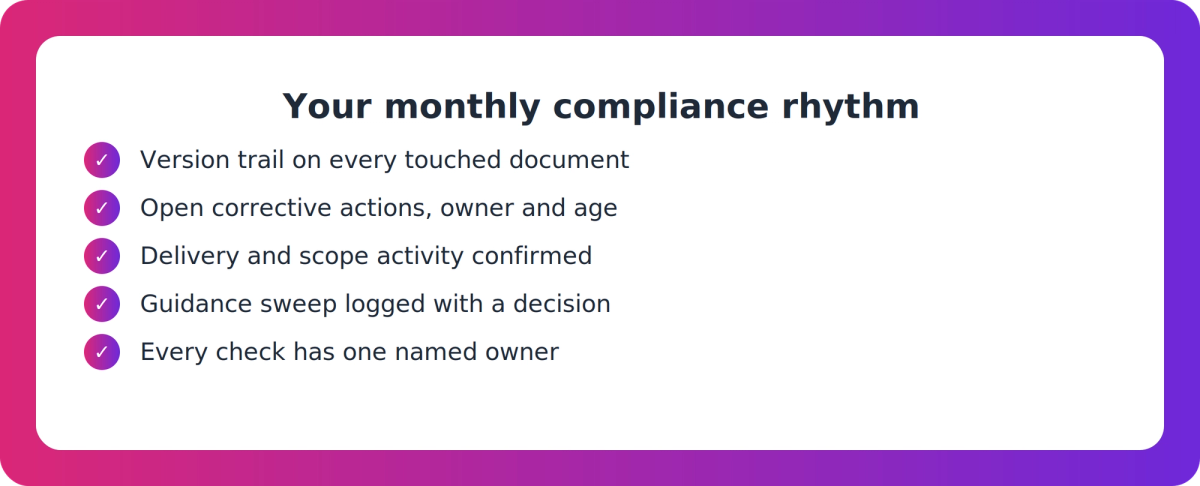
Every month (30–60 minutes each)
- Version trail. Which policies, TAS or procedures were touched this month, and does each show a version, date and reason for change?
- Corrective actions. List what is open, who owns it, how old it is and what evidence closes it.
- Delivery and scope activity. Since March 2024, registration lapses if an RTO hasn't delivered training and assessment for 12 months. New RTOs also can't expand scope in their first 24 months. Check that every scope item shows real delivery.
- Guidance sweep. Scan ASQA's recent updates and log what changed and what you decided to do about it, including "nothing".
Every quarter
- Trace a small sample. Pick a few learners and follow each from enrolment through assessment evidence to credential issue. Gaps in the trail are the early warning you want to find before a regulator does.
- Report to governing persons. One consultant, eSkills Australia, suggests governing persons should be able to show active risk review, compliance dashboards, self-assurance reports and follow-up on corrective actions. That is the consultant's interpretation, not ASQA direction. It is still a useful test: could your quarterly pack show those four things?
Once a year
- Confirm the annual declaration deadline. Some vendor blogs mention a declaration on compliance around March. We couldn't verify that, so check ASQA's official page rather than trusting the date.
- Review the priorities, with caution. Consultants report 2025–26 priorities including shortened course duration, student work placement, non-genuine providers, RPL, academic integrity and international student marketing and recruitment. They report 2026–27 as covering governance, delivery quality, qualification integrity and transparency in complex delivery models. These aren't confirmed on ASQA's own page, so treat them as a prompt for your own risk review and check ASQA directly.
Dates you don't control still need owners
Some tasks arrive on someone else's timetable. The Data Streamlining Instrument 2026 takes effect on 1 October 2026. The 2026–27 Fees and Charges Determinations were released on 1 July 2026. The 29 March 2024 amendments also extended ASQA's internal review period to 120 days and raised maximum penalties fivefold.
Put each external date on the calendar with a lead time, an owner and a definition of done. The date itself is rarely the problem. The problem is the task nobody realised was theirs.
Spreading the load is a capacity decision
If you review every document, you are the bottleneck, and the calendar will quietly collapse into your inbox. Jobs and Skills Australia describes a thin, ageing and casualised VET workforce, so compliance knowledge tends to concentrate in a few people.
Give each monthly check an owner outside the compliance function wherever you can: the trainer lead for assessment evidence, operations for delivery activity, the executive for corrective-action follow-up. Your job shifts from doing every review to confirming the reviews happened and the evidence exists. That is also the better answer to "who is accountable?"
Key takeaways
- The 2025 Standards for RTOs commenced on 1 July 2025, and ASQA signals more regulatory engagement and an outcomes focus.
- ASQA's risk-targeted performance assessments found non-compliance in 78% of cases in 2024–25 and 37% in July–December 2025.
- With 3,127 tip-offs in 2024–25, scrutiny can arrive between scheduled audits.
- Version and date every document, because you are assessed against the Standards in force when a decision is made.
- Put delivery and scope checks, corrective-action follow-up and external dates such as 1 October 2026 on a calendar with named owners.
- Treat consultant-reported priorities and deadlines as prompts, and confirm them with ASQA.
Our take
The most useful thing a Compliance Manager can produce isn't a clean audit folder. It's a dated record showing that problems were found early, assigned and closed, because that is what continuous quality management looks like from the outside.
We'd go further: if your readiness depends on you personally remembering things, you don't have a calendar, you have a risk. A small check with a named owner, run monthly and logged, beats a heroic review run once a year.
A first step for this week: list every compliance task you currently do from memory, then give each one an owner, a month and a place to record the result.
FAQ
How often should an RTO review its evidence for audit readiness?
Monthly for small, specific checks such as version trails, open corrective actions and delivery activity, and quarterly for deeper sampling. ASQA doesn't prescribe this schedule. It is a practical rhythm that gives you a dated record of ongoing practice.
Which Standards will ASQA assess us against?
ASQA says providers must show compliance against the Standards in effect when a decision is made. The 2025 Standards commenced on 1 July 2025. An audit that began under the 2015 Standards and ran past that date may have needed additional evidence against the revised Standards, so keep version and date trails.
Can ASQA act on a problem without a scheduled audit?
Yes, scrutiny can arrive between audits. ASQA's 2024–25 Annual Report records 3,127 tip-offs, and its Integrity Unit has cancelled seven critically non-compliant providers since November 2024 for systematically issuing fraudulent qualifications.
Should we plan around the regulatory priorities consultants publish?
Use them as prompts, not directives. Consultants report priorities such as RPL, academic integrity and governance, but these aren't confirmed on ASQA's own page. Check ASQA directly, then test your own risk profile against them.