ASQA publishes no official TAS template and does not approve or endorse TAS or AI software, so "ASQA-compliant TAS" is a vendor phrase, not a regulatory status. When you evaluate TAS generator software, the real test is whether it helps your RTO produce a contextualised, current, reviewed strategy that your own people can explain and defend.
What does "ASQA-compliant TAS" actually mean?
Not much, on its own. ASQA's 2025 Standards FAQ says providers can decide how they compile and present their strategies for training and assessment, and that ASQA will not provide a template. We also found no ASQA accreditation, approved vendor list or certification scheme for TAS or AI software.
So if a vendor's homepage says "ASQA-compliant", read it as marketing. It may describe a tool built with the Standards in mind. It is not a status ASQA has granted.
The revised Standards for RTOs came into full regulatory effect on 1 July 2025. They have three components: the Outcome Standards, the Compliance Standards and the Credential Policy. ASQA's Practice Guides sit alongside them. They are not prescriptive. They offer compliance examples, known risks and self-assurance questions.
Is a TAS mandatory under the 2025 Standards?
Commercial sources disagree. RTO Works says the Standards don't specifically reference one but that it remains best practice. RTO Pilot says every RTO must have one. We did not retrieve the primary legislative text, so check the Standards on asqa.gov.au and legislation.gov.au yourself. Either way, Standard 1.1 still expects training that is consistent with the training product and structured and paced to allow enough time for instruction, practice, feedback and assessment.
What should you check in TAS generator software?
Work through these criteria with the tool open, on your own scope. A demo built around a vendor's sample qualification tells you little.
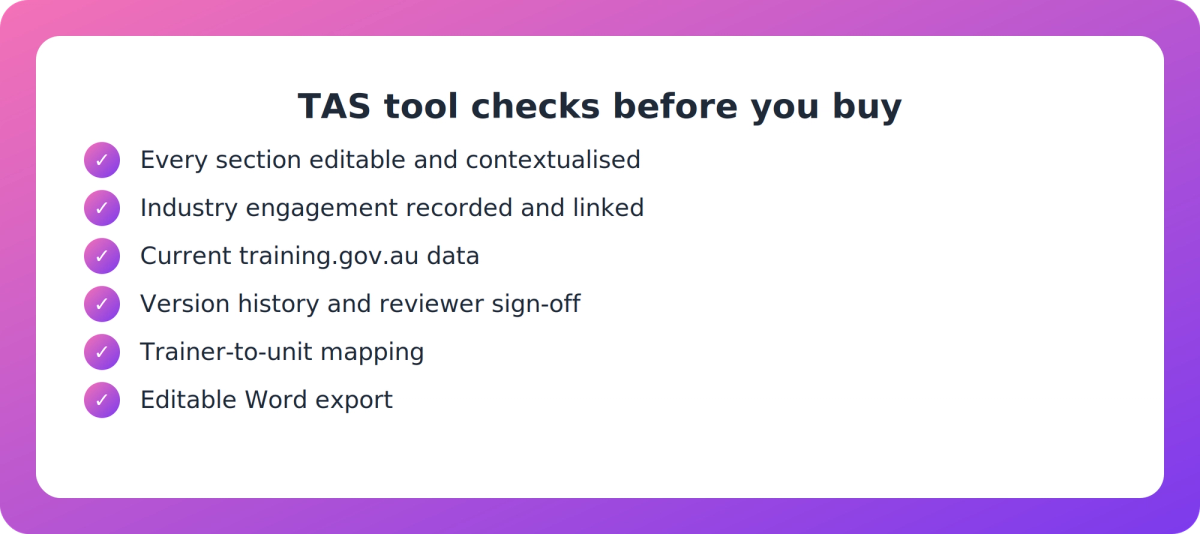
- Editability and contextualisation. Can your team edit every section to reflect your cohorts, delivery modes, locations and industry input? Or does it output generic wording? One commercial interpretation (CAQA) is that identical timeframes for every cohort, location and mode can't satisfy Standard 1.1. Look for variation by cohort, mode and location, not a one-size template.
- Industry engagement. ASQA's FAQ says providers must engage with industry, employer and community representatives when reviewing their strategies. Can the tool record that consultation and tie it to changes in the TAS? Some sector commentary says auditors expect to see that link. That is commentary, not an ASQA rule, but it's a sensible test.
- Currency of requirements. Does it pull current training package and training.gov.au data and handle training-product updates? Or does it rely on a one-off imported template? While traditional and ASK-format units coexist under TPOF 2025, check it handles both.
- Version history and reviewer sign-off. Look for dated versions and a record of who reviewed and approved each change.
- Evidence of review before use. Reported obligations include reviewing assessment tools before use and validating every training product at least once every five years (Knowledge Foundry). Can you show who reviewed outputs and when?
- Trainer-to-unit mapping. Standard 3.2 requires delivery by credentialled people with current skills and knowledge. Does the tool map trainers to units?
- Export options. Editable Word and PDF keep the TAS your document, not something locked inside the vendor's platform.
- Cost and support. Look for transparent pricing, a trial on your own scope, and a clear picture of ongoing support.
If the tool uses AI, who stays accountable?
You do. ASQA's five Principles for the Responsible Use of AI in VET create no new regulatory requirements. They frame how AI is managed within existing obligations. Secondary sources report that one principle is that AI must not replace qualified human decision-making.
In practice, AI can assist by drafting. A qualified, accountable person reviews, edits and signs off, and that review is evidenced. Nothing about the software removes validation, moderation or compliance checking.
Data handling is yours too. Providers remain responsible for due diligence on externally supplied tools, particularly where student or organisational information could be entered. Ask where data is stored and processed, what goes into the tool, and for documentation to back up the answers.
How do you judge a vendor's compliance or audit-success claims?
Carefully. The category is mostly described by vendor marketing. RTOComply.ai (in beta), RTO Radar, Cloud Assess and Acadamise all make claims, and we found no independent benchmark or audit-outcome data for any of them.
- Treat audit pass-rate claims as unverified unless the vendor discloses its methodology and sample size.
- Don't accept "ASQA-approved" language. No such scheme exists.
- Ask for a trial on your own scope, then have your compliance lead assess the output as they would a new staff member's draft.
Where does Supahuman's VETos fit?
As one option to evaluate, not the only one. VETos is Supahuman's AI platform for Australian VET. Its FAQ says it generates training and assessment content, including training and assessment strategies, alongside assessment tools and study guides. Supahuman's material describes drafts that an assessor reviews and refines, and says accountability stays with the RTO.
There are limits. The sites describe TAS generation only briefly. They don't detail a TAS-specific feature set such as sections, consultation-log linking or TAS versioning, so ask for a demonstration against the criteria above.
What the material does say: VETos exports editable Word, builds its mapping matrix from live training.gov.au data across traditional and ASK-format units, and lists a 14-day free trial on your own scope. Supahuman states its applications are hosted on AWS in Australia with ISO 27001 / NZISM-aligned controls. That is the vendor's own statement, so ask for supporting documentation. Supahuman's own writing also advises treating pass-rate claims, its own included, as unverified until you see the methodology.
Separately, Supahuman's Custom AI Studio is an engineering team for one-off builds, such as enrolment-to-completion automation or compliance reporting. Its page doesn't mention TAS generation. It may suit an RTO or group with organisation-specific workflow needs.
Key takeaways
- There is no ASQA TAS template and no ASQA approval for TAS or AI software. "ASQA-compliant" is a vendor phrase.
- Prioritise editability, contextualisation, recorded industry engagement, current training package data, version history and reviewer sign-off.
- If the tool uses AI, it assists a qualified person. Your RTO remains accountable for the final strategy and for data handling.
- Treat audit-success claims as unverified until the vendor shows its methodology and sample size.
- Trial any tool on your own scope, and make sure you can export an editable document.
Our take
The best TAS generator software saves drafting time and then gets out of the way. If a tool makes your strategy look identical to every other RTO's, it's solving the wrong problem. Judge it by how easily your people can change, evidence and defend what it produces. A tool that makes the review trail easier to keep is worth more than one that promises an audit outcome.
FAQ
Does ASQA approve or require a particular TAS format or TAS generator?
No. ASQA's 2025 Standards FAQ says providers can decide how they compile and present their strategies, and that ASQA will not provide a template. We found no ASQA approval or certification scheme for TAS or AI software, so "ASQA-compliant TAS" is a vendor claim, not an ASQA status.
What should an RTO check in TAS generator software under the Standards for RTOs 2025?
Check that every section is editable and contextualised to your cohorts, modes and locations. Check that industry engagement is recorded, training package data is current, and versions and reviewer sign-offs are kept. Also check trainer-to-unit mapping for Standard 3.2, and that you can export an editable document.
If a TAS generator uses AI, who is accountable?
The RTO. ASQA's AI principles create no new requirements but frame how AI is managed within existing obligations. AI should assist a qualified person whose review is evidenced. Providers remain responsible for due diligence on externally supplied tools, especially where student or organisational information could be entered.
How can I tell whether a vendor's audit-success claims are reliable?
Ask for the methodology and sample size behind any pass-rate figure. Without them, treat the claim as unverified. We found no independent benchmark or audit-outcome data for TAS tools. The safest check is a trial on your own scope, reviewed by your own compliance lead.