Most RTOs size operations headcount to enrolments. The work of keeping resources, mapping and evidence current runs on a different clock: training package change, outcomes-focused Standards and a new data standard. Enrolments are flat. The maintenance load almost certainly isn't, though no public source has measured it, so you'll have to.
Why this lands on your desk
You own the capacity model. If aggregate enrolments are flat or falling but the team still needs more people, something other than enrolments is driving headcount. That something is usually content upkeep, and it rarely has its own line in the budget.
You're also judged on reporting that arrives on time. The 2026 annual submission window runs from 1 January to 28 February 2027, with no extensions, and late submission may bring follow-up from the VET regulator(s) (NCVER Data Support Bulletin, September 2026). The Q3 2026 fee-for-service window is 1–16 November 2026.
Those deadlines draw on the same people who know which resource maps to which unit of competency. And in many RTOs, that knowledge sits in two or three heads.
Three pressures that don't track enrolments
The Standards put the burden of evidence on you
The Standards for RTOs 2025 took effect on 1 July 2025. They have three components: the Outcome Standards, the Compliance Standards and the Credential Policy (ASQA). ASQA has said it will do more regulatory engagement and give providers more flexibility in how they demonstrate compliance. Its Practice Guides are not prescriptive. They offer example actions, known risks and self-assurance questions (ASQA, 17 June 2025).
Flexibility sounds like relief. Operationally it moves the burden of evidence onto your own processes. One consultancy analysis, relayed by Supahuman from VET Advisory Group, reads the Standards as expecting ongoing, evidenced industry consultation, including keeping learning resources current. Treat that as interpretation, not regulator text. But if your auditor asks when a resource was last validated and by whom, "someone checked it" won't be an answer.
Training package change is a pipeline, not an event
Jobs and Skills Councils keep producing change. The aeroskills (MEA) update alone covers 18 qualifications, 262 units of competency (plus 8 new) and 171 skill sets (plus 1 new), with public consultation starting 20 April 2026 (JSC Quarterly Update, April 2026). That is one example of the pipeline, not an average RTO's workload. It does show how a single update can touch hundreds of mapped items, whatever your enrolment count.
Reporting is changing underneath you
The VET Information Standard will replace AVETMISS for the VET Provider Collection. The amended Data Provision Requirements Instrument 2020 took effect on 1 October 2026, and NCVER says all RTOs must report under the new standard by January 2029. NCVER also contrasts point-in-time outcome-code reporting with status-based reporting, where each change is reported.
Individual RTO transition dates weren't found publicly. Victoria's reported 1 January 2027 transition date needs checking with the VRQA. Whatever your date is, the transition competes with content upkeep for the same capacity.
Demand is flat. The workload probably isn't.
NCVER reports 5.1 million students in nationally recognised VET in 2025, up by just 1,585 on 2024. The domestic participation rate for ages 15 to 64 fell marginally to 26.4%. NCVER's release is headed "VET participation remains high, while qualification enrolments fall". A secondary source (eSkilled) reports program enrolments falling from 2.96 million in 2024 to 2.80 million in 2025.
So demand is flat to softening, while the obligations above keep accumulating. That's consistent with the idea that maintenance load diverges from enrolments. It isn't proof.
The evidence gap, stated plainly
We looked for an authoritative public source on how much staff time RTOs spend on content maintenance, how that scales against enrolments, or how many training package updates an average RTO must remap each year. We found none. The claim that maintenance outpaces enrolment growth is a hypothesis that fits the data, not a finding.
That's useful. It means your own numbers are the only ones that count, and they're easy to start collecting.
How to measure content maintenance inside your RTO
Stop counting per enrolment. Count against the things that actually change.
- Hours per unit of competency. For your top 20 units by delivery volume, log time spent on resource updates, mapping checks and validation records over a quarter.
- Hours per training package change. When a release lands, time the full remap: identify affected units, update resources, re-map assessments, re-validate, retrain trainers.
- Hours per resource. Tag each resource with its last review date and reviewer. The untagged ones show you where knowledge is trapped.
- People, not just hours. Note who does each task. If one person holds most of it, you've found a continuity risk as well as a cost.
- Overlay it on enrolments. After two or three quarters, plot maintenance hours against enrolments. If the lines separate, your capacity model is wrong.
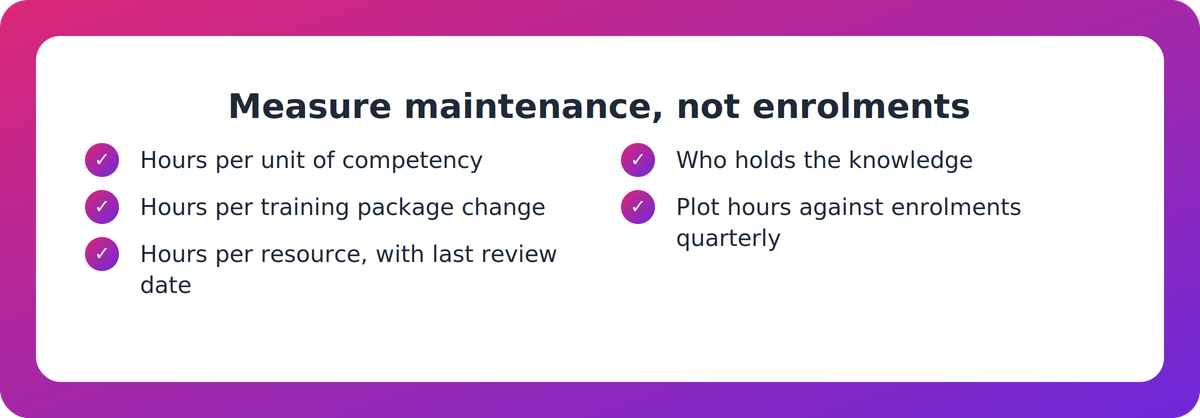
A short checklist makes the first pass manageable.
Key takeaways
- Content maintenance is driven by training package change, the 2025 Standards and the VET Information Standard, not by enrolment volume.
- NCVER shows 5.1 million students in 2025, up only 1,585, with the participation rate down marginally to 26.4%.
- No public source quantifies maintenance effort, so treat divergence from enrolments as a hypothesis and test it internally.
- Measure hours per unit of competency, per training package change and per resource, and record who holds the knowledge.
- Reporting deadlines (annual submission window 1 January to 28 February 2027, no extensions) compete with upkeep for the same people.
Our take
We think the enrolment-based capacity model is the wrong default for an RTO in this environment. It's tidy, it's easy to defend to a board, and it hides a cost that grows with regulatory and training package change rather than with students.
We can't prove that. Nobody can yet, which is the point. The COOs who benefit will be those who put a number on maintenance before the next remap or reporting transition forces the conversation.
A first step this week: pick one recent training package change and ask the team to reconstruct, honestly, how many hours the remap took and who did them. That single figure will tell you whether the question is worth a quarter of tracking.
FAQ
Does the 2025 Standards for RTOs explicitly require resources to be updated on a schedule?
The brief's sources don't show a fixed schedule. The Standards are outcomes-focused, and ASQA's Practice Guides offer example actions and self-assurance questions rather than prescriptions. One consultancy analysis reads them as expecting ongoing, evidenced industry consultation, including keeping resources current. Treat that as interpretation and confirm with ASQA's published guidance.
Is there data on how much time RTOs spend on content maintenance?
No authoritative public source was found on staff time spent on content maintenance, how it scales against enrolments, or how many training package updates an average RTO must remap annually. The only reliable data is what you collect inside your own RTO.
When must my RTO report under the VET Information Standard?
The VET Information Standard will replace AVETMISS for the VET Provider Collection. NCVER says all RTOs must report under it by January 2029, and the amended Data Provision Requirements Instrument 2020 took effect on 1 October 2026. Individual RTO transition dates weren't found publicly, and Victoria's reported 1 January 2027 date should be checked with the VRQA.
What should I track first if I only have a month?
Pick one recent training package change and reconstruct the remap effort: units affected, resources updated, hours spent and who did the work. Then tag your highest-volume units' resources with last review date and reviewer. That gives you a first view of both cost and key-person risk.