Paid placements are coming to allied health, but a payment doesn't create a placement. The Commonwealth Prac Payment (CPP) reaches 10 allied health disciplines from 1 July 2027, so the sharper question is how much practice can credibly be simulated. Occupational therapy's cap of 200 of 1,000 hours is the one hard benchmark we found.
What is changing with the Commonwealth Prac Payment?
The Department of Education announced on 23 July 2026 that CPP will extend from 1 July 2027 to students in 10 frontline allied health disciplines in areas of national skills shortage. They join teaching, nursing, midwifery and social work students already eligible on mandatory placements.
The driver is hardship. The payment is $338.60 a week, and commentary in Independent Australia (1 July 2026) argues it still leaves students in poverty. That's an opinion piece, but the debate over adequacy is clearly live.
How bad is placement poverty, really?
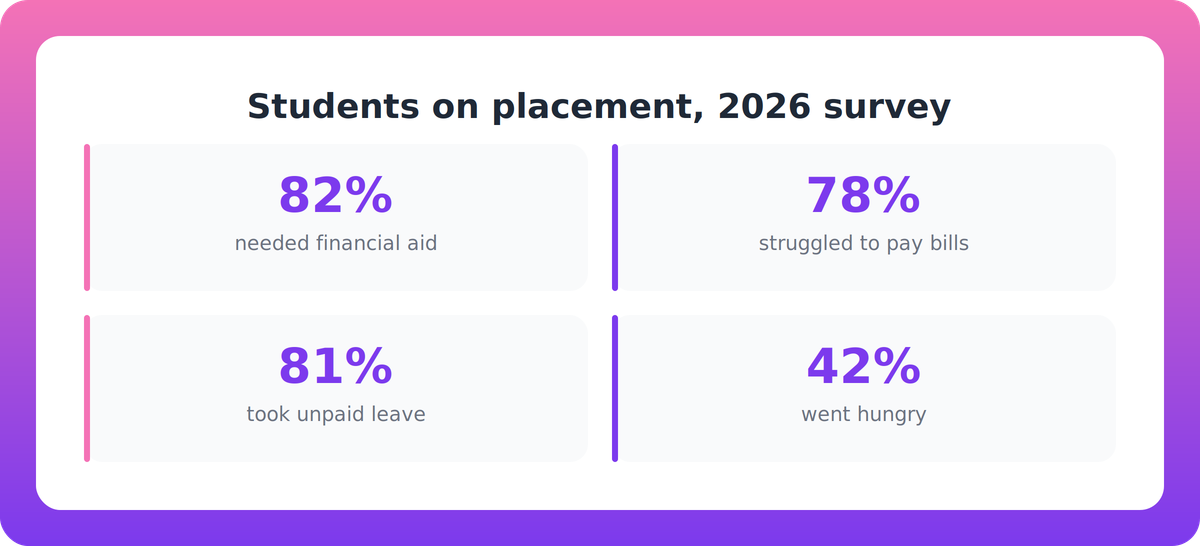
The 2026 National Placement Poverty Survey, as cited by the Pharmacy Guild, found the following among students on placement:
- 82% needed financial aid
- 78% struggled to pay bills
- 81% took unpaid leave
- 42% went hungry
Rural Health West, citing the same survey via the Health Students Alliance, adds that 49% of students considered leaving their degree. The Parliamentary Budget Office costed extending support to medical and allied health students at an additional $290 million over the forward estimates (Haines and Pocock, 9 February 2026).
Does paying students fix the placement problem?
Not on the evidence we found. Payment eases the cost of doing a placement. It says nothing about how many supervised places exist, or where.
We found no recent placement-supply data, so we can't tell you whether supply will tighten or loosen once more students are funded. Workforce pressure isn't easing either. Jobs and Skills Australia's 2026 Occupation Shortage List, seen only through secondary coverage, found 279 of 1,021 occupations (27%) in shortage. The primary release is worth checking for its training-gap findings.
The responsible planning assumption is that demand for placement hours stays high and capacity stays uneven.
How much practice can be simulated?
Less than many people assume, and the limit sits with each accrediting body. A 2026 scoping review and evidence-and-gap map of simulated clinical placements (Pollock et al., *Advances in Simulation*, 18 February 2026) records that Australia's occupational therapy accrediting body allows up to 200 of the mandatory 1,000 placement hours to be completed via simulation.
That's 20%. Simulation is a partial complement to placement, not a substitute for it.
We found no new simulation-hour rulings from the nursing, social work or teaching regulators. Check those directly before you plan around any number.
What does the evidence say about simulated placements?
It's encouraging and balanced. Two Australian examples stand out:
- Physiotherapy trials: students in a simulated first week performed as well as controls and felt more confident before placement. The authors caution that long-term benefits may be limited because simulated settings are predictable.
- University of New England psychology pilot: a simulated placement for postgraduate students reported more students completing the placement than in earlier face-to-face cohorts, and students meeting competence in shorter time frames.
The pattern is readiness and confidence up front, with a question mark over durability. That points to where simulation belongs: before and alongside real placement, not instead of it.
Where does vocational education fit?
For RTOs, a low-authority commentary says the Standards for RTOs 2025, in force since 1 July 2025, require outcomes to be demonstrated rather than prescribing how practical skills are taught. If that holds, it leaves room for simulation in delivering units of competency within training packages.
Treat that as a lead, not a ruling. Verify it against ASQA and DEWR primary documents, and against the assessment conditions in the relevant training package, before relying on it.
How do you design simulation deliberately?
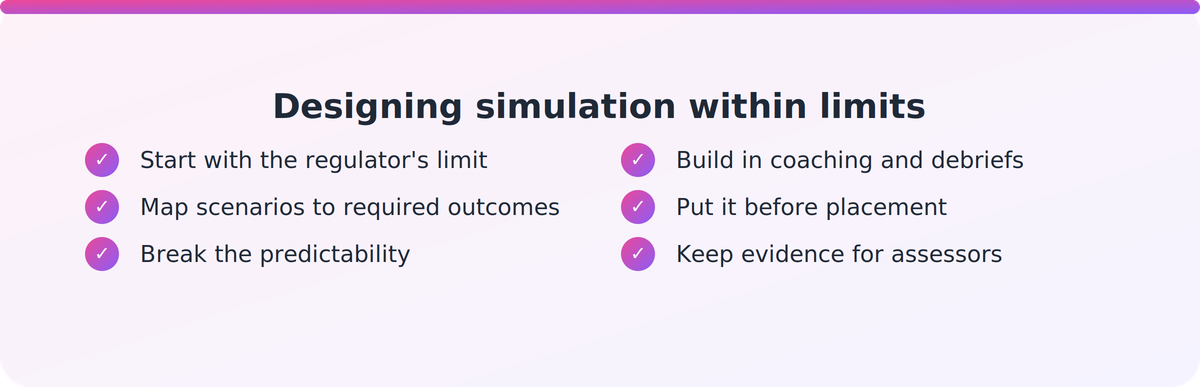
If the cap is the ceiling, design is the floor. A practical checklist for prac-heavy degrees:
- Start with the regulator's limit. Write down the maximum simulated hours for each accrediting body, then plan inside it.
- Map scenarios to required outcomes. Every simulated hour should trace to a specific competency or capability, not just fill time.
- Break the predictability. The physiotherapy authors flagged predictable settings as a weakness. Vary the patient, client or learner behaviour, and the context, so students can't rehearse a script.
- Coach, don't just run. Practice that gets feedback beats practice that doesn't. Build debriefs and repeat attempts into the design.
- Put it before placement. The strongest evidence we found is for readiness and confidence going in.
- Keep evidence for assessors. Capture what each student did, so simulated hours stand up in an accreditation review.
One practical note on cost: simulation has traditionally meant actors, facilitators and weeks of scenario writing. AI-generated role plays and coached practice are starting to change that equation. We unpack that in more depth in our piece on simulation-based training and the AQF skills gap.
What don't we know yet?
Three gaps are worth stating plainly:
- Recent placement-supply data for allied health
- Any new simulation-hour rulings from the nursing, social work or teaching regulators
- Whether the 2026 shortage findings point mainly to training gaps or to retention
Planning around them without checking is how providers get caught out.
Key takeaways
- CPP extends to 10 allied health disciplines from 1 July 2027, but payment doesn't create supervised placement capacity.
- The only hard simulation benchmark found is occupational therapy's cap of 200 of 1,000 hours.
- Australian physiotherapy trials show simulation can lift confidence before placement, though long-term benefits may be limited.
- A University of New England psychology pilot reported higher completion and faster competence, though it was a small pilot.
- For RTOs, verify what the Standards for RTOs 2025 allow against ASQA and DEWR primary documents.
Our take
The policy conversation is about who pays for placement. The more useful provider question is what a placement hour is for, and which of those purposes can be met safely elsewhere. We think the providers who come out ahead will treat the cap as a design constraint, not a loophole: use simulation to make real placement hours count for more. Anything that makes simulation feel like a script students can game defeats the point.
FAQ
When does the Commonwealth Prac Payment extend to allied health?
The Department of Education announced on 23 July 2026 that CPP extends from 1 July 2027 to students in 10 frontline allied health disciplines in areas of national skills shortage. Teaching, nursing, midwifery and social work students are already eligible on mandatory placements.
How many placement hours can be simulated in occupational therapy?
According to a 2026 scoping review (Pollock et al., *Advances in Simulation*), Australia's occupational therapy accrediting body allows up to 200 of the mandatory 1,000 placement hours to be completed via simulation. Other professions have their own rules, so check each regulator directly.
Does simulation work as well as real placement?
The evidence supports it as a complement. In Australian physiotherapy trials, students in a simulated first week performed as well as controls and felt more confident before placement. The authors caution that long-term benefits may be limited because simulated settings are predictable.
Can RTOs use simulation under the Standards for RTOs 2025?
One low-authority commentary says the Standards for RTOs 2025 require outcomes to be demonstrated rather than prescribing how skills are taught. That would leave room for simulation, but confirm it against ASQA and DEWR primary documents and the relevant training package before relying on it.
Will paid placements solve the placement shortage?
Not by themselves, on the evidence found. CPP addresses student financial hardship, but we found no recent placement-supply data showing it adds supervised places. Simulation designed within regulator limits can help, but only as a partial complement.