Most RTOs never decide to deliver a superseded unit of competency. They find out when someone compares the unit version on file with what's actually in delivery. By then, the gap may be weeks or months old, and it's a finding that ASQA can check and prove.
Why do RTOs get caught running a superseded unit?
Because nothing tells them a change affects them. According to Supahuman's own analysis of training package currency, there's no single central alert that says, "this update touches your scope."
So currency usually runs on manual, periodic reviews. Someone checks the register every so often, compares it to the scope, and updates what they find. It works until it doesn't.
The gap between a training package changing and an RTO noticing is where the audit finding sits. In that window, trainers keep delivering. Learners keep being assessed. The superseded unit stays in the TAS and the assessment tools.
What does an auditor actually check?
The check is simple, and that's the problem. Supahuman's currency article says ASQA's 2026 audit cycle compares the actual version of a unit of competency with what appears in a provider's TAS and delivery resources.
There's no judgement call in that. The unit is either current or it isn't. The same article calls a superseded unit still in active use a "checkable, provable breach the moment an auditor pulls the file".
Compare that with a softer finding, such as assessment judgements that vary between trainers. Those take argument and evidence. A superseded unit code takes one look.
Where does the drift hide?
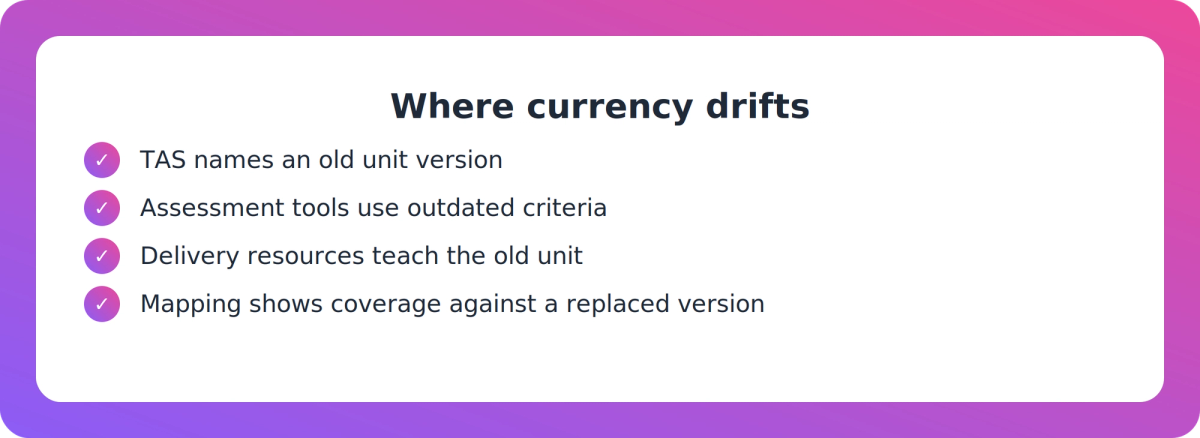
The unit code is the obvious place. It's rarely the only one. Currency risk tends to sit in several documents that each age at their own pace:
- The TAS. It names a unit version that no longer matches the current one.
- Assessment tools. Questions and tasks still reflect elements or performance criteria that have since changed.
- Delivery resources. Learner guides and slides teach to the old unit.
- Mapping documents. These show coverage against a version that's been replaced.
Mapping is the quiet one. Supahuman's post on the TPOF 2025 unit format notes that mapping is often done once and then left. The gap then surfaces at a validation session or, worse, during an ASQA audit.
Is a superseded unit a governance problem, not just a trainer's one?
Yes, and that's the part that makes it uncomfortable. Supahuman has framed a superseded unit sitting in assessment tools as a Fit and Proper Person question: are managers actually governing the training they deliver?
It stops being housekeeping. It becomes a question about whether the people accountable for the RTO can show they know what's in delivery. A trainer who missed an update is a process failure. A manager who can't show how currency is monitored is a different conversation.
Under the Standards for RTOs 2025, that distinction matters. Currency of the training and assessment you deliver is something an RTO is expected to be able to demonstrate, not just assert.
Is a written policy enough?
Not on its own. Most RTOs have a policy on managing superseded units. It says reviews happen, who does them and how often.
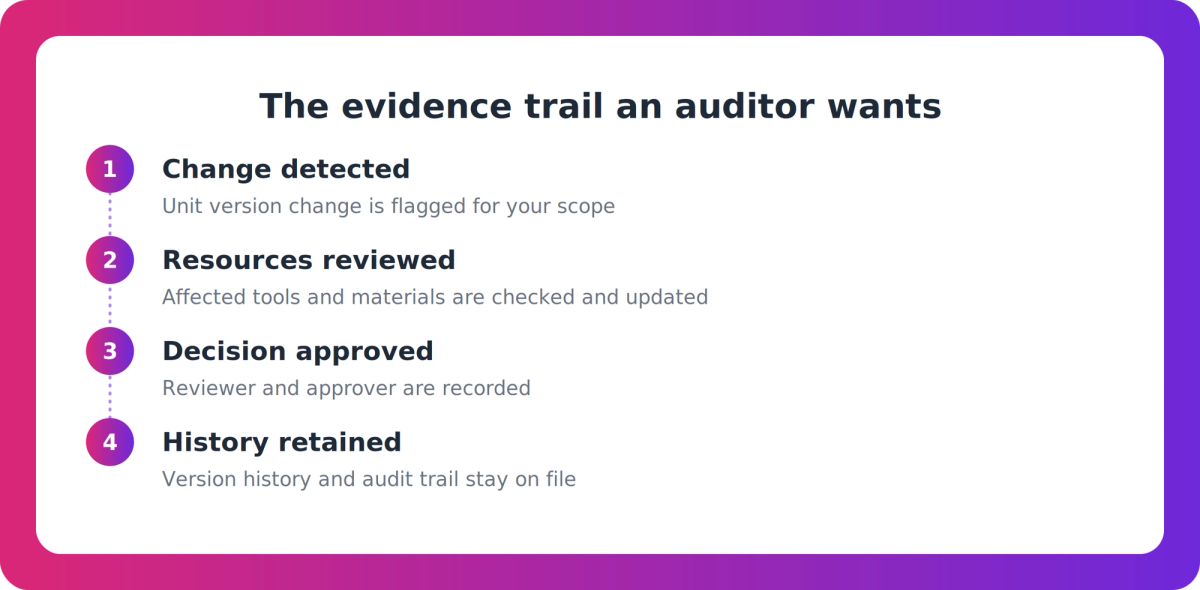
The trouble is that a policy describes intent. An auditor wants evidence the process worked. That means being able to show:
- Which version of each unit was in use, and when it changed.
- Who reviewed the affected resources, and what they decided.
- When the update was approved, and by whom.
- A record that sits behind all of it, not one rebuilt the week before audit.
If that evidence only exists in someone's inbox, it isn't evidence. It's a reconstruction.
How are RTOs closing the gap?
The fix is to stop relying on someone remembering to look. Supahuman VETos holds a live graph of an RTO's scope: units, elements, performance criteria and performance evidence requirements. It auto-flags when a training product is superseded.
That changes the job. Instead of re-checking the whole catalogue by hand, a team can see which resources sit against the affected unit and update those precisely.
A few other shipped capabilities support the "show it worked" side:
- Version history on every artefact, with an audit trail captured without extra clicks.
- Role-based review and approval flows that route work between authors, validators and quality leads, and log every decision.
- Resources mapped to units, elements and performance criteria directly from the national training register, with mapping done while the draft is written.
- AI-assisted validation that flags issues before they become findings.
- Upgrades to existing assessment tools as units convert to the new unit format, so teams don't rebuild from a blank page.
To be clear about scope: this is about catching the change and documenting the response. It doesn't replace the judgement of a qualified practitioner deciding what an update means for delivery.
Key takeaways
- Superseded units usually go unnoticed because currency is monitored through manual, periodic reviews, and no central alert says a change affects you.
- ASQA's 2026 audit cycle compares unit versions against the TAS and delivery resources, which makes a superseded unit easy to prove.
- The risk spreads across the TAS, assessment tools, delivery resources and mapping, not just the unit code.
- It's also a governance question about whether managers oversee what the RTO delivers.
- A policy isn't enough. You need version history, review decisions and an audit trail to show the process worked.
Our take
The superseded unit is the most avoidable finding in VET, and that's exactly why it stings. The fix isn't a better policy or a more diligent person with a calendar reminder. It's a system that notices for you and keeps a record of what you did about it. RTOs that treat currency as a monitoring problem rather than a memory problem will spend a lot less time explaining themselves.
FAQ
What happens if an RTO delivers a superseded unit of competency?
It can become an audit finding. An auditor can compare the unit version in your TAS and delivery resources with the current one, which makes the issue easy to prove. The seriousness depends on how long it ran and what the RTO did once it found out.
Why don't RTOs notice when a training package changes?
There's usually no single central alert telling a provider that a change affects its scope. Most rely on manual, periodic reviews, so delivery can run against the old unit for weeks or months before anyone spots it.
Is a superseded unit only a trainer's responsibility?
No. It's also a governance question. Managers are accountable for the training the RTO delivers, so a superseded unit in assessment tools raises the question of whether that oversight is working.
Is a policy on superseded units enough for an ASQA audit?
A policy helps, but it describes intent. You also need evidence the process worked, such as version history, documented review decisions and an audit trail showing who approved what and when.
How does VETos help with superseded units?
VETos holds a live graph of an RTO's scope and auto-flags when a training product is superseded. Version history, role-based approvals and an audit trail record the response. You can read more at vet.supahuman.com.
If you'd like a sanity check, pick one unit in your scope and trace it. Compare the version in your TAS, your assessment tool and your delivery resources. How long would it take you to prove they match?