AI Assessment Generator for NZ Unit Standards: A Buyer's Guide
Yes, a New Zealand PTE can use AI to draft NZQA unit standard assessments, provided a qualified assessor reviews and approves every draft and your own moderation system stays in charge. We found no NZQA rule that prohibits or approves AI authoring, and NZQA approves no tool in this category. Accountability and evaluation sit with the provider.
Key takeaways
- An AI assessment generator is a drafting aid. It does not replace assessor judgement, internal moderation or NZQA's external moderation.
- NZQA does not approve any AI assessment tool, so you carry the evaluation. Test any tool on your own scope.
- Weigh six things: current-standards handling, traceable mapping, approval and audit trails, moderation fit, context fit and Privacy Act 2020 data handling.
- Standard-setting changed in 2026. Confirm each standard's status and the version of the rules that applies before you build on it.
- Treat vendor speed claims, ours included, as self-reported until you have tested them.
Who is accountable when AI drafts an assessment?
Your assessors and your moderation processes are accountable, not the vendor. We found no NZQA rule that specifically covers AI authoring of unit standard assessments. NZQA's tertiary page on academic integrity and AI appears to focus on learner integrity. We could not retrieve its content, so read it directly.
The Ministry of Education's generative AI guidance says AI should support, not replace, teachers' professional judgement. It is school-sector guidance, not tertiary. It is still a sound principle for an "assessor stays accountable" workflow.
In practice, a qualified assessor should read, edit and approve every draft. The Achieved or Not Achieved decision should always stay with a human.
How do AI drafts fit consent to assess and moderation?
They fit only if they meet the same requirements as any other assessment. NZQA requires providers to hold consent to assess before assessing against standards. They must then run internal moderation and take part in the national external moderation system (NZQA, Assessment of standards).
Every standard on the Directory of Assessment and Skill Standards (DASS) has a Consent and Moderation Requirements (CMR) document. It sets out what providers must meet to be granted and keep consent. See NZQA's consent to assess guidance for DASS standards.
A draft is only as useful as its fit with that CMR. Check any generated assessment against it before it reaches a learner.
What should you check before buying an AI assessment generator?
Use the same criteria for every vendor, and ask for evidence rather than assurances.
- Standards currency. Does the tool use current unit and skill standards and CMRs? Does it handle current, expiring and discontinued statuses? Can it help you upgrade unit-standard materials to skill-standard replacements?
- Assessor accountability. Are there human review and approval gates, a version history and a decision audit log?
- Traceable mapping. Is every element and performance criterion mapped back to the standard? Is there assessor guidance a moderator can follow?
- Moderation fit. Do outputs support your internal moderation and the external moderation requirements of the relevant standard-setting body?
- Context fit. Can drafts adapt to your industry, delivery mode (classroom, workplace, distance) and learner needs without a full rewrite?
- Privacy and data handling. Ask about data residency, retention, model training on your content and the Privacy Act 2020 position.
- Evidence and honesty. Are claims backed by named customers or independent evaluation? Does the vendor say plainly that output is a draft and NZQA does not approve the tool?
- Cost and transparency. Is pricing clear? Are "coming soon" features separated from what is live today?
Why standards currency matters more in 2026
The standards landscape moved in 2026, so a tool built on stale standards is a real risk. Vendor blogs say the eight Industry Skills Boards took over standard-setting on 1 January 2026, and that revised NZQA rules and the iQAF followed on 19 January. Treat those as vendor claims and verify them with NZQA and the Ministry of Education.
Also note that NZQA's rules page is titled "Consent to Assess Against Standards on the DASS Rules 2026", while another NZQA page still refers to the 2022 version. Confirm which applies. Then check which Industry Skills Board now owns moderation for each standard you assess.
What privacy questions should you ask under the Privacy Act 2020?
Ask where data goes, how long it stays and whether it trains anyone's model. The Privacy Act 2020 applies when AI tools handle personal information. The Privacy Commissioner does not approve or endorse any AI technology or provider, and recommends a privacy assessment before use (Privacy Commissioner AskUs).
DLA Piper and Bell Gully both say a privacy impact assessment is not mandatory but is strongly encouraged. Bell Gully notes that agencies remain responsible for decisions made using AI tools.
For assessment authoring, the simplest control is to keep learner personal information out of prompts unless you have assessed the privacy impact.
What does a safe AI-drafting workflow look like?
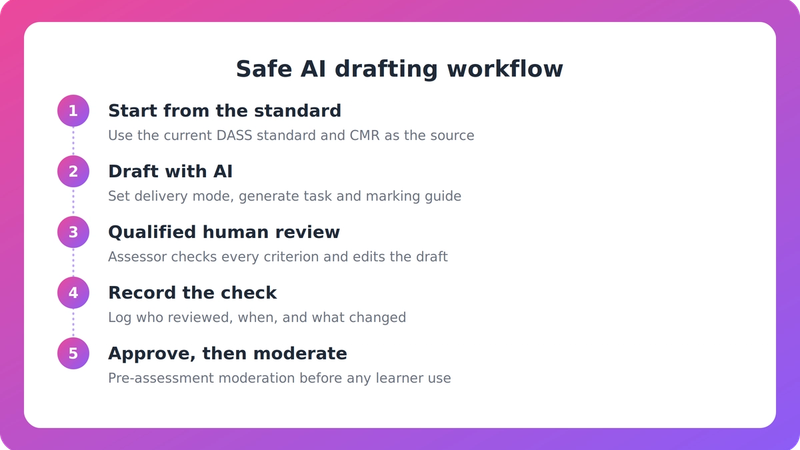
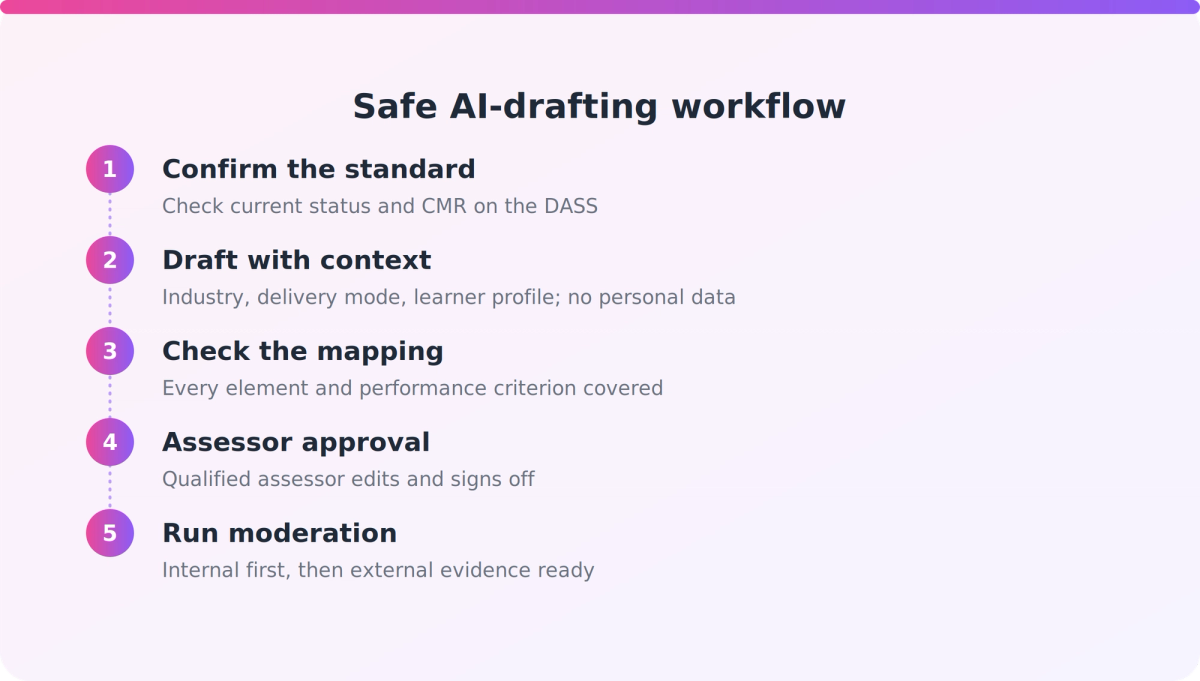
Treat the AI as a fast first drafter inside your existing quality system. Here is a workflow that keeps the assessor in charge:
- Confirm the standard. Check its current status and CMR on the DASS before drafting.
- Draft with context. Give the tool your industry, delivery mode and learner profile, with no learner personal information.
- Check the mapping. Verify every element and performance criterion is covered, and that the assessor guide is usable.
- Assessor review and approval. A qualified assessor edits and signs off, with the approval recorded.
- Run your moderation. Put the assessment through internal moderation before use, then keep evidence ready for external moderation.
An illustrative example: a PTE with ten unit standards on its scope pilots the tool on two of them. Assessors and the quality manager compare drafts with their existing materials. They check mapping line by line and record the edits needed. Only then do they decide whether to extend the pilot. The numbers are yours to measure.
Where does VETos fit?
VETos is one option in this category, and you should evaluate it against the same criteria. Its NZ page says it holds both unit and skill standards and lets you pull a standard into a workspace. It also says it supports upgrading unit-standard materials with regenerated mapping and a version trail.
Its own pages describe drafting of assessment tools, assessor guides and learner guides. Mapping runs to each element and performance criterion. Theory and Practical delivery modes can produce classroom or workplace versions of the same standard. Its legals page describes a QA Engine that checks assessments against the NZQA Principles of Assessment and external moderation expectations. Some items, such as Assessor Quality Assurance tools, are listed as coming soon.
The sites say AI-generated assessments need human review, the qualified assessor stays accountable, and NZQA approves no tool. Performance figures are self-reported. The MAST Academy case study claims authoring time fell from around six weeks to minutes, an 80% reduction. We found no independent accuracy studies, and VETos pricing is not publicly available. Test it on your own scope.
Our take
Buy for the workflow, not the draft. Every tool in this category can produce plausible text quickly. The harder question is whether it makes your assessor's review faster and your moderation evidence easier to trace. Ask for a pilot on two or three of your own standards, with your assessors marking the output hard. Treat any vendor that skips that conversation as a warning sign.
FAQ
Can a PTE use AI to write NZQA unit standard assessments?
Yes, as drafting support. We found no NZQA rule prohibiting or approving AI authoring and no NZQA approval of any tool. A qualified assessor must review and approve every draft. Your internal moderation and NZQA's external moderation still apply.
What should I check before buying an AI assessment generator for NZ standards?
Check current-standards handling, mapping to each element and performance criterion, approval and audit trails, moderation fit, context fit, privacy and data handling, evidence behind claims, and pricing transparency. Test it on your own scope.
How do AI-drafted assessments fit consent to assess and moderation?
They must meet the same requirements as any assessment. Providers need consent to assess, run internal moderation and take part in national external moderation. Check each draft against the standard's CMR on the DASS.
What privacy questions should I ask an AI assessment vendor?
Ask about data residency, retention, whether your content trains models and how the vendor approaches the Privacy Act 2020. The Privacy Commissioner recommends a privacy assessment before use. Keep learner personal information out of prompts unless you have assessed the impact.
Next step
Before speaking to any vendor, write down the five to ten standards on your scope you would pilot on. Use the eight criteria above as your scorecard. If you want to see how VETos handles them, ask for a walkthrough on one of your own standards via vet.supahuman.com/nz.