Yes. A PTE can use AI to draft NZQA assessment materials, provided a qualified, accountable assessor reviews and approves every draft before pre-assessment moderation. We found no AI-specific NZQA rules for tertiary providers, so your existing moderation and fair, valid and consistent assessment obligations apply, and so does the Privacy Act 2020 for any data you put into a tool.
Key takeaways
- AI assessment writing in NZ is a workflow decision first and a software decision second. The tool should make human review, standards mapping and audit evidence easy.
- AI drafts; a qualified assessor validates. Every AI-drafted task and marking guide still goes through your approval and pre-assessment moderation before use with learners.
- A coverage map shows alignment to the standard. It does not prove compliance on its own.
- Check privacy before you upload anything. The Privacy Act 2020 covers generative AI, and a Privacy Impact Assessment is a sensible first step.
- Confirm NZQA's current position directly. The sources on tertiary AI guidance we found are mostly secondary.
What does NZQA actually say about AI in tertiary assessment?
Not much, and that is the gap. NZQA's main AI page is written for schools and kura. It covers student use of AI in external assessment, not how a provider drafts its own tasks.
New Zealand also has no AI-specific law, according to Nemko Digital's commentary. A vendor source reports no tertiary-specific generative AI rules from NZQA. That is a secondary source, so treat it as a prompt to ask NZQA, not as a ruling. We cover this in more detail in our piece on what providers should expect.
No rules specific to AI doesn't mean no rules. It means your existing obligations carry the weight.
Which obligations still apply when AI drafts the assessment?
The obligations that matter are the ones you already carry as a PTE. NZQA says PTEs must comply with sections 342 to 361 of the Education and Training Act 2020 and the PTE Rules (see NZQA's PTE registration information and the Private Training Establishment Rules 2026). One vendor blog gives a commencement date for the 2026 rules that we did not see on an NZQA page, so confirm it with NZQA.
Three things do the heavy lifting:
- Internal moderation. NZQA says it must be embedded in every TEO's quality management system, including pre-assessment moderation of materials. A good system ensures all tasks and marking guidance are moderated and approved before use with learners.
- Consent and Moderation Requirements (CMRs). A CMR applies to each standard on the Directory of Assessment and Skill Standards (DASS). It sets out the national external moderation system for that standard. See an example CMR on NZQA's site.
- External moderation. NZQA expects an accurate annual assessment plan, met deadlines, and evidence that assessor judgements are fair, valid and consistent nationally. Materials found not yet consistent with the standard must be modified before reuse (NEM guidelines 2020).
None of that cares who or what wrote the first draft. It cares whether the material is valid, approved and moderated.
A safe drafting workflow for PTEs
Here is a workflow that fits those obligations. It is our inference from the moderation rules, not an NZQA-endorsed method.
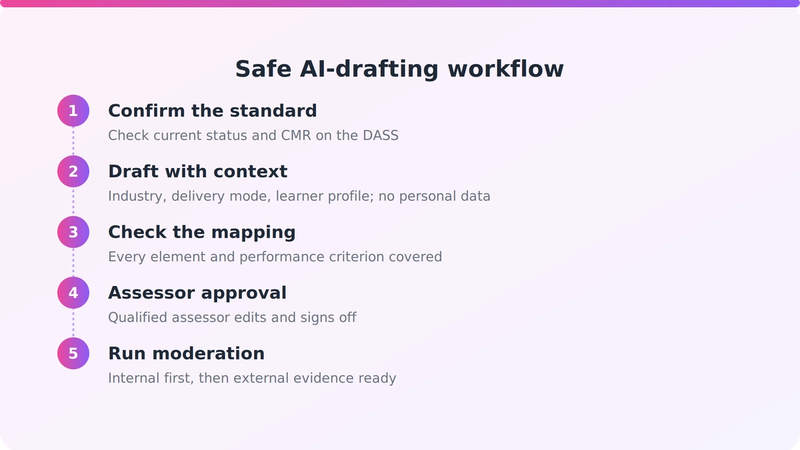
- Start from the standard. Use the current unit or skill standard from the DASS as the source, including the CMR. Don't let a tool work from memory.
- Draft with AI. Specify the delivery mode (theory or practical) and generate the task, assessor guidance and marking guide.
- Human review and edit. A qualified assessor checks the draft against every element, performance criterion and assessment specification. They fix errors and remove anything that doesn't fit your learners or context.
- Record the check. Note who reviewed it, when and what changed. Recording who checks AI-touched content supports audit readiness.
- Approve, then moderate. Run normal pre-assessment moderation and approval before the material goes near a learner. Keep post-assessment moderation of learner work as usual.
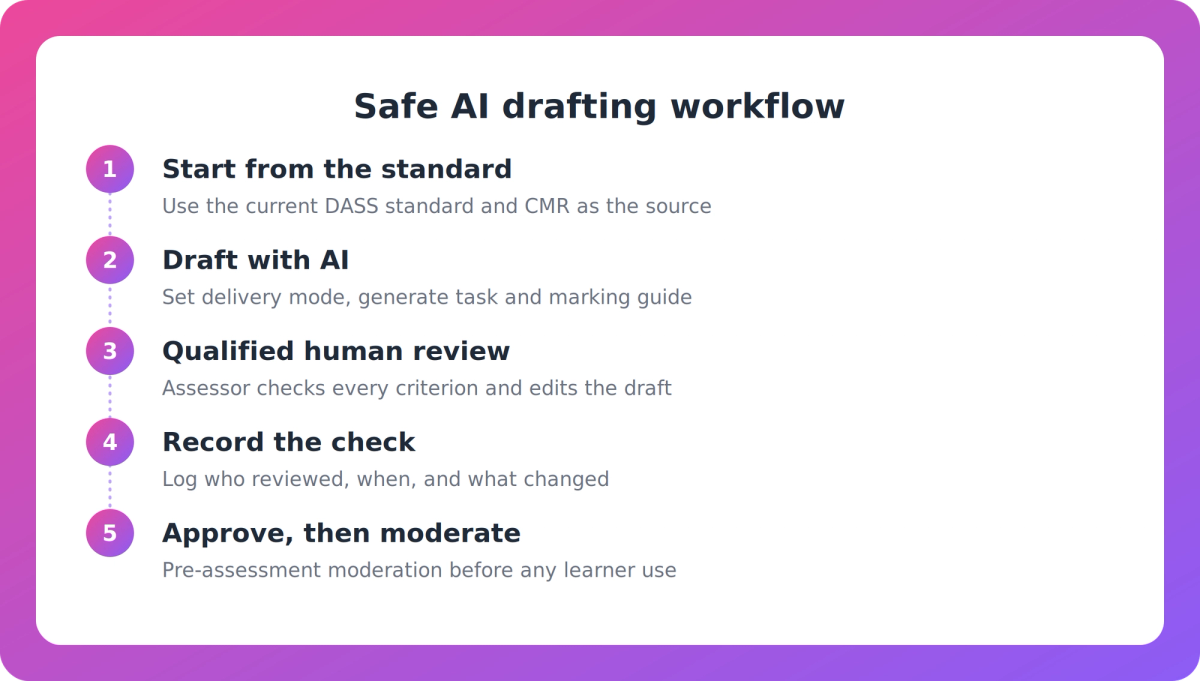
If you can't produce step 4 within a day of an auditor asking, the workflow isn't safe yet, however good the draft was.
What should you look for in an AI assessment writing tool?
No authoritative NZ source gives a certification or checklist for AI assessment-drafting tools, so the criteria below are our inference from the moderation requirements. Use them to compare options fairly.
- Traceable mapping. Does output map to the specific unit or skill standard on the DASS, including elements, performance criteria and assessment specifications?
- Standards currency. Unit standards are being replaced by skill standards. Does the tool handle that, and does it keep a version trail moderators can follow?
- An auditable human review point. Is there a clear step where a qualified person reviews, edits and approves, and can you record who checked what?
- Moderation readiness. Does it produce assessor guidance, marking guides and mapping evidence in forms your moderators expect, and export to the formats your team uses?
- Honest gap checking. Does it flag coverage gaps, and does the vendor admit that a coverage map is not proof of compliance?
- Fit with your design. Can you choose theory or practical delivery, and does it support clustered or integrated assessment and reassessment variants?
- Evidence behind claims. Are speed claims independent or vendor-stated? Are there NZ customer references? Ask to test on your own units.
- Policy fit. Does it sit within your AI policy, academic integrity approach and staff training?
What privacy checks apply under the Privacy Act 2020?
The Privacy Act 2020 covers generative AI. The Office of the Privacy Commissioner expects agencies to consider whether a tool is necessary and proportionate, and to check how the provider has designed privacy into it. Its 2023 guidance is non-binding but recommends a Privacy Impact Assessment up front. The risk areas are training data, confidentiality of inputs and accuracy of outputs.
Practically, ask what happens to uploaded material and learner data, and whether the vendor has published how privacy is designed in. Keep learner data out of drafting prompts unless you have a clear reason and a clear answer.
The Government Chief Digital Officer's AI guidance for the public service doesn't bind a private PTE. It is still a handy reference for procurement questions on governance, security and hallucinations.
Where does VETos fit?
VETos is the Supahuman product for drafting. Its NZ page says it helps PTEs, polytechnics and wānanga create assessments mapped to unit and skill standards and ready for moderation. It drafts assessment tools, assessor guides, learner guides and mapping, checks for gaps before moderation, and exports to Word and InDesign. Trainers choose theory or practical mode, and mapping traces back to the unit standard, including when upgrading unit-standard materials with a version trail.
Two caveats. The speed claims (minutes rather than months) are the vendor's own and not independently evidenced, and we have no published NZ case studies or quantified outcomes. Test it on your own units. Supahuman's materials are also clear that educators review and refine the output, and that a coverage map can't prove compliance on its own.
Nova, our formative practice companion, is different. It doesn't draft NZQA assessments, mark work or make competency decisions. Assessors keep those calls. It generates role plays and simulations from uploaded unit standard material so learners arrive at their real submission better prepared.
Our take
Most PTEs shouldn't be asking "which AI writes the best assessment?" They should be asking "where in our moderation system does a qualified person take responsibility for this draft?" A tool that is fast but leaves that step vague just moves the risk to your next audit. We'd pick the slightly less impressive tool with a clean review trail over the dazzling one without it, and we'd put NZQA on the phone before committing.
FAQ
Can a PTE use AI to draft assessment materials and still meet NZQA moderation requirements?
Yes, if a qualified assessor reviews and approves each draft and it goes through pre-assessment moderation before use. NZQA's moderation guidance focuses on materials being moderated and approved, not on how they were first written. Confirm your approach with NZQA.
Does NZQA have rules on AI in tertiary assessment?
We found none specific to tertiary providers. NZQA's main AI page is written for schools and kura and covers student use of AI in external assessment. Existing moderation and quality obligations still apply, and the sources on tertiary guidance are secondary, so check directly with NZQA.
Who is accountable for AI-drafted assessments?
The PTE and its qualified assessors remain accountable. A vendor buyer's guide says the same, though that is vendor interpretation, not NZQA text. Record who checked AI-touched content and how.
What privacy checks should we do before using an AI drafting tool?
Consider whether the tool is necessary and proportionate, and check how the vendor has designed privacy in. The Privacy Commissioner's non-binding 2023 guidance recommends a Privacy Impact Assessment up front. Look closely at confidentiality of inputs and accuracy of outputs.
Next step
Before you shortlist anything, run one real unit standard through the five-step workflow above, with a named reviewer and a written record. If you'd like to see how VETos handles that on your own units, you can start at supahuman.com.