Training Package Updates: The Real Cost for RTOs
A training package update costs an RTO far more than the unit code change suggests. ASQA expects RTOs to transition to the newest version and assess the impact on strategies, tools, resourcing and trainer currency, so one release sets off a chain of work. No independent dollar figure exists, so build a cost model from your own portfolio.
Key takeaways
- The baseline obligation is simple: transition to the newest version. The work sits in the impact assessment, not the code swap.
- Cost lives in several places at once: the training and assessment strategy (TAS), tools, resourcing, trainer currency and the evidence trail.
- Some changes alter delivery without touching a unit code, so code-level monitoring alone will miss them.
- No ASQA, DEWR or NCVER source puts a dollar figure on an update. Your estimate should come from releases hitting your portfolio multiplied by your own hours per unit.
- Transition dates can move, so verify enrolment and teach-out wording against ASQA and training.gov.au before you lock it in.
What does ASQA actually require when a training product changes?
RTOs must transition to the newest version when training products are updated. ASQA's guidance on when training products change says all updates are published on the National Training Register, and RTOs can register at training.gov.au for notifications.
The more useful page for costing is ASQA's How to transition guidance. It tells RTOs to assess the impact on:
- training and assessment strategies
- tools
- licensing, resourcing and equipment
- trainer professional development and currency
That list is a ready-made cost structure. It also shows why "we updated the unit codes" is rarely the end of the job.
Why is the unit code change the smallest line item?
Because a new version ripples outward. A changed unit can mean a rewritten assessment task, a revised mapping document, updated learner resources, a trainer briefing and a fresh set of records showing what was delivered to whom, and when.
The cost chain looks like this:
- Strategy: revisit the TAS for the new version.
- Tools: revise assessment instruments and assessor guides, then re-prove coverage against the unit.
- Resourcing: check equipment, facilities, licensing and learner materials.
- People: brief trainers and assessors and confirm their currency against the new content.
- Evidence: keep a trail showing which version was delivered to which cohort.
Skip any step and the cost doesn't vanish. It shows up later, usually in an audit.
How heavy is the release churn in practice?
Heavier than most calendars assume. VET Resources reports that AUR Release 9.0 was endorsed on 24 June 2026 and released on 9 July 2026, superseding Release 8.0, which was endorsed in March 2026. That is two AUR releases in about four months.
The pattern isn't limited to automotive. eSkilled's RII update guide describes a BuildSkills project that updated 26 RII products, 25 of them major changes. Precision RTO Resources also covers HLT changes, though check the detail against training.gov.au before you act on it.
These are mostly vendor and resource-provider summaries. Treat them as signals of volume, and confirm each release on the National Register.
Which changes can a unit-code diff miss?
The ones that change delivery without adding or removing a unit. Precision RTO Resources notes that CHC Release 11.1 (17 July 2026) adds a mandatory National Child Safety Training requirement before work placement for CHC30125 Certificate III in Early Childhood Education and Care. It adds no unit.
A tool that compares unit codes between versions would show nothing. Yet placement scheduling, learner communication and evidence collection all change. Currency monitoring has to read release notes and qualification rules, not just unit lists.
Can you trust a hard-coded teach-out date?
Not without checking. Transition dates can move. ASQA's list of products with current transition extensions includes AHC41316 Certificate IV in Wool Classing, with the enrol-by date extended to 31 July 2027.
There is also a wording tension to resolve. ASQA's transition page still refers to a one-year limit on new enrolments in a superseded product. VET Resources says the 2025 Standards removed the rigid 12-month rule for existing students. We can't settle that from the sources here, so confirm the current position with ASQA before you state either one in a learner agreement or a transition plan.
Why is release timing so hard to plan around?
Because nobody gives you a calendar. Training packages go through DEWR's Training Package Assurance, where the Assurance Body assesses products against the Training Package Organising Framework and recommends to Skills Ministers whether to endorse them. They appear on the National Register only once endorsed.
Several Jobs and Skills Council streams can also touch the same package at different times. Our own earlier commentary on Jobs and Skills Council training package updates argues there is no single standard currency period across packages. That is vendor interpretation, not a regulator statement, but it matches the churn above.
How do you build a cost model without a benchmark?
Start from your own data. The evidence gap is real: no ASQA, DEWR, NCVER, Productivity Commission or peak-body study we found quantifies the cost of an update. So any figure you see quoted should be treated as an estimate.
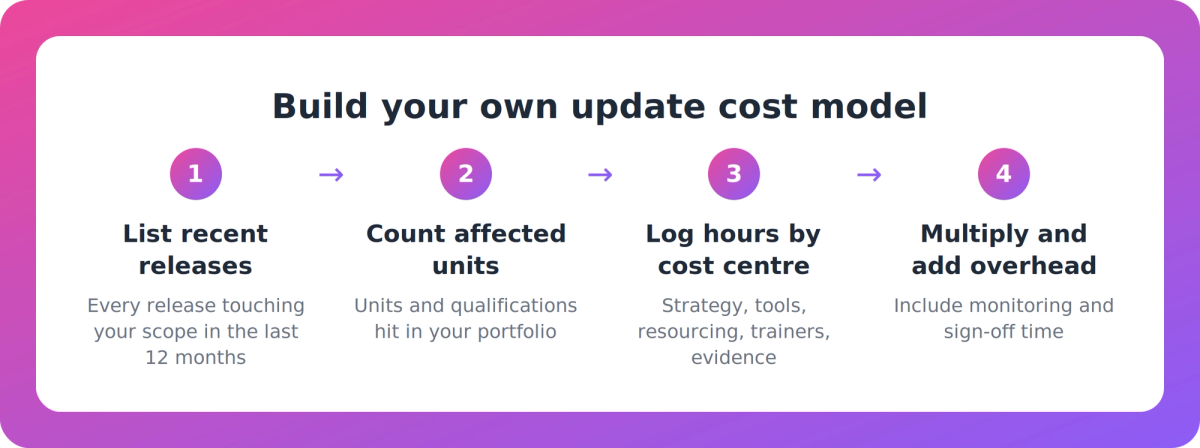
A workable model:
- List every release in the last 12 months that touched a unit, qualification or rule in your scope.
- Count the units and qualifications affected in your portfolio.
- For each, record hours across the five cost centres: TAS, tools, resourcing, trainer currency and evidence.
- Multiply, then add the overhead of monitoring and sign-off.
Illustrative example only (hypothetical numbers): say a release hits 12 of your units. Your team estimates 3 hours on strategy and mapping, 6 on tools, 2 on resourcing and 1 on trainer briefing per unit. That is 12 hours per unit, or 144 hours for the release. If a second release lands four months later, you run the model again.
The point isn't the number. It's that the model shows which cost centre is quietly eating your time.
Our take
Most RTOs treat currency as a periodic project. The evidence says it's closer to a standing operating load, and the biggest risk is the change nobody logged, such as a new placement prerequisite. We think the sensible move is to cost updates per release and per cost centre, then use that data to decide where tighter process or automation actually pays off. Guessing at a blended figure won't tell you that.
FAQ
Does ASQA require RTOs to move to the newest training package version?
Yes. ASQA says that when training products are updated, RTOs must transition to the newest version. Updates are published on the National Training Register, and RTOs can register at training.gov.au for notifications.
What should an RTO assess when it transitions to a new version?
ASQA's How to transition guidance points to training and assessment strategies, tools, licensing, resourcing and equipment, and trainer professional development and currency. Add the evidence trail showing which version was delivered.
Is there an official dollar cost for a training package update?
No independent source found here, including ASQA, DEWR, NCVER or the Productivity Commission, quantifies it. A defensible estimate multiplies the releases affecting your portfolio by your own hours per unit.
Can a training package change affect delivery without changing a unit code?
Yes. CHC Release 11.1 (17 July 2026) adds a mandatory National Child Safety Training requirement before work placement for CHC30125, without adding a unit. A unit-code comparison would miss it.
Next step
Pick the last release that touched your scope and trace it through all five cost centres. Note where you found out about it, how long each step took and what evidence you kept. That one trace is the start of your cost model.