PTE Reporting Process Improvement NZ: What Operations Leaders Can Reclaim from SDR and Funding Returns
The reporting week at a New Zealand PTE is rarely a data problem. It is a process-design problem: the SDR calendar is fixed, first-pass validation sends errors back, and nobody has slack to absorb the rework. Operations leaders who make reporting a by-product of daily work, rather than a periodic event, get the week back.
Key takeaways
- TEC's reporting windows are fixed and public, so the only variable operations controls is how clean the data is before the window opens.
- Rework is built into the design: uploads go through first-pass validation, and errors must be corrected and re-uploaded before full validation runs.
- DXP Ngā Kete changes how data moves (CSV upload, an optional API), not whether the source data needs to be right.
- With extra funding unlikely and NZQA's PTE Rules 2026 favouring self-review, reliable reporting is a cost-control and evidence-quality lever.
- Reclaimed hours are only worth having if they go to improvement and capability, not into the next fire.
Why the reporting week lands on your desk
You own windows you cannot negotiate. TEC's SDR submission dates show the March IND running 1–6 March, the April SDR 16–29 April, the August SDR 8–21 August, and the December SDR 1–31 January the following year. The August 2026 round, for example, closed at 5.00pm on 21 August.
A miss, or a messy re-upload, lands on operations first. And the margin for absorbing that cost has shrunk. TEC's 2026 Plan Guidance says additional funding in 2026 is unlikely and that provider financial sustainability is critical. RNZ reported that TEC lacked funding to meet all forecast demand from 2026 onwards.
When revenue has no slack, hours spent compiling and correcting returns are one of the few costs you can actually move.
The calendar is fixed; the rework is optional
TEC's SDR FAQs describe first-pass validation. If errors are found, they must be corrected and re-uploaded before full validation runs.
That design tells you where the time goes. The upload is quick. The expensive part is the clean-up before it, and the loop after it when something bounces. Every error caught at the point of entry is one you never have to chase in the window.
The extract dates matter here too. TEC lists them as 1 March, 15 April, 7 August and 31 December. Data that is only tidied after the extract date is already late to the problem.
What DXP Ngā Kete changes, and what it doesn't
The Data System Refresh gives providers a single portal, DXP Ngā Kete. TEC's data submissions page says CSV uploads replace the SDR txt files and Excel templates on Workspace 2. A new API for SDR submissions is an alternative that student management system vendors may implement, and TEC says both options are fully supported.
Whether your SMS supports the API is not publicly stated, so ask your vendor directly. But don't confuse a better pipe with better water. A CSV or API submission of inconsistent enrolment, status or completion data fails first-pass validation just as a txt file did.
Five moves that turn reporting into a by-product
These are things you can start this quarter, without buying anything.
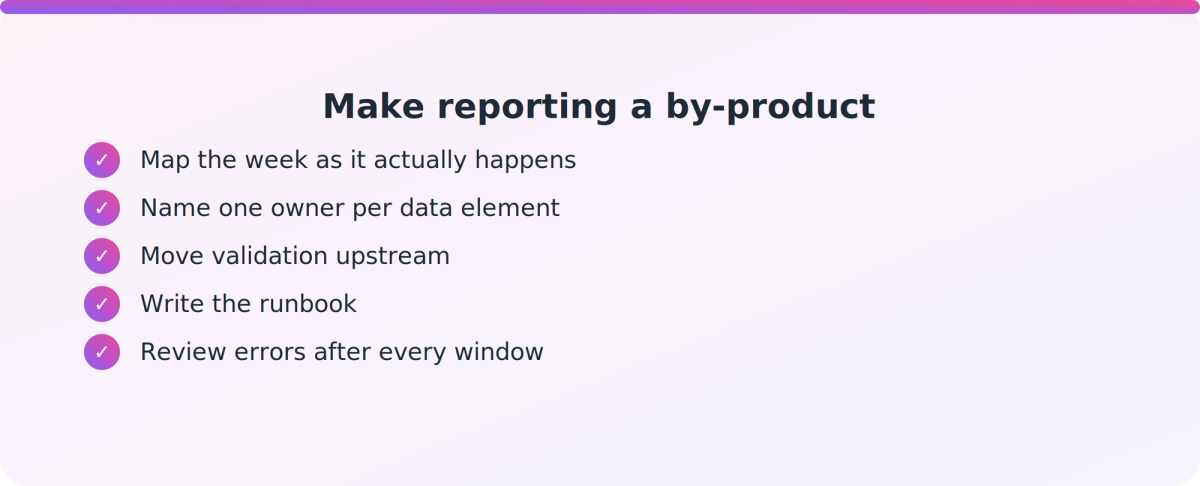
- Map the week as it actually happens. List every extract, spreadsheet, manual fix and hand-off between the extract date and the close of the window. Most teams discover steps that exist only because one person remembers them.
- Name one owner for each data element. Enrolment dates, course codes, completions and withdrawals each need a person accountable at the point of entry, not at the point of reporting.
- Move validation upstream. Run a monthly internal check against the same kinds of errors first-pass validation catches, so the window is a confirmation, not a discovery.
- Write the runbook. Document the steps so the process survives leave, resignation and restructure. Process knowledge trapped in individuals' heads is a risk you can retire.
- Review after every window. Log the errors found and where they originated. Fix the cause, not the record.
An illustrative example: a PTE finds that most of its corrections each round trace back to withdrawals recorded late by delivery staff. Reporting staff clean these up in the window every time. The fix isn't a faster clean-up. It is a withdrawal step in the daily workflow with a clear owner, which makes the correction unnecessary.
The same logic applies to the board and funding conversations. If you are working on cadence, our piece on board-ready PTE reporting covers the downstream side, and the TEC reporting process as a funding risk covers the upstream side.
Why self-review raises the stakes
NZQA's Private Training Establishment Rules 2026, re-issued 19 January 2026, replace the PTE Registration Rules 2025 and the PTE Enrolment and Academic Records Rules 2022. They remove the annual fee and remove EER in favour of self-review and monitoring.
Secondary sources such as Technical Institute describe an annual self-review discussed with NZQA, and say new EERs stopped from 1 January 2026. Treat those specifics as reported, and confirm them with NZQA.
The operational implication is safe either way. Credible, ongoing evidence has to come out of your systems, not out of a one-off scramble before a review. The same clean, owned data that makes your SDR painless also makes your self-review defensible.
The restructure adds uncertainty. From 1 January 2026, most Te Pūkenga programmes, functions, assets and staff transferred to regional polytechnics. Work-based learning moved to Industry Skills Boards for up to two years before transitioning to PTEs, polytechnics and wānanga, per the Ministry of Education and TEC's FAQs. New reporting streams are a possibility, not a confirmed outcome, but a documented process is far easier to extend than a tacit one.
Where the reclaimed hours should go
The hours you win back from rework and manual compilation will disappear into firefighting unless you assign them first. Decide in advance where they go.
The best candidate is capability. Your admin and delivery teams are the ones who create data quality at the point of entry. Time spent on realistic practice, for example working through tricky enrolment and withdrawal scenarios with a coach or peer, builds the habits that stop errors reaching you. It also makes the team less dependent on the two people who know how everything works.
The second is the improvement backlog you keep deferring: system integrations, duplicate data entry, handover documentation.
Our take
Most reporting-week pain is self-inflicted, and that is good news. TEC's calendar and validation rules are fixed, but the data quality feeding them is entirely yours to shape.
We think operations leaders should stop measuring reporting by whether the return went in on time. Measure it by how little heroics it needed. A return that lands on day one of the window with no correction loop is a sign of a healthy operation. A return that lands on the last afternoon after a week of effort is a warning, even if it was accepted.
FAQ
When are the TEC SDR and IND windows?
TEC's published dates show the March IND running 1–6 March, the April SDR 16–29 April, the August SDR 8–21 August, and the December SDR 1–31 January the following year. Check TEC's submission dates page each year for confirmation.
Does moving to DXP Ngā Kete remove the need for data clean-up?
No. It changes the submission method to CSV upload, with an optional API that vendors may implement. Uploads still go through first-pass validation, and errors must be corrected and re-uploaded before full validation runs.
Does my student management system support the SDR API?
TEC does not publicly state this. TEC says the API is an alternative that vendors may implement, so ask your SMS vendor directly.
How do NZQA's PTE Rules 2026 affect reporting?
The rules remove EER in favour of self-review and monitoring. That puts more weight on continuous, credible evidence from your own systems. Confirm specifics such as the self-review cycle with NZQA.
One thing to do this month
Before the next window, sit down with your reporting lead and list every correction made during the last round, with where each error originated. Pick the top one and give it an owner at the point of entry. If one fix cuts the next window's rework, you'll know where to look next.