Yes, an Australian RTO can use AI to draft assessment tools, provided the AI is an assistant inside a documented process. ASQA's AI guidance adds no new requirements. Qualified staff must still review and tailor every draft before use (Standard 1.3), and independent, appropriately credentialed validators must still validate it (Standard 1.5).
Key takeaways
- AI drafting is allowed in practice, but it never replaces pre-use review (Standard 1.3) or validation (Standard 1.5).
- Staff remain responsible for whether AI-supported outputs are appropriate, accurate and relevant.
- Judge tools on traceable mapping, contextualisation, version history and data handling, not on how fast they produce a draft.
- No independent certification of AI assessment-writing tools exists, so test any vendor on your own units.
- Keep drafting and validation separate: validators must hold the required credentials and not be the people who built the tool.
What do ASQA and the 2025 Standards actually say about AI?
ASQA treats its five Principles for the Responsible Use of AI in VET as a way to interpret existing obligations, not as new rules. Principle 1 calls for governance so that AI does not undermine the quality or integrity of VET. ASQA also asks who will make sure AI outputs are reviewed, tailored and verified before they are used in training or assessment.
The 2025 Standards for RTOs commenced on 1 July 2025 and replaced the 2015 Standards, according to Knowledge Foundry. That is a secondary source, so check the primary instruments on the Federal Register of Legislation.
Two secondary sources, CAQA and SKG Consulting, say ASQA's 2026 sector workshops stated that AI cannot make assessment decisions or complete validation. We could not find that on an ASQA page, so confirm it with ASQA directly. It is consistent with the existing Standards either way.
What does a validation-ready workflow look like?
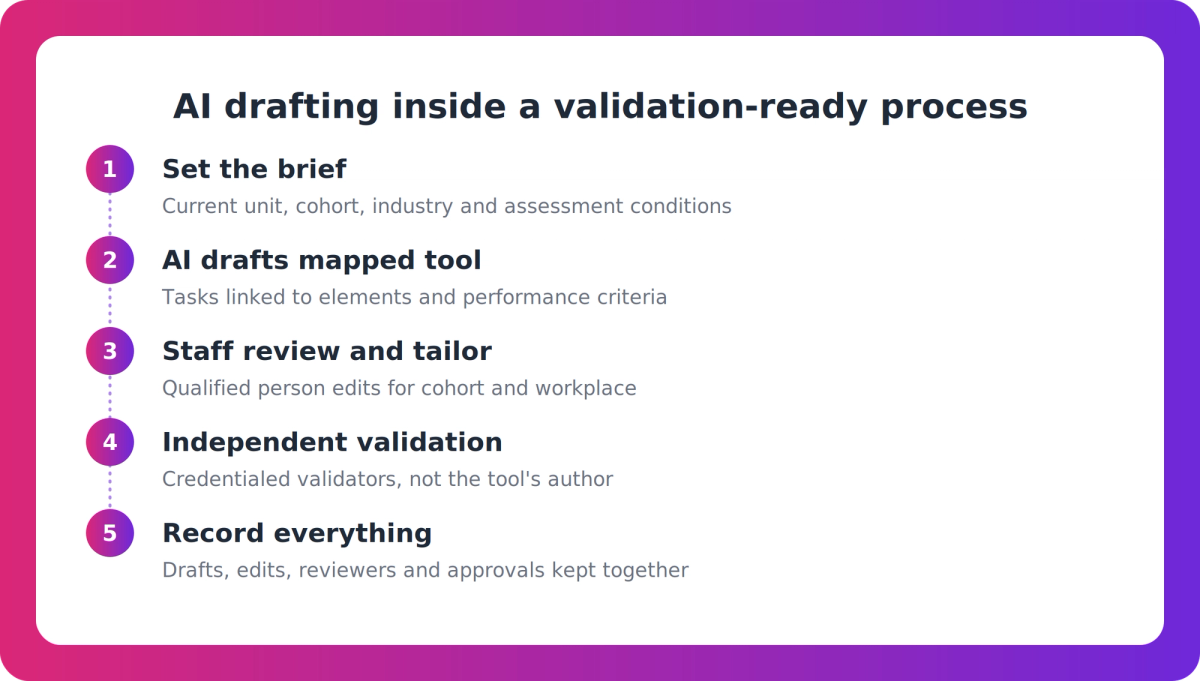
A validation-ready workflow keeps AI at the drafting step and puts named, qualified people on every step after it. The ASQA brief does not prescribe these exact steps. This is our practical reading of Standards 1.3 and 1.5 and ASQA's expectations.
- Set the brief. Choose the unit of competency from the current training package and define the cohort, industry context and assessment conditions.
- Generate a mapped draft. Each task should link to the unit's elements, performance criteria and evidence requirements.
- Review and tailor. A qualified staff member checks the draft against the cohort and workplace expectations, then edits it. ASQA's Assessment Practice Guide lists tools not contextualised to the student cohort as a known risk.
- Run the pre-use review. CAQA describes this under Standard 1.3 as confirming validity, reliability and alignment with the Principles of Assessment (fairness, flexibility, validity, reliability) and the Rules of Evidence (validity, sufficiency, authenticity, currency).
- Validate independently. Under Standard 1.5, as reproduced by Skills Education, validation is carried out by people who collectively hold the credential specified in the Credential Policy. The outcome is not solely determined by someone who designed or delivered the training or assessment.
- Record it. Keep the AI draft, the edits, the reviewers and the approvals together. ASQA does not state this as a requirement. It is our inference from audit expectations, and it makes the process easy to evidence.
An illustrative trial on your own unit
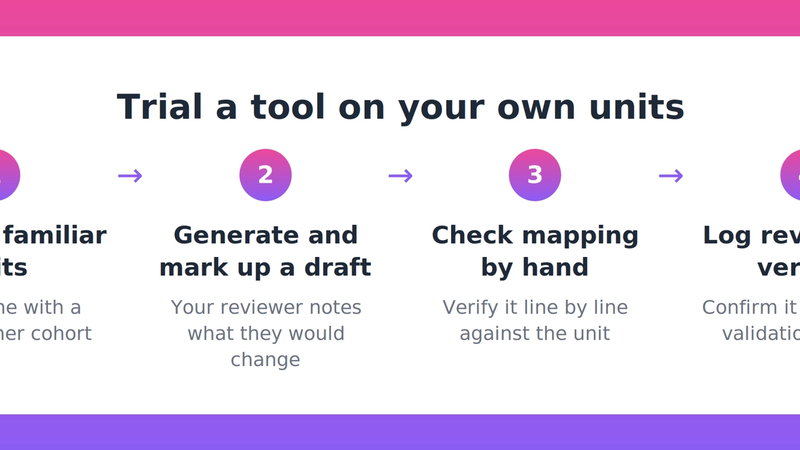
This is a hypothetical example, not a customer result. Pick one unit your RTO already delivers and has a validated tool for. Have the vendor draft a tool, then ask a trainer to find the gaps: unmapped criteria, generic scenarios, missing workplace conditions. Compare the effort to fix the draft with the effort of starting from scratch. That tells you more than any demo.
Does AI drafting replace pre-use review or validation?
No. An AI draft is an input to pre-use review, not a substitute for it, and it cannot stand in for validation. The Standards still require people with the right credentials, independent of the tool's author, to validate. A secondary source says the five-year maximum validation cycle remains but is now risk-based.
The ASQA guide also flags a related risk: not reviewing mandated tools for licensed outcomes. If a unit has a mandated assessment tool, AI drafting is not the place to improvise.
What should you look for in an AI assessment tool writing product?
Use these criteria to compare options consistently:
- Human review step: does it support documented review, tailoring and verification by qualified staff before use?
- Traceable mapping: does each task link to elements, performance criteria and evidence requirements?
- Contextualisation: can you adapt output to your cohort, industry and assessment conditions, including real workplace expectations?
- Validation kept separate: does your process keep validators independent of whoever authored the tool?
- Record keeping: is there version history of drafts, edits, reviewers and approvals?
- Data handling and privacy: where is data stored, is your content used to train models, and how are privacy obligations met? The RTO remains responsible for due diligence and lawful, secure use.
- Format and currency: does it work from current training packages and export to editable formats your team can finalise?
- Evidence quality: can you verify the vendor's claims, or are they only vendor-authored?
Speed of generation is deliberately absent from this list. A fast draft that needs a full rebuild saves nothing.
How do you tell vendor claims from independent evidence?
There is currently no publicly available independent certification, benchmark or ASQA endorsement scheme for AI assessment-writing tools. Public comparisons, such as Cloud Assess's list of AI assessment tools, are written by vendors. Read them as marketing, including ours.
So the RTO has to evaluate outputs against the Standards itself. Ask for a trial against your own units, have your trainers and a validator pick it apart, and ask the vendor to show where your data lives and whether it trains models.
Where does VETos fit?
VETos is Supahuman's product for RTOs. According to its site, it drafts assessment tools, assessor guides, learner guides and mapping for units on an RTO's scope, so trainers start from a mapped draft rather than a blank page. Listed features include checking each tool for gaps before it goes to validation, exporting to editable Word and InDesign (.idml), and drafting to TPOF 2025 (ASK format). The site describes its model as AI building and reviewing, with people deciding anything the AI is unsure about, and staff reviewing and signing off.
These are vendor statements, so test them on your own units. The site does not publish a step-by-step validation workflow or quantified customer results. Nova 5, Supahuman's other product, is for learner practice and coaching. It does not author assessment tools, and its legal documents say competency and assessment decisions stay with the customer's qualified assessors.
Our take
The real risk with AI drafting is not a bad draft, because trainers have always fixed bad drafts. It is a good-looking draft that skips the thinking: nobody contextualises it, and the review becomes a rubber stamp. Buy for the process around the draft, meaning mapping you can trace, edits you can show and a clean line between author and validator. If a tool makes that line blurrier, it is the wrong tool, however quick it is.
FAQ
Can an RTO use AI to draft assessment tools and still meet the Standards for RTOs 2025?
Yes, as long as qualified staff review, tailor and verify every draft before use, and independent, appropriately credentialed validators still validate it. ASQA's AI guidance introduces no new requirements, and staff remain responsible for the accuracy and relevance of AI-supported outcomes.
Who must review and validate an AI-drafted assessment tool?
Qualified staff carry out the pre-use review and contextualisation (Standard 1.3). Validation under Standard 1.5 is done by people who collectively hold the credential specified in the Credential Policy, and the outcome is not solely determined by someone who designed or delivered the assessment.
How can I tell vendor claims from independent evidence?
There is no independent certification or ASQA endorsement of AI assessment-writing tools, and public comparisons are vendor-authored. Run a trial against your own units, with a trainer and a validator checking mapping, contextualisation and data handling.
Does AI drafting replace the pre-use review or validation of assessment tools?
No. AI drafting feeds the pre-use review and cannot replace it or validation. Both still require accountable, qualified people.
Next step
Before speaking to any vendor, write down your review and validation workflow and the roles in it. Then test one or two tools against a unit you already know well. If you would like to see how VETos handles that on your own unit, you can book a demo.