Standards for RTOs 2025: A COO's Case for Treating Practice Hours as an Operational Asset
Under the Standards for RTOs 2025, practice hours stop being a trainer's private business and become an operations question. Can you show, on demand, how placement, simulated practice and assessor-observed practice are scheduled, delivered and evidenced? If the answer lives in spreadsheets and individual memory, RTO operations scaling trainer capacity will always mean adding headcount.
Key takeaways
- The 2025 Standards ask how training and assessment work in practice, so practice arrangements are an operational record, not just a delivery detail.
- No specific "practice hours" rule could be verified beyond the Standards' general wording. Check the Outcome Standards instrument and each training package before you design anything.
- Treat practice like capacity: schedule it, track it, evidence it and connect it to the data you report.
- Short courses and stand-alone subjects are growing, so manual coordination per student is the cost that scales fastest.
Why this lands on your desk
You don't write the assessment tools, but you own the systems and people that must produce the evidence. ASQA says the 2025 Standards focus on the quality of outcomes for students and employers, with more regulatory engagement and more flexibility in how providers demonstrate compliance. Flexibility cuts both ways. It means you decide how to prove it, and you carry the consequences if the proof is thin.
Secondhand notes from ASQA's March 2026 workshop say the regulator looks for evidence of active implementation. That is not an ASQA publication, so treat it as colour rather than rule. It is still a useful test: if ASQA asked how placement works in your RTO, would you hand over a process or a person?
Third-party summaries also list student work placement among ASQA's 2025–26 risk priorities. One summary of the 2026–27 themes includes the quality, sufficiency and fitness-for-purpose of training delivery. Verify both against ASQA's own pages. Either way, they land on whoever is accountable for delivery capacity and the records behind it.
What the Standards say, and what we can't confirm
Be careful here, because this is where RTOs over-claim. ASQA-regulated RTOs are assessed against the Outcome Standards Instrument 2025 and the Compliance Standards Instrument 2025. The Outcome Standards cover training and assessment, VET student support, VET workforce and governance.
We could not verify a standalone practice-hours requirement from a primary source. Third-party summaries say training should be structured and paced to support progress, with work-integrated learning or placements where necessary. They also say that where a product requires work placement, the RTO must show the necessary skills and knowledge can be attained in that environment.
So read the clause wording in the Outcome Standards instrument on the Federal Register. The requirement for each unit of competency comes from its training package and training product, not from a general rule of thumb.
Treat practice like capacity
You already plan classroom seats, assessor loads and campus rooms. Practice is the same kind of asset, with a supply side (host employers, simulated environments, supervisors, assessors) and a demand side (learners who need it, by when). The difference is that it is usually managed in the least structured part of the business.
ASQA's Practice Guides are not prescriptive. They offer example actions, known risks to quality outcomes and self-assurance questions. Borrow those questions and turn them on your own operation: is this evidenced, and is it repeatable, or merely assumed?
What a practice ledger needs to hold
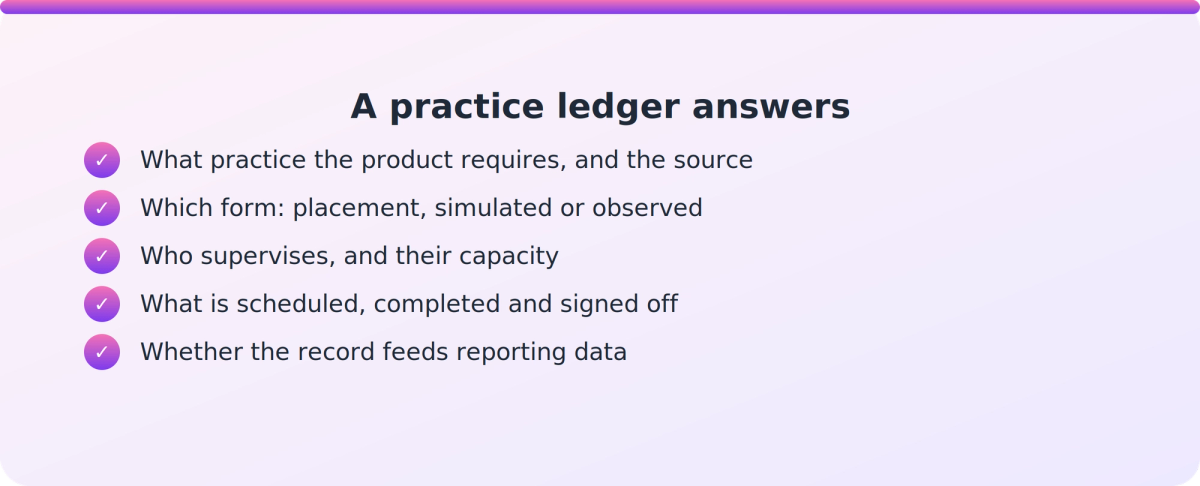
Whatever tool you use, the record should answer the same few questions for every learner and every unit that involves practice:
- What practice does this training product require, and where is that sourced (training package, unit of competency, internal design)?
- Which form is it: supervised placement, simulated practice or assessor-observed practice?
- Who is the supervisor or assessor, and what is their current capacity?
- What has been scheduled, completed and signed off, and where is the evidence?
- Does the same record feed enrolment, progress and reporting data, or is it re-keyed?
Why volume makes this urgent
NCVER reports more than 5.1 million students in nationally recognised VET in 2025, with qualification enrolments down 108,360 and short courses and stand-alone subjects up. The headline looks calm. The operational reality is more transactions per student: more enrolments, more starts, more finishes, more records.
Coordinating practice by hand works at one cohort a term. It breaks when it multiplies, and it breaks quietly, because the person who holds it all in their head is the person who is also delivering.
Reporting adds a second squeeze. ASQA states that reporting is transitioning from AVETMISS to the VET Information Standard under the VET Data Streamlining Program. The cut-over date wasn't confirmed in the research, and all RTOs must still report Total VET activity to NCVER at least annually. Delivery and practice data that sit outside your core systems become reconciliation work, and that is where reporting cycles lose their weeks.
An illustrative example
Imagine, hypothetically, an RTO whose placement coordination lives in one coordinator's inbox and a shared spreadsheet. A new short-course intake doubles the starts. The coordinator becomes the bottleneck, trainers book their own arrangements differently, and nobody can say how many learners are waiting for a host.
The fix isn't heroic. Write down the required practice per product, record it in one place, and make the supervisor's capacity visible. Then the question "do we need another coordinator?" becomes a number rather than a feeling.
Our take
Most RTOs frame practice as a quality issue and leave it with trainers. We think that undersells it. Practice is where your cost, your compliance exposure and your learner outcomes meet, and only operations can see all three at once.
The case for managing it as an asset isn't that ASQA has published a practice-hours rule. It hasn't, as far as we could verify. The case is that a regulator asking how your Standards work in practice will find it much easier to be satisfied by a repeatable process than by a good person's memory. If you want a broader view of why every document lands on the operations desk, we explored it in RTO compliance ownership under the 2025 Standards.
FAQ
Do the Standards for RTOs 2025 set a specific number of practice hours?
We could not verify a specific practice-hours rule beyond the Standards' general wording. Requirements for each unit of competency come from the relevant training package and training product. Check the Outcome Standards instrument on the Federal Register for exact clause wording.
What would ASQA want to see about placement or practice?
Third-party summaries say that where a product requires work placement, the RTO must show the necessary skills and knowledge can be attained in that environment. Secondhand workshop notes say ASQA looks for evidence of active implementation. Neither is an ASQA publication, so verify against ASQA's own material.
How should a COO use ASQA's Practice Guides?
Treat them as prompts, not a checklist. They are not prescriptive, and they include example actions, known risks and self-assurance questions. Use those questions to test whether your practice arrangements are evidenced and repeatable.
Why does this matter more as enrolments shift to short courses?
NCVER shows qualification enrolments down 108,360 in 2025 while short courses and stand-alone subjects grew. That means more transactions per student. Manual coordination scales with headcount, so structured practice records matter more as volume rises.
A first step for this quarter
Pick one training product with a practice component and trace a single learner from enrolment to sign-off. Note every handoff, every re-keyed detail and every point where the answer depends on one person. That map is your capacity plan, your evidence gap and your reporting risk in one page.