RTO Cost Per Student Under the Standards for RTOs 2025: Where Margin Really Goes
Nobody publishes a benchmark for RTO cost per student under the Standards for RTOs 2025, so you are steering margin without a reference point. The costs that matter most are evidence, rework, trainer turnover and practice delivery. They rarely have their own line in the P&L. Build your own view first.
Key takeaways
- The research found no regulator, NCVER or government benchmark for RTO cost per student or operating margin under the 2025 Standards. Your own data is the only reference you have.
- Outcome-focused regulation and more regulatory engagement shift cost into evidence, self-assurance and rework. Few management reports show these.
- Trainer supply is a direct margin lever. Attrition, replacement and casualisation are real costs, even when they sit inside general wages.
- A single average cost per student can mislead while the mix moves from qualifications to short courses.
- An unusually low cost per student can read as a risk signal to a regulator, not just a good result.
Why this lands on your desk
You answer to the board for margin and for regulatory standing. Those two numbers are now linked in a way the old reporting never captured.
The Standards for RTOs 2025 commenced on 1 July 2025. ASQA says they focus on the quality of outcomes for students and employers, give providers more flexibility, and that providers should expect more regulatory engagement. Flexibility sounds like a cost saver. In practice it means you carry more of the burden of showing that your own approach produces outcomes.
That has a price. It is paid in staff hours, system capacity and rework, and most management accounts spread it across overheads where nobody sees it.
Cost per student is also a measure of how cheaply you can prove outcomes
The usual definition is delivery cost divided by enrolments. Under outcome-focused regulation it needs a second reading: what does it cost to produce credible evidence that a student can do the job?
ASQA's Practice Guides include compliant-activity examples, risks to avoid, self-assurance questions and case studies. They are useful. They also raise a question for you: what does it cost, in hours and systems, to run self-assurance routinely rather than in a scramble before an audit?
If you cannot answer that, you do not know your real cost per student.
Be careful with audit statistics
Published audit-outcome figures are secondary claims, and they conflict. One consultancy reports non-compliance in 78% of performance assessments in 2024-25 and 39% (45 of 116) from July 2025 to March 2026, and cautions the two are not directly comparable. Another reports 89 reviews with a 62% compliance rate.
I would not put either in a board paper. Check ASQA's own data before you size the cost of rework. The gap between the figures is the useful signal: nobody outside your RTO can tell you your rework rate.
Where margin leaks that your P&L doesn't show
Trainer attrition and replacement
Jobs and Skills Australia reports not enough VET teachers, an older and highly casualised workforce, and lower pay than other education sectors. Skills Insight reports severe workforce shortages for regional, rural and remote providers, with much higher delivery costs.
Every trainer who leaves takes recruitment time, induction, vacancy cover and sometimes a delayed intake with them. That is also key-person risk: when one trainer holds the industry relationships or the assessment know-how, their exit is a cost event. It rarely gets coded as one.
Practice and placement
Secondary sources list ASQA risk priorities such as shortened course durations, weak or absent placements, rubber-stamp recognition and compromised assessment integrity (see Skiltrak, a secondary source). Each one maps to a cost decision: course hours, placement arrangements, assessment resourcing.
The uncomfortable conclusion is that cutting cost per student in these areas can create the very pattern a regulator looks for. A low number is not automatically a good one.
Mix shift
NCVER shows total VET participation above 5.1 million students in 2025. Qualification students fell by 108,360 while short-course and stand-alone subject students rose. Short-course growth was seen in both fee-for-service markets, while government-funded training declined.
If your cost base was built for full qualifications, a blended average hides what is happening. A short course may carry less trainer time but similar evidence, enrolment and compliance overhead per head.
How to build your own cost-per-student view this quarter
You do not need a benchmark. You need a consistent internal baseline you can track over time.
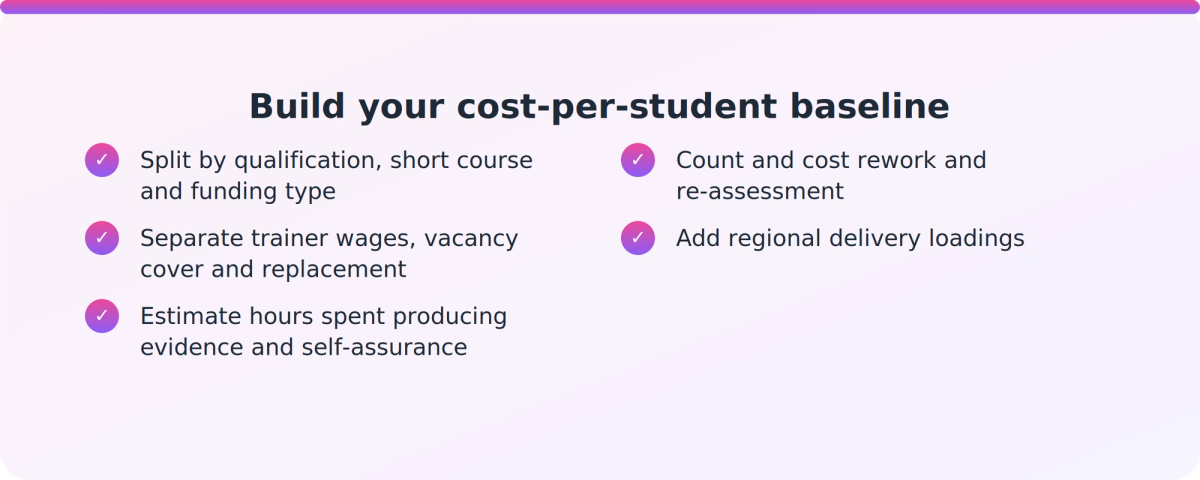
- Split by product. Report qualifications, short courses and stand-alone subjects separately, and by funding type.
- Pull trainer cost apart. Show base wages, casual loading, vacancy cover, recruitment and induction, so attrition becomes visible.
- Estimate evidence cost. Ask your compliance and training leads for the hours spent on assessment validation, evidence review, self-assurance and audit preparation.
- Track rework. Count re-assessments, re-marked evidence and corrections after internal review, and put hours against them.
- Add regional or delivery-mode loadings where you deliver outside metro areas.
The numbers will be rough at first. A rough, consistent view beats a precise one nobody trusts.
Technology that changes delivery cost needs evidence of review
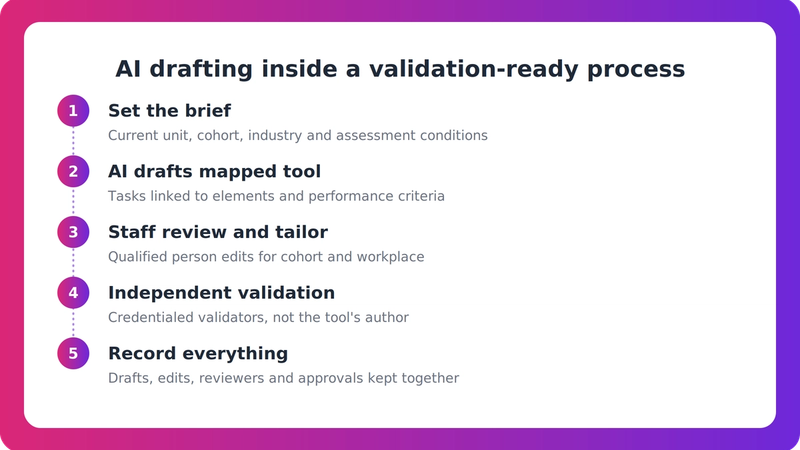
If you are considering AI or other technology to lower delivery or practice costs, treat the evidence trail as part of the cost. ASQA hosts an AI use in VET section with case studies. Its Assessment Practice Guide says RTOs can show how they reviewed assessment tools, for example confirming that AI in assessments aligns to actual workplace expectations and doesn't compromise skill demonstration.
A saving that arrives without that review is a deferred cost.
Our take
Most RTOs will treat the 2025 Standards as a compliance project. The better frame is a unit-economics project. Outcome-focused regulation makes credible evidence a product you manufacture for every student, and manufacturing has a cost.
The CEOs who protect margin will not be the ones who cut the lowest. They will be the ones who can show the board, and ASQA, why their cost per student is what it is. With no external benchmark, that explanation is your competitive position.
FAQ
Is there an official benchmark for RTO cost per student?
The research found no authoritative public benchmark for RTO cost per student, compliance cost per student or operating margin under the Standards for RTOs 2025. Any figure you quote has to come from your own data.
How do the 2025 Standards affect RTO costs?
The Standards commenced on 1 July 2025 and focus on the quality of outcomes. ASQA also signals more regulatory engagement. That puts more weight on how you evidence outcomes and run self-assurance, which carry staff-hour and system costs.
Can a lower cost per student be a risk?
Yes. Secondary sources list shortened course durations, weak placements and compromised assessment integrity as regulatory risk areas. Each links to a cost decision, so cost-cutting there can attract attention rather than avoid it.
Should I quote published ASQA audit statistics to my board?
Not without verifying them. Published figures from consultancies conflict, and one explicitly cautions that its two datasets are not directly comparable. Confirm against ASQA's own data first.
Next step
This week, ask your compliance lead and head of training one question: how many hours did we spend last quarter producing and fixing assessment evidence? Whatever the answer, write it down. It is the first line of a cost-per-student view you can defend.