TPOF 2025 brings the ASK unit format to training.gov.au. The units your RTO built assessments against will be reissued with no elements-and-performance-criteria grid. Your mapping matrices were built on that grid, so they can't simply carry over. The real planning question is which tools you rebuild, which you upgrade and which you re-map.
Key takeaways
- ASK replaces elements, performance criteria and (in most units) a separate knowledge evidence table with one integrated statement of the skills and knowledge for a task.
- Old mapping matrices won't survive the change. Coverage has to be re-demonstrated against the ASK statements and the unit's assessment requirements.
- Most RTOs will run traditional and ASK units side by side, so you need a unit-by-unit plan rather than one big rebuild.
- Training materials are the quiet risk. They can keep teaching to gaps or duplications the new statement has already closed.
- Whatever you use to speed this up, a qualified assessor still validates and signs off every tool before it meets a learner.
What actually changes when a unit moves to the ASK format?
The structure changes, and so does the way you prove coverage. In the traditional template, you map assessment tasks to elements, performance criteria and a knowledge evidence table. In an ASK unit, one integrated statement describes the skills and knowledge a learner applies in a task.
Per VETos's own TPOF 2025 guidance, the new format sits alongside the traditional template. It doesn't replace it overnight. Your scope will hold both kinds of unit for a while, and each one needs its own handling.
That guidance frames the shift as a workload and compliance event, not a cosmetic update. We agree. Nothing about your tools breaks on the day a unit is reissued, but the evidence that they cover the unit stops lining up with the unit.
Why can't you just retrofit your old mapping matrix?
Because there's nothing left to map against. A traditional matrix is a grid: tasks down one side, elements and performance criteria across the other. Take the grid away and the matrix has no columns.
The VETos assessment mapping page makes the same point: an old matrix doesn't survive a format change. Coverage has to be shown again against the ASK statements and the unit's assessment requirements.
There's a second problem, and it's easy to miss. If your learning materials were written to the old performance criteria, they may now teach to gaps or duplications that the integrated statement has closed. Learners get content that doesn't quite match what they'll be assessed on. That's a learner experience problem before it's an audit problem.
Rebuild, upgrade or re-map: a triage for each converted unit
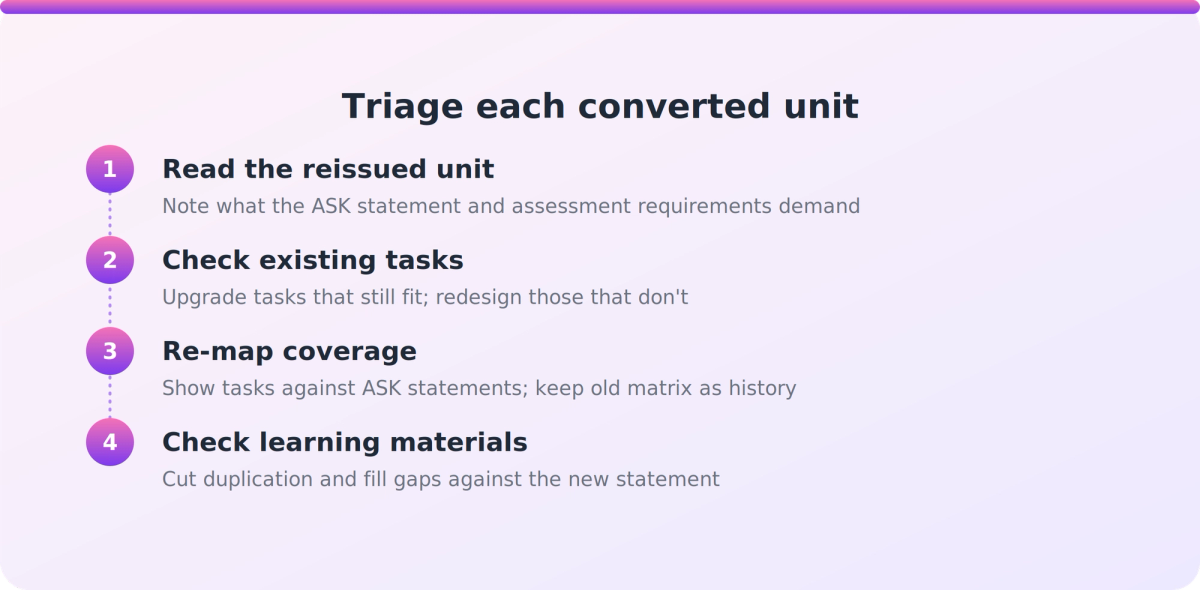
You don't need to treat every unit the same way. For each converted unit, work through the same four questions in order.
- Read the reissued unit. What does the ASK statement actually require, and what do the assessment requirements say about conditions and evidence?
- Check the tasks. Do your existing assessment tasks still ask learners to do what the statement describes? If yes, they're upgrade candidates. If the tasks are built around criteria that no longer exist, they may need a fresh design.
- Re-map. Show which task covers which part of the ASK statement and the assessment requirements. Keep the superseded matrix as history, not as current evidence.
- Check the materials. Compare study guides and learner resources against the new statement. Cut what's duplicated and fill what's missing.
Units you rarely deliver can wait. Units with high enrolments, or those that sit in several qualifications, are the ones to triage first.
Where does software fit in?
Software helps with the repetitive parts: drafting, re-mapping and keeping a record. It doesn't replace the judgement. Here's what VETos says it does for this change, drawn from its FAQ and mapping page:
- Drafts to either format. Assessment and training content is written to whichever format the unit uses, traditional or ASK.
- Upgrades existing tools as units convert. Tools are re-mapped to the new structure with the version trail intact, so you aren't starting from a blank page every time.
- Generates the matrix from live training.gov.au data. For ASK units, tasks map to the application-of-skills-and-knowledge statements and the unit's assessment requirements.
- Updates the mapping when a task is adapted. The matrix can be exported for pre-use validation, with version history kept as the evidence trail.
- Flags superseded units. It holds your scope from training.gov.au, keeps each assessment linked to it, and flags a unit when it changes.
One honest caveat. These are product claims. The sites don't publish customer case studies or measured results for ASK conversions, so treat any speed claim as something to test on one of your own units before you plan around it.
Who signs off the upgraded tool?
Your assessor does. A qualified assessor still validates each assessment tool against the Principles of Assessment and the Rules of Evidence before it's used with learners. That doesn't change with the format.
What can change is what the validator sees. VETos says every assessment bundle ships with an Assessment Design Reasoning Report, and it offers AI-assisted validation flagging. Used well, that gives a validator the design logic up front rather than leaving them to reverse-engineer it. It supports the human check. It doesn't stand in for it.
This matters under the Standards for RTOs 2025 too. If ASQA asks how you know a tool covers a reissued unit, a dated matrix with a version trail and a recorded validation is a far better answer than a spreadsheet nobody can explain.
Our take
The format change is the smaller half of the job. The bigger half is deciding, unit by unit, whether your existing tools were good in the first place. A conversion is a rare, forced moment to retire tasks that only existed because a performance criterion needed ticking.
We'd push RTOs to resist two temptations: rebuilding everything because it feels safe, and relabelling old matrices because it feels fast. Neither shows that a learner is assessed on what the unit now says. Start with your highest-volume units, and get the evidence trail right on those before you scale.
FAQ
What is the ASK unit format?
ASK stands for application of skills and knowledge. It replaces elements, performance criteria and, in most units, a separate knowledge evidence table with one integrated statement of the skills and knowledge needed for a task. It sits alongside the traditional template on training.gov.au.
Will my existing assessment mapping matrices still work for ASK units?
No, not as they stand. A traditional matrix maps to elements and performance criteria, and ASK units don't have that grid. You need to re-demonstrate coverage against the ASK statements and the unit's assessment requirements.
Do I have to rebuild every assessment tool from scratch?
Not necessarily. For each converted unit, check whether your tasks still ask learners to do what the integrated statement describes. Tasks that do can be upgraded and re-mapped. Tasks built around criteria that no longer exist may need redesigning.
Does AI remove the need for assessor validation?
No. A qualified assessor still validates and signs off each tool against the Principles of Assessment and the Rules of Evidence before it's used with learners. AI-assisted flagging and a design reasoning report can inform that review, but they don't replace it.
Next step
Pick one high-volume unit that's due to be reissued. Put its current matrix beside the new unit page on training.gov.au and note what no longer lines up. That single comparison will tell you more about your rebuild-or-upgrade workload than any estimate. For a deeper walk-through, see the TPOF 2025 ASK unit format guide.