Your content library isn't ageing because you built it badly. It's ageing because it was funded as a project and is regulated as a process. The 2025 Standards for RTOs and a crowded training package reform pipeline both assume continuous maintenance, so the useful design question is what makes upkeep cheap.
Key takeaways
- Instructional design technical debt in an RTO is a maintenance-model problem. Faster one-off rebuilds only reset the clock.
- ASQA's Assessment Practice Guide expects assessment tools to be reviewed before use and expects you to act on validation findings. That makes upkeep compliance work, not polish.
- Training package reform is running through many Jobs and Skills Councils at once, so the gap between what you built and what is current keeps reopening.
- Libraries that separate stable design from volatile detail, and keep a visible trail of review decisions, are cheaper to keep current.
Why this lands on your desk
You own the triage call: rebuild, patch or retire. That list gets longer whenever a package moves, and you answer for quality and compliance at the same time.
The pressure is not only volume. Content built for one version of a unit can be stranded when the package changes, yet you're still expected to show it fits the outcome. The 2025 Standards came into effect on 1 July 2025, and ASQA describes them as outcome-focused, with a focus on quality outcomes for students and employers. Evidence of fit now counts for more than the volume of material produced.
What ASQA's guidance already expects you to maintain
The Assessment Practice Guide gives the regulatory basis. Its Standard 1.3 examples cover reviewing assessment tools before use and demonstrating the validity, sufficiency and authenticity of judgements. They also expect the provider to show it acts when validation identifies problems.
Read that as a designer. Review before use, and action after validation, are recurring activities. If your library only gets attention when someone panics, the pattern doesn't match what ASQA's own guidance describes.
ASQA also says the 2025 Standards give providers more flexibility and support innovation in delivery. The trade-off is that you need to explain how your design decisions meet the outcomes, not just show that materials exist.
Why the currency gap keeps reopening
The pressure is structural. The National Skills Plan 2025–26 update says the updated Training Package Organising Framework took effect from 1 July 2025, with Jobs and Skills Councils leading phased implementation. The Future Skills Organisation's quarterly updates show many packages under concurrent review or demonstration, including ICT, Aviation, Police and Manufacturing.
I can't tell you how often units change. No authoritative source I found quantifies it, so treat any confident figure with suspicion. What the pipeline does show is that change is routine and arrives in parallel.
New areas arrive too. The October 2025 update lists a project to update the BSB training package with new digital capability units, including standalone generalist generative AI and cyber security products. That means designing from a blank page where your library has nothing.
There's a deeper design signal as well. The Qualification Reform Design Group's final report (December 2024) moves away from the one-size-fits-all approach used for roughly 30 years. A sector summary from VDC quotes its concern that over-prescribed assessment and delivery requirements produce a compliance approach to learning. If your content is built to tick off coverage, it's the content most exposed when the unit changes.
Design choices that make a library cheaper to keep current
These are my suggestions, not ASQA requirements. They follow from the maintenance model above.
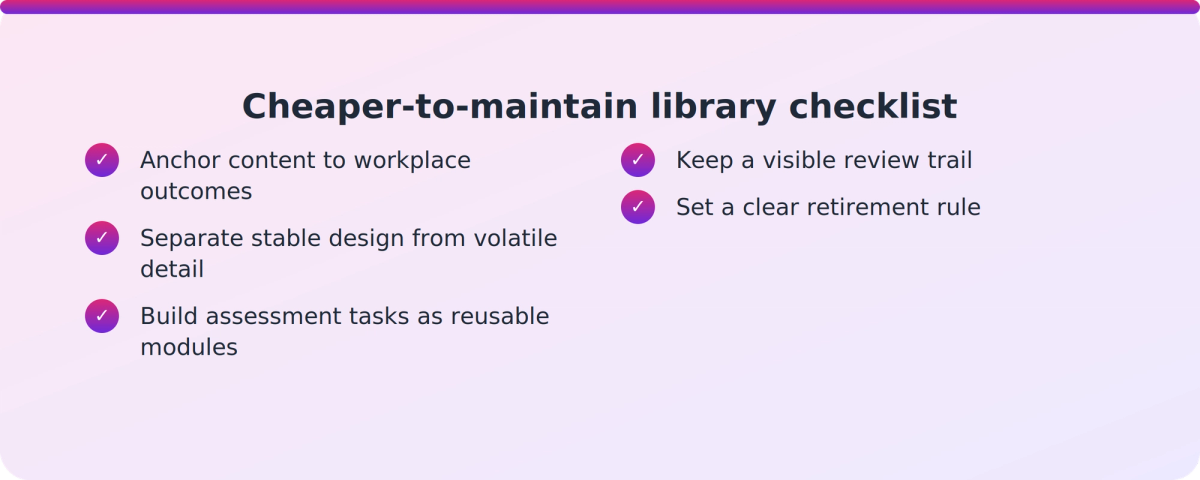
- Anchor to the outcome, not the unit wording. Design around the workplace performance a learner must show. Reference unit codes and versions in one mapping layer rather than throughout the content.
- Separate stable from volatile. Core scenarios and practice tasks change slowly. Regulatory references, tools and terminology change often. Keep them in different places so a patch doesn't mean a rebuild.
- Build assessment tasks as modules. One task that serves several units is cheaper to validate once than five near-duplicates are to validate five times.
- Keep a review trail. Record when a tool was reviewed before use, what validation found, and what you changed. This is the evidence that you act on findings.
- Set a retirement rule. Decide up front what triggers a retirement, so low-value content doesn't quietly consume review time.
An illustrative example
Imagine a library with one long case study copied into six assessment tasks, each with the legislation and unit code written into the text. When the package updates, six documents need editing and re-reviewing. If the case study is one source asset and the references sit in a mapping layer, you update the mapping, review one asset and record one decision. The second design isn't smarter. It just assumes change is coming.
What about AI in your design decisions?
You're probably being asked how to handle it. The Assessment Practice Guide includes a case study where a provider chose a structured, AI-informed assessment model over prohibiting AI. It used staged evidence collection and an AI use declaration documenting prompts and outputs.
The design lesson is that task and evidence structure carry more weight than a ban. Reports of ASQA's more recent statements on AI come from secondary sources, so check them against ASQA directly before you build policy on them.
Our take
Most RTO design teams are measured on delivery, then asked to fund upkeep from whatever is left. That's the debt generator. Maintenance needs a standing allocation and an owner, in the same way validation does.
We also think "rebuild faster" is the wrong ambition. A library designed to be reviewed and patched will beat one that can be regenerated quickly but can't show why it changed. The context matters: the JSA VET Workforce Study describes an older, highly casualised workforce. That's context, not proof of a design-capacity gap, but it's a reason not to depend on heroic effort.
FAQ
Is content maintenance really a compliance obligation?
In effect, yes. ASQA's Assessment Practice Guide expects assessment tools to be reviewed before use and expects providers to act when validation identifies problems. Neither can be met with a one-off build.
How often do training package units change?
No authoritative source I found quantifies this. What is documented is that many packages are under concurrent review or demonstration through the Jobs and Skills Councils, so plan for continuous change rather than a rate.
Where should I start with an ageing library?
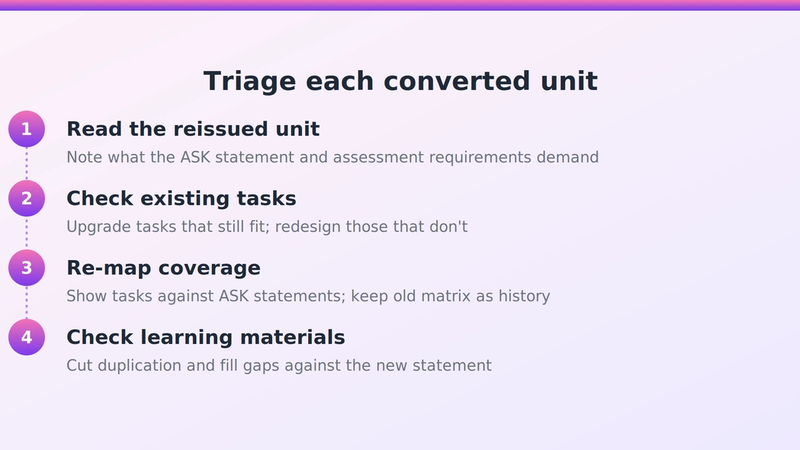
Triage by risk. List content tied to packages under review, content with open validation findings, and content with no clear owner. Those three groups usually justify attention first.
Does AI change what I should design?
It changes the evidence structure. ASQA's practice guide includes a case study of staged evidence collection and an AI use declaration rather than a ban. Verify any newer ASQA position on AI directly with ASQA.
Next step
This week, pick ten pieces of content and write one line for each: which unit version it maps to, when it was last reviewed, and what you'd do if that unit changed tomorrow. The ones you can't answer for are your real debt.