RTO Delivery Capacity Planning: The COO's Role-Play Model
Role-play looks like a teaching choice, but in your operating model it is a capacity commitment. Each assessed role-play draws on credentialed assessor time, support staff, someone to play the client, scheduling and recording. The COO's question is not whether role-play works. It is whether it scales with enrolments.
Key takeaways
- A single role-play can involve several people, but ASQA's practice guide shows only the assessor's final judgement is non-delegable. That is the line your capacity model should be built around.
- No authoritative public data exists on role-play cost or time per learner. Build your own model from your own workflow rather than borrowing someone else's numbers.
- If every role-play step depends on an assessor in the room, delivery capacity rises in step with enrolments. That is the linear-scaling pattern operations leaders are trying to break.
- Assessor supply, a shifting enrolment mix and the move to new reporting all compete for the same operational bandwidth. Hidden role-play overhead has a real opportunity cost.
Why this lands on your desk
You own utilisation and scalability. If role-play needs an assessor, a support person and an industry expert in the same place at the same time, you are scheduling three scarce calendars for one learner event. Multiply that by every cohort and the pattern is linear: more learners, more assessor hours.
You also answer for evidence. The 2025 Standards for RTOs took effect on 1 July 2025 under the National Vocational Education and Training Regulator Act 2011, and ASQA says providers must demonstrate compliance against the Standards in effect when a decision is made. One secondary commentator, eSkills Australia, argues the 2025 Standards put more weight on showing systems work in practice, not just that documents exist. That is interpretation, not ASQA text. But it points the same way: a role-play process has to be repeatable and evidenced, not a good session run by one good trainer.
What ASQA's own example says about who does what
ASQA's Credential Policy practice guide includes a floristry example. Students complete a role-play in a simulated environment. A support staff member provides written client briefs, manages timing, records the role-plays and documents observations without making assessment judgements. An industry expert plays the customer. The qualified assessor keeps responsibility for the final assessment judgement.
Read it as an operations person, not a trainer. One role-play is at least three roles and a sequence of tasks. Only one of those tasks must sit with a credentialed assessor. The rest is a question of who, or what, else could do it.
That is an analytical lens drawn from the guide, not a ruling that any particular task can be reassigned in your context. Check your own delivery against the Standards and the guide before you change anything.
Build your own role-play capacity model
Nobody has published reliable cost or time-per-learner figures for role-play, so quoting a benchmark would be guesswork. Build the model from your own workflow instead.
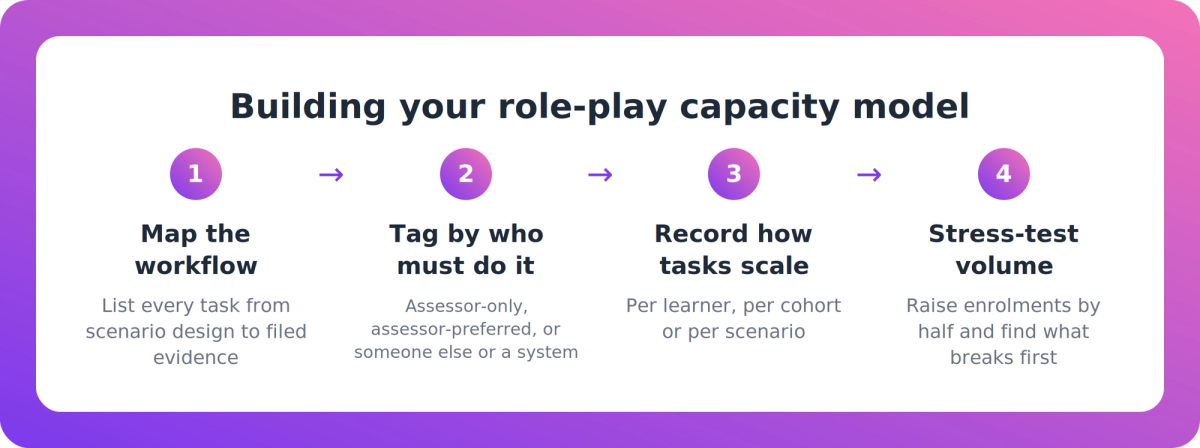
1. Map the workflow by task
List every step from scenario design to final outcome: writing the brief, scheduling, setting up, playing the client, timing, recording, observation notes, the judgement, feedback, resubmission and filing the evidence.
2. Tag each task by who must do it
Use three tags: assessor-only (the final judgement), assessor-preferred, and could be done by someone else or by a system. Be honest. Process knowledge trapped in one person's head usually gets mislabelled as assessor-only.
3. Record how each task scales
For each task, note whether effort grows with learners, with cohorts or with scenarios. Recording and filing grow with every event. Brief design may grow only with the number of scenarios.
4. Stress-test the volume
A rough structure is: assessor hours = judgement time × assessment events × (1 + reassessment rate). Add a second line for non-assessor hours. Then ask what happens if volume rises by half, and whose calendar breaks first. This is a structure, not a benchmark. Every input has to be your own.
Why linear scaling is the risk right now
Three external pressures make this more urgent.
The mix of enrolments is shifting. NCVER reports more than 5.1 million students in nationally recognised VET in 2025. Qualification students fell by 108,360 while short courses and stand-alone subjects rose, and commencing qualifications were 61.2% of qualification enrolments, down 2.3 percentage points. Our inference, not NCVER's, is that more, shorter enrolments mean more enrolment transactions and potentially more assessment events per student.
Assessor supply is tight. Jobs and Skills Australia reports that VET teachers have been in shortage nationally and in every state and territory for two years. Almost 50% are over 50, the workforce is highly casualised, and pay is lower than in other education sectors. If assessor hours are your scarcest input, a model that spends them on setup and paperwork is expensive by definition.
Your reporting load is changing at the same time. NCVER's VET Information Standard guidance says all RTOs must report under the new standard by January 2029, with minimum quarterly reporting, status-based reporting and new validation rules. Confirm your own transition pathway with NCVER or your state authority, because timelines are staged. Fee-for-service data reported directly to NCVER has firm windows. The September 2026 Data Support Bulletin says the annual 2026 window opens 1 January 2027 and closes 28 February 2027, with no extensions.
Our take
Most RTOs treat role-play overhead as a cost of doing quality delivery, and so never measure it. We think that is the mistake. The overhead is rarely in the judgement itself. It sits in the surrounding tasks: briefs, scheduling, recording, filing and chasing.
The operational goal is to protect assessor judgement and shrink everything that competes with it. Ask of every task whether it needs a credentialed person, or only a reliable process. The answer will not always be "someone else". Sometimes it is "a better checklist", a standard brief template or a recording routine that doesn't depend on who is on shift. Where learners can practise before the assessed event, that is a lever worth testing too, provided the assessed event still meets the requirements.
FAQ
Is role-play cost per learner published anywhere authoritative?
No. Our research found no public, authoritative data on the cost or time of role-play per learner. Build a model from your own workflow, tagging each task by who must perform it and how it scales with volume.
Who can take part in a simulated role-play under ASQA's guidance?
ASQA's Credential Policy practice guide gives a floristry example. Support staff provide briefs, manage timing, record and document observations without making judgements. An industry expert plays the customer. The qualified assessor retains responsibility for the final assessment judgement.
Does the VET Information Standard replace AVETMISS for every RTO now?
Not on current evidence. NCVER describes a staged timeline, with all RTOs reporting under the new standard by January 2029. Confirm your own pathway and dates with NCVER or your state authority.
Why does the enrolment mix matter for role-play capacity?
NCVER data shows qualification students declining while short courses and stand-alone subjects rise. Our inference is that this could mean more enrolment transactions and assessment events per student. Test it against your own enrolment and assessment data.
Your next step
Pick one unit that uses role-play and map every task in it by role this week, in an hour with your lead assessor and a support person. Then ask which of those tasks would break first if enrolments rose by half.