NZQA says it no longer offers its micro-credential equivalency service and will archive the register after 31 December 2026. Combined with the 2026 listing rules, that leaves providers to show for themselves where a micro-credential sits on the NZQF and what it covers. No single body owns that question.
Key takeaways
- The equivalency register was the only official reference point for non-NZQA-approved micro-credentials. Once it is archived, the judgement moves to providers.
- Coverage is split across NZQA, Universities New Zealand and eight Industry Skills Boards (ISBs), and ISB scopes can overlap.
- The 2026 rules replace fixed review periods with an expiring-status process, so currency is now something you have to monitor.
- Creative and digital training shows the fragmentation most clearly.
- The practical answer is a coverage file for every micro-credential you offer, build on, or recognise.
What is actually changing for micro-credentials on the NZQF?
Two things changed at once: an official reference point is going away, and the currency rules are shifting.
NZQA's register of micro-credential equivalency gave corporate, international and MOOC-style micro-credentials a route to a level and credit statement on the NZQF (which NZQA now calls the NZQCF). NZQA states the service is no longer offered, the list won't be maintained, and it will be archived after 31 December 2026. The register includes employer-built examples such as the Torpedo7 Bike Mechanic micro-credential.
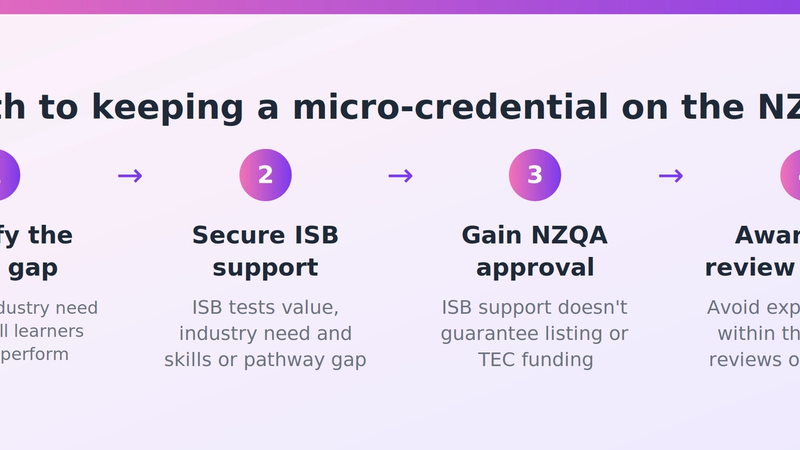
Separately, NZQA's Listing and Operational Rules came into force on 19 January 2026. They remove maximum review periods and add a process for assigning expiring status to qualifications and micro-credentials that haven't been awarded or reviewed. The rules refer only to "a specified period". Some commentary cites a three-year figure, but we couldn't confirm it in NZQA's text, so don't plan around it.
Who now owns the equivalency judgement?
No regulator has said so explicitly, so this part is interpretation. NZQA hasn't announced a replacement, and we found no NZQA, ministerial or sector-body statement on what happens after the register closes.
In practice, if you embed a third-party micro-credential in a programme, or credit it towards one, you will need your own documented position on level, credit and scope. An auditor, an employer or a learner will ask, and there will be no register entry to point to.
Why is coverage split across so many bodies?
Responsibility is divided, and the boundaries are not tidy:
- NZQA lists and approves micro-credentials. It will not list one with more than 40 credits, subject to the rules' conditions.
- Universities New Zealand receives applications for university micro-credential approval. Rule 18 on who may award micro-credentials doesn't apply to university micro-credentials, per the 2026 rules.
- Industry Skills Boards develop, set and maintain standards, qualifications, micro-credentials, national curricula and capstone assessments, according to TEC.
TEC also says all industries are covered by the eight ISBs, with some industries spanning more than one. NZQA notes applicants may need written ISB support where a micro-credential falls within an ISB's industry scope. Scope becomes a gatekeeping question, and the answer isn't always obvious.
Why do creative and digital show the problem most clearly?
These sectors sit across several ISBs. After the government reversed its proposal to move creative areas to NZQA, screen, game development, AI and cybersecurity went to different boards. Toi Mai's chief executive raised concern about the split.
There is a sharper irony. Toi Mai's September 2025 report argues short, flexible training such as micro-credentials often suits creative work better than long qualifications. The format fits the sector, while the coverage map doesn't.
The same report notes people enrolled in micro-credentials aren't eligible for student loans and allowances. We haven't verified whether that has changed, so check current TEC settings before you build a funding story around it.
How do you build a coverage file for each micro-credential?
Think of a short, repeatable evidence pack. It is the thing the register used to stand in for.
- Record the pathway. Is it NZQA-listed, university-approved, or neither?
- State level and credits, and how you derived them. Cite the learning outcomes and notional hours you used.
- Map content to standards. Show which unit standards or qualification outcomes it supports, and where it doesn't.
- Check ISB scope. Note which board or boards cover the industry, and whether written support applies.
- Set a currency trigger. Diarise a review date, since expiring status now attaches to micro-credentials that aren't awarded or reviewed.
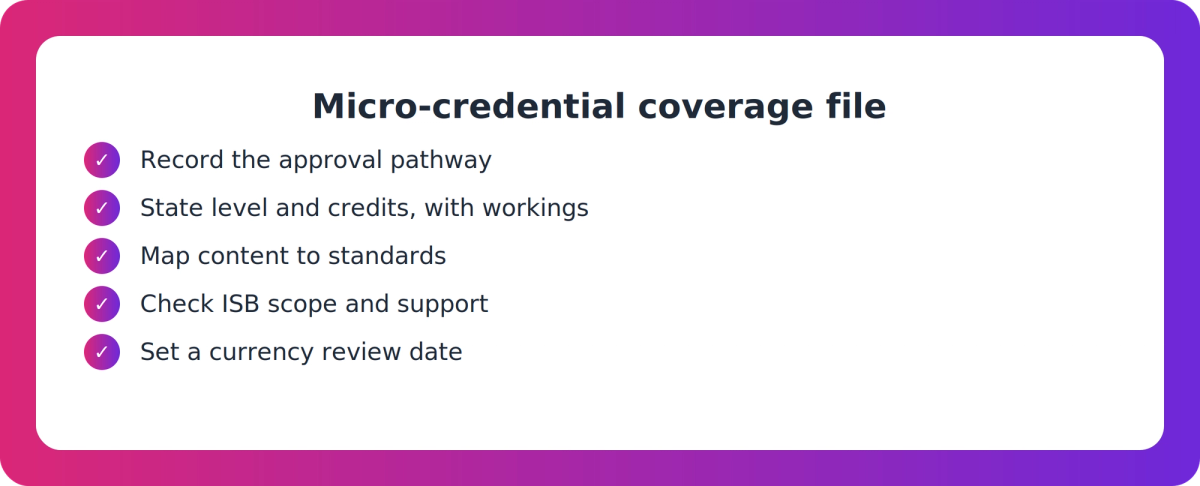
Here is an illustrative example. A PTE wants to credit an employer-built digital content micro-credential towards a creative programme. The file would show who approved it, how its outcomes map to the programme's, which ISBs could claim the sector, and when the PTE will next review it. It is a few pages, written once and refreshed.
Our take
The register's closure exposes a gap that was always there: the sector has treated "where does this sit?" as someone else's job. We think the 2026 rules push that job onto providers, and the ones who treat coverage mapping as routine quality work, not a one-off scramble, will move faster and argue less at audit. Waiting for a single owner to emerge looks like the riskier plan, especially as ISB scopes overlap and we found no announced replacement for the register.
FAQ
Is NZQA closing the micro-credential equivalency register?
NZQA says it no longer offers the equivalency service. The list won't be maintained and will be archived after 31 December 2026.
Can a micro-credential be more than 40 credits?
NZQA will not list a micro-credential with more than 40 credits, subject to the conditions in its rules. Anything larger is a qualification question, not a micro-credential one.
Do university micro-credentials follow the same approval path?
No. Applications for university micro-credential approval go to Universities New Zealand rather than NZQA, and Rule 18 on who may award micro-credentials doesn't apply to them.
Do I need Industry Skills Board support for a micro-credential?
Possibly. NZQA says applicants may need written ISB support if the micro-credential falls within an ISB's industry scope. Because TEC says some industries span more than one ISB, check which boards could claim your sector.
Next step
Pick three micro-credentials your organisation offers or recognises and draft the five-point coverage file above for each. The gaps you find will show how exposed you are before the register is archived.