RPL Assessment in RTOs: Why Evidence Gaps Stall Decisions
RPL assessment in Australian RTOs stalls less because applicants lack skills than because the evidence chain can't be shown at audit. Standard 1.6 of the Standards for RTOs 2025 expects documented, fair, transparent and consistent decisions, and ASQA names RPL a risk priority. The gap is in evidence practice, not policy wording.
Key takeaways
- ASQA describes issuing qualifications through RPL without appropriate assessment as an enduring and growing risk, so thin evidence is a registration issue, not an admin one.
- Standard 1.6 requires RPL decisions to rest on evidence of prior skills, learning and experience and to follow your assessment system. A good policy alone doesn't meet it.
- The most common stall point is a broken trail: evidence, requirement and judgement that can't be traced from one to the next.
- Live verification (conversation, oral questioning, observed practice) is the practical answer to weak or doubtful paper evidence, though that is practitioner opinion, not regulator position.
- Policy is leaning towards structured, validated RPL. Fast and thin is the wrong bet.
Why does RPL stall at audit rather than at enrolment?
Because the work is done, but it isn't visible. An assessor may know an applicant is competent and still be unable to show why in a way a third party can follow.
ASQA's Risk priorities 2025-26 flag unethical RPL marketing, inadequate assessment practices and under-reporting of RPL data. Vendor commentary from CAQA goes further. It argues that a decision which can't be traced from evidence to requirement to judgement won't survive audit. CAQA sells compliance services, so weigh that below ASQA's own material.
What does Standard 1.6 actually require?
It requires RPL decisions to be based on evidence of the applicant's prior skills, learning and experience, and to follow the RTO's assessment system. Decisions must be documented, fair, transparent and consistent. That's the position in ASQA's Practice Guide on RPL and credit transfer. Check asqa.gov.au for the current version, as the research didn't confirm a publication date.
Note what isn't on that list: reputation, goodwill or a verbal claim. RTOPilot makes the same point in its commentary.
Where does the evidence chain break?
The chain has three links. Each can fail on its own.
- Evidence: a folder of payslips, position descriptions and references, with no note on what each item proves.
- Requirement: evidence that isn't mapped to the elements and performance criteria in the relevant units of competency from the training package.
- Judgement: a "competent" outcome with no recorded reasoning about why this evidence was sufficient, current and authentic.
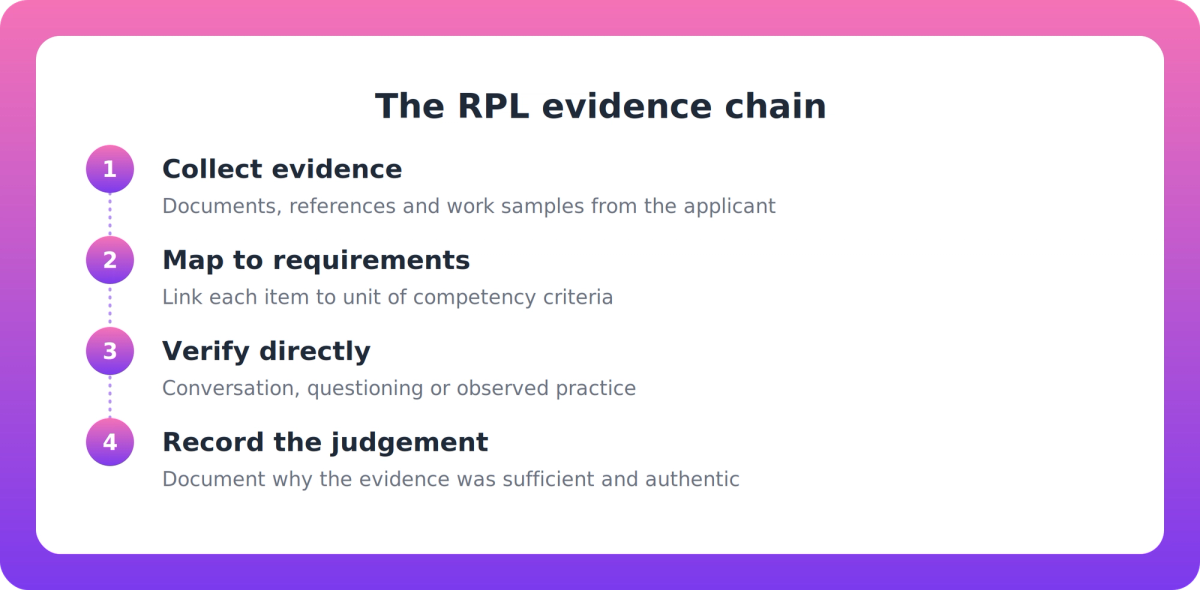
An auditor looks at completed student files and validation outcomes, not just written policy, according to Supahuman's own commentary on the evidence trail. A beautiful RPL policy with unexplained student files is the classic mismatch.
What about authenticity?
Vendor commentary flags fake or AI-generated documents and the difficulty of verifying overseas evidence. Treat that as practitioner opinion, not regulator position. The practical response it recommends is consistent, though: confirm competence directly through a live conversation, oral questioning or practical observation, and record what you saw and heard.
Why is ASQA watching RPL so closely?
Because speed and revenue pull against rigour. ASQA says it is targeting misleading RPL marketing, gap training that isn't available and fraudulent qualifications. It also says third-party RPL brokers play a facilitatory role in issuing non-genuine RPL qualifications.
That should make any informal evidence-gathering arrangement uncomfortable. If a third party collects the evidence and your assessor never tests it, you own the outcome anyway.
How can an RTO close the gap?
Start with the files you already have. Practitioner guides from Knowledge Foundry and VET Advisory Group point in the same direction.
- Audit a sample of completed RPL files. Can a stranger follow evidence to requirement to judgement in five minutes?
- Align the RPL evidence guide to your assessment system. It should say what counts as sufficient, current and authentic.
- Record the evidence relied on. Name each item and say what it demonstrates against the unit.
- Add a direct verification step. Use a structured competency conversation or observed task, with a recorded outcome.
- Test your gap training arrangements. If gap training is promised, check that it's actually available and delivered.
- Check your RPL data reporting. ASQA lists under-reporting as a risk.
An illustrative example
Say an applicant has a decade of supervisory experience and submits references, rosters and a résumé. A thin file says "evidence reviewed, competent." A defensible file maps each document to specific unit requirements, notes the gaps, and records a 30-minute assessor conversation with the questions asked and the answers given. The applicant is the same. Only the second file survives scrutiny. This is a hypothetical, not a customer story.
Where is policy heading?
Towards structure. The Department of Employment and Workplace Relations describes real RPL as an initial consultation, self-assessment, an evidence portfolio, and interviews or practical assessments.
ASQA's submission to the Productivity Commission, in ASQA's role and purpose, supports exploring independent assessments of prior learning for VET enrolment. It also notes the Commission's draft credit transfer and RPL recommendation focuses mainly on higher education admissions. That points to possible future independent verification, but it isn't settled policy. Plan for scrutiny, don't wait for a rule.
One caution on sources: the research found no new ASQA, DEWR or Jobs and Skills Australia RPL publication in the last 90 days, and much of the commentary is vendor material of uncertain date. Verify dates and versions before you cite any of it in your own documents.
Our take
Most RTOs don't have an RPL problem. They have a record-keeping problem that shows up as an RPL problem. We think the winners will be the providers who treat direct verification, such as a recorded conversation or an observed task, as a standard part of every RPL file rather than a rescue step when paper looks weak. It costs assessor time up front. It costs far less than defending a thin file to ASQA.
FAQ
Why does RPL assessment stall in Australian RTOs?
Usually because the RTO can't show how evidence maps to unit requirements and how the assessor reached a decision. Applicants often have the skills. The documented trail is what's missing.
What does Standard 1.6 of the Standards for RTOs 2025 require for RPL?
RPL decisions must be based on evidence of prior skills, learning and experience and follow the RTO's assessment system. They must be documented, fair, transparent and consistent. Confirm details in ASQA's practice guide.
Does ASQA treat RPL as a risk?
Yes. Its Risk priorities 2025-26 name unethical RPL marketing, inadequate assessment practices and under-reporting of RPL data. It describes RPL issued without appropriate assessment as an enduring and growing risk.
How can RTOs verify RPL evidence is genuine?
Practitioner commentary recommends live competency conversations, oral questioning and practical observation alongside documents. That is vendor opinion rather than an ASQA requirement, but it fits Standard 1.6's emphasis on evidence-based decisions.
Next step
Pull three recent RPL student files this week and ask one assessor who didn't work on them to trace evidence to requirement to judgement. Wherever they get stuck is where your audit risk sits.