NZQF micro-credentials now have to keep earning their place. Since 19 January 2026, NZQA's rules let a listing expire if it isn't awarded or reviewed on time, and Industry Skills Boards must back new ones first. The test underneath is simple: does this short credential build a skill people can actually perform?
Key takeaways
- A micro-credential can now expire. NZQA's 2026 rules add an "expiring" status for credentials that go unawarded or unreviewed.
- Industry Skills Board (ISB) support comes before NZQA approval, and the ISB asks whether the credential meets an industry need and addresses a skills or pathway gap.
- The 40-credit ceiling forces focus. Each micro-credential needs to target one specific, practicable skill.
- Non-approved short courses can no longer gain NZQF equivalency, so formal listing is the only route to NZQF status.
- There is no independent outcome evidence yet that micro-credentials close practice gaps. Providers should build their own.
What changed in NZQA's 2026 rules?
The short answer: currency is now a condition of staying listed. NZQA's Qualification and Micro-credential Listing and Operational Rules took effect on 19 January 2026. They remove maximum review periods and add an "expiring" status.
According to NZQA's 2026 rules document, a micro-credential can expire in two situations:
- It hasn't been awarded for three consecutive years.
- It hasn't been reviewed within one year of its listed review period.
A listing that sits on the shelf, untouched, is now a liability. We covered the mechanics in our earlier piece on the NZQA currency clock.
How does a micro-credential now get on the NZQF?
It goes through an Industry Skills Board first. Eight ISBs began operating on 1 January 2026. TEC says they develop and maintain standards, qualifications, micro-credentials, national curricula and capstone assessments.
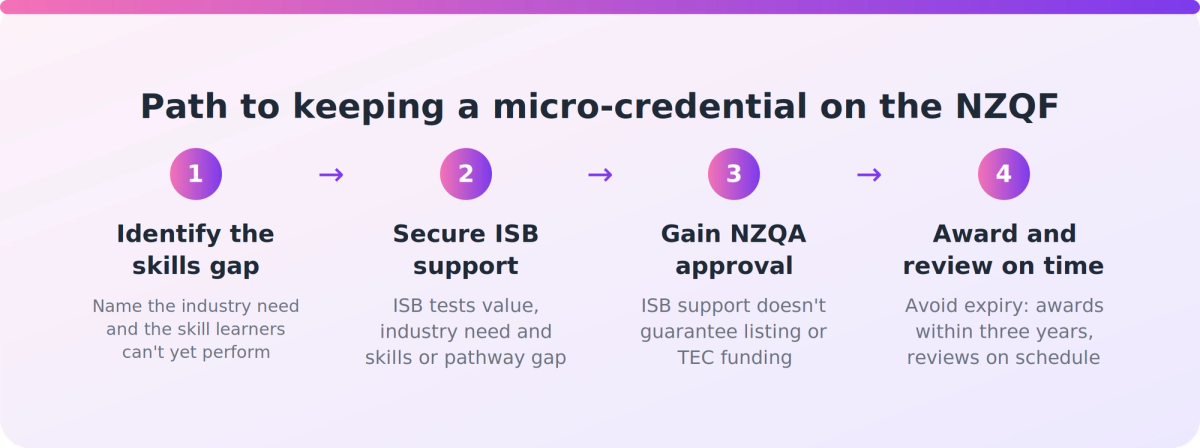
ISB support is now required before a provider seeks NZQA approval. Services ISB asks whether the micro-credential adds value, meets an industry need and addresses a skills or pathway gap. Transport ISB is clear that its support doesn't guarantee NZQA listing or TEC funding.
Why does the 40-credit ceiling matter for practice?
Because a short format leaves no room for padding. NZQA won't list micro-credentials above 40 credits, with limited exceptions. That keeps each one narrow.
A narrow credential can't lean on breadth to look substantial. It has to do one thing well: build a skill that a learner can show in a workplace. Content coverage alone won't carry it.
What is the "practice gap", and what evidence exists?
The practice gap is the distance between knowing something and being able to do it under real conditions. The rules don't use that phrase, but the ISB question about a skills or pathway gap is the closest formal test of it.
The evidence is thin. NZQA's early insights paper recorded 249 approved micro-credentials by June 2022 and framed them as making the system more relevant and responsive. We found no independent recent evaluation showing that micro-credentials close practice gaps.
So the link between short credentials and applied skill rests on policy intent and ISB criteria, not outcome data. That's a reason to gather your own evidence, not a reason to assume the case is made.
A practical check before you approach your ISB
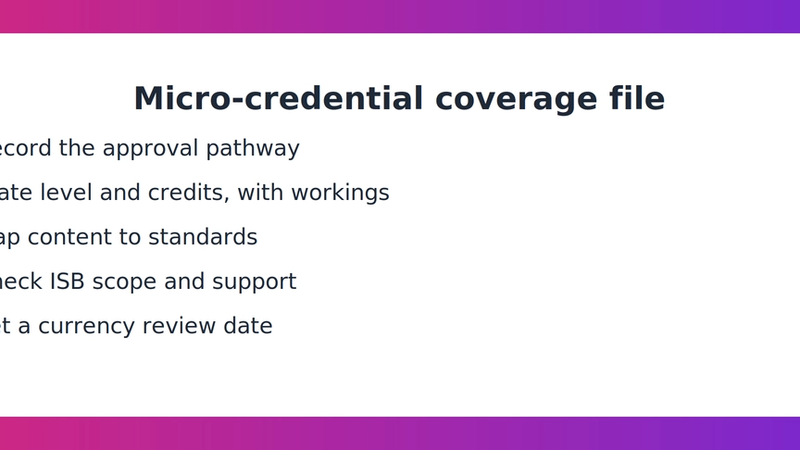
Run each proposed or existing micro-credential through these questions:
- Which named skill gap does it address? Say what people can't yet do, and who says so.
- Where does the learner practise? Count the opportunities to rehearse the skill, not the hours of content.
- Who gives feedback on that practice? Skill builds with repeated, corrected attempts.
- What does assessment observe? Performance in a realistic situation beats recall of information.
- How will you know it's still needed? Plan your review evidence before the clock forces it.
*Illustrative example (hypothetical):* a PTE has a short customer-conversation credential made of reading and a quiz. Reframed around the check above, it keeps the content but adds three scenario rehearsals with feedback, and assesses a recorded conversation. Same credit size, a much stronger answer to "what can graduates now do?"
The hard part is delivering coached rehearsal without a facilitator for every learner. That's where simulation and AI-supported practice tools are worth a look, as long as they sit inside your own assessment design.
What does the calendar look like?
Two dates matter. Services ISB advises that material submitted after 24 November 2026 may not be finished before the 23 December to 5 January shutdown.
Separately, NZQA no longer offers equivalency assessment, and the equivalency register will be archived after 31 December 2026. Non-approved short courses can't gain NZQF level and credit equivalency any more. Providers and employers who want NZQF status need a formal listing.
Our take
The expiry rules are the useful part. They turn "is this still needed?" from a nice-to-have into a recurring obligation, and that favours credentials built around performance over those built around coverage. We'd bet the providers who hold their listings comfortably will be the ones who can show practised skill, with feedback, in their assessment evidence. Given there's no outcome data yet, that evidence is a differentiator, not paperwork.
FAQ
Can an NZQF micro-credential expire?
Yes. From 19 January 2026, NZQA's rules add an "expiring" status. A micro-credential can expire if it hasn't been awarded for three consecutive years, or hasn't been reviewed within one year of its listed review period.
Do I need Industry Skills Board support before applying to NZQA?
Yes. ISB support is now required before providers seek NZQA approval. ISBs ask whether the credential meets an industry need and addresses a skills or pathway gap. Transport ISB notes its support doesn't guarantee NZQA listing or TEC funding.
How big can an NZQF micro-credential be?
NZQA won't list micro-credentials above 40 credits, with limited exceptions. The cap keeps the format short and focused on a specific skill.
What happens to short courses that aren't NZQA-approved?
They can no longer gain NZQF level and credit equivalency. NZQA no longer offers equivalency assessment, and the register will be archived after 31 December 2026. Formal listing is needed to carry NZQF status.
Is there evidence that micro-credentials close practice gaps?
Not independently. NZQA's early insights paper recorded 249 approved micro-credentials by June 2022 and described them as making the system more relevant and responsive. We found no recent independent evaluation of outcomes.
Next step
Pick one micro-credential you offer or plan to offer. Run it through the five questions above, then check your ISB's submission timing against the 24 November 2026 advice before you commit to a review.