The pre-audit sprint is a design flaw, not a discipline problem. Under the Standards for RTOs 2025, ASQA expects more regulatory engagement, gives providers flexibility in how they show compliance, and asks you to confirm you've monitored it. An annual evidence hunt can't support that sign-off. A continuous, owned, traceable assurance cycle can.
Key takeaways
- RTO audit readiness is a state you maintain, not a project you run. The Annual Declaration asks the RTO to confirm it has monitored compliance.
- Flexibility in the 2025 Standards means you define, and defend, what good evidence looks like for your RTO.
- Build the cycle around the evidence chain behind each credential: assessment tools mapped to units of competency, trainer currency and delivered hours.
- ASQA's practice-guide self-assurance questions make a ready-made monitoring calendar.
- Distribute evidence ownership so you review exceptions, not every document. Continuous monitoring is our reading of ASQA's direction, not a stated ASQA rule.
Why this lands on your desk
You own the answer to "are we compliant today?", not just "will we pass in March?". That is a harder question, and the 2025 Standards make it yours to answer.
The Standards came into full effect on 1 July 2025. ASQA said it expects more regulatory engagement and gives providers more flexibility in how they demonstrate compliance. Flexibility is welcome, but it also means nobody hands you a checklist. You decide what adequate evidence looks like, and you defend that call.
The transition rule adds pressure. Providers must demonstrate compliance against the Standards in effect when a decision is made. Changes can't wait for the next audit. They have to be tracked as they land.
Then there is the declaration. A Skiltrak summary says the Annual Declaration on Compliance confirms the RTO has monitored compliance with the Act, the Outcome Standards and the Compliance Requirements. ASQA's Corporate Plan 2026–27 includes a KPI on provider conformance with the 2025 Standards, measured partly through that declaration. Your signature is more credible when a year-round monitoring record sits behind it.
Flexibility moves the burden to you
According to a Knowledge Foundry explainer, the Standards have three components: the Outcome Standards, the Compliance Standards and the Credential Policy. ASQA has also published practice guides with examples of compliant activity, risks to avoid, self-assurance questions, case studies and FAQs, as the same explainer notes.
Those self-assurance questions are underused. Most RTOs treat them as reading. Treat them as a monitoring calendar instead: assign each question an owner, a frequency and a place to record the answer.
ASQA is also differentiating supervision by provider risk profile. Your own risk posture will increasingly shape how much attention you get. A clean, current monitoring record is part of that posture.
Build the cycle around the evidence chain
The credential evidence chain is where scrutiny is heading. A VET Resources summary says ASQA wants planned hours reconciled with the hours students actually received, and is looking at the whole chain behind a credential. Treat that as a third-party reading rather than an ASQA statement.
A workable monitoring cycle keeps these links current:
- Assessment tools to units of competency. Can you show each tool covers the required competencies?
- Trainer and assessor currency. Is each person's vocational currency and professional development recorded and recent?
- Delivered hours. Does what was planned in the training and assessment strategy match what happened?
- Standards changes. Is there a dated log of what changed, who assessed the impact and what was updated?
Currency deserves special attention. The Jobs and Skills Australia VET workforce study describes an older, highly casualised workforce. Industry Skills Australia says digital change is raising the time and cost of keeping vocational currency up to date. Casual trainers with scattered records are a recurring exposure, and a secondary summary links Standard 3.2 to continuing professional development for trainers and assessors.
A worked example (illustrative)
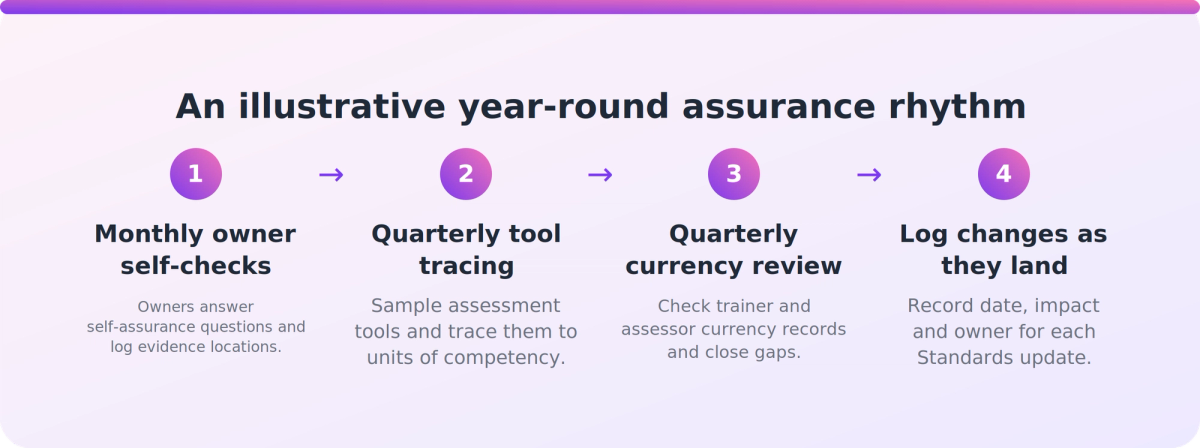
Here is a hypothetical rhythm for a mid-sized RTO. It is a sketch, not a prescribed ASQA model.
- Monthly: each owner answers their assigned self-assurance questions and logs the answer and evidence location. You review only the items flagged as uncertain.
- Quarterly: sample a few assessment tools per qualification and trace each one back to its units of competency. Reconcile planned and delivered hours for one cohort.
- Quarterly: check the currency register for every active trainer and assessor, and chase gaps while there is still time to close them.
- On change: whenever ASQA updates guidance, log the date, the impact and the owner of the fix.
By the time the declaration window opens, the evidence already exists. Per the Skiltrak summary, the 2026 window ran 3–31 March.
Stop being the bottleneck
If every document passes through you, your RTO's compliance capacity equals your calendar. That is fragile, and it hides risk behind a queue.
Shift to ownership. Trainers own currency records. Operations owns delivered hours. Training managers own tool-to-unit mapping. You own the framework, the sampling and the exceptions. Early warning then comes from owners closing their own items on schedule, and a missed item becomes a visible signal rather than a surprise.
What the early signals say
Treat this evidence cautiously. Attendee notes from ASQA's March 2026 sector workshop, published by Skills Education and not by ASQA, record 89 performance reviews between July 2025 and 30 January 2026, with a 62% compliance rate. The notes describe reviews as more targeted and smaller in scope than audits, and list assessment tools not aligning to required competencies as a finding. We found no primary ASQA release for those figures.
The direction is still useful. Narrow, targeted reviews reward providers who already know where their evidence is. They punish those who need six weeks to find it.
Our take
ASQA hasn't, on the sources we reviewed, mandated continuous monitoring. Our position is that the direction of travel makes it the sensible reading: flexible standards, risk-differentiated supervision and a declaration about monitoring all point the same way.
The measure of a compliance manager isn't how well they run the sprint. It is whether the sprint becomes unnecessary. If your best audit preparation depends on your personal heroics, the system is the risk.
FAQ
Does ASQA require continuous compliance monitoring?
Not on the sources reviewed. The Annual Declaration asks the RTO to confirm it has monitored compliance, and continuous monitoring is a practical inference from that and from ASQA's direction, not a stated rule.
Which Standards apply when ASQA makes a decision?
Providers must demonstrate compliance against the Standards in effect at the time the decision is made, according to ASQA's guidance. Track changes as they happen.
Where should we start with self-assurance?
Start with ASQA's practice guides, which include self-assurance questions. Assign each question an owner and a review frequency, and record the answers and evidence locations.
Can we rely on the 62% compliance figure?
Treat it cautiously. It comes from attendee workshop notes published by a third party, and no primary ASQA release was found.
One step for this week
Pick one qualification and trace a single unit end to end: assessment tool, trainer currency, delivered hours. Note how long it takes and who you had to ask. That time is the size of your pre-audit sprint.