Assessment Consistency Across Trainers: A Head of Training's Guide
Assessor consistency isn't something you can audit into an RTO afterwards. You have to design it into how evidence is judged week to week. ASQA expects you to show a reasonable level of consistency across assessors, locations and cohorts. With a stretched, casualised workforce, habit won't hold that line. Validation should confirm consistency, not discover drift.
Key takeaways
- ASQA's guidance asks you to *demonstrate* a reasonable level of consistency of judgements across the RTO, not just assert it.
- Validation is required at least once every 5 years for every training product on scope, and sooner when risks, product changes or feedback emerge. Your day-to-day signals are the trigger.
- Casualised, fast-turnover assessor pools make consistency a design problem. Shared judgement has to be built into the working week.
- Validation outcomes can't be determined solely by people who designed or delivered the training. Plan independent, industry-current validators early.
- The Standards don't prescribe how assessment tools are reviewed before use, so you can set that bar internally.
Why this lands on your desk
You own the assessor pool, so you answer for how it behaves. The Jobs and Skills Australia VET Workforce Study describes a workforce that is older, lacks diversity and is highly casualised. It projects a need for 3,800 more VET teachers over five years, and 48.5% of the workforce is in Teach, Train and Assess roles.
Every new or part-time assessor is another potential source of divergent judgements. They are rarely careless. They simply haven't spent enough time in a room with colleagues looking at the same evidence.
You also hold the early-warning information: trainer feedback, learner outcomes, differences between cohorts. That is exactly what should trigger earlier validation. Few people in the organisation see it sooner than you do.
What ASQA actually expects you to show
The Assessment Practice Guide for the 2025 Standards sets out three things worth reading closely.
- Frequency. Validate assessment practices and judgements at least once every 5 years for every training product on scope. Validate more often where you become aware of risks, product changes or relevant feedback.
- Sample. The validation sample should reflect the diversity of cohorts, delivery locations and number of assessors.
- Outcome. There should be a reasonable level of consistency of assessment judgements across the RTO.
The sampling expectation is the quiet one. It means a tidy sample from your two most experienced assessors at your main site doesn't answer the question. The sample has to look like your delivery model, so it tests that model.
The guide also lists, among practices to avoid, neglecting to review assessment systems after cohorts have completed. A post-cohort look is part of the job, not a nice-to-have.
Why a casualised workforce turns this into a design problem
In a stable team, consistency often comes from osmosis. People share a staffroom, argue about borderline cases and absorb each other's standards. Casual and part-time assessors don't get that by default. They arrive, assess against the tool and the unit of competency, and leave.
That isn't a criticism of casuals. It means shared judgement has to be scheduled and paid for rather than hoped for. The DEWR VET Workforce Blueprint lists reducing administrative and compliance burden among its actions. That is a fair sign of how much paperwork competes with calibration time. We couldn't find authoritative Australian data quantifying that burden, so treat any figure you see quoted with caution.
Build calibration into the working week
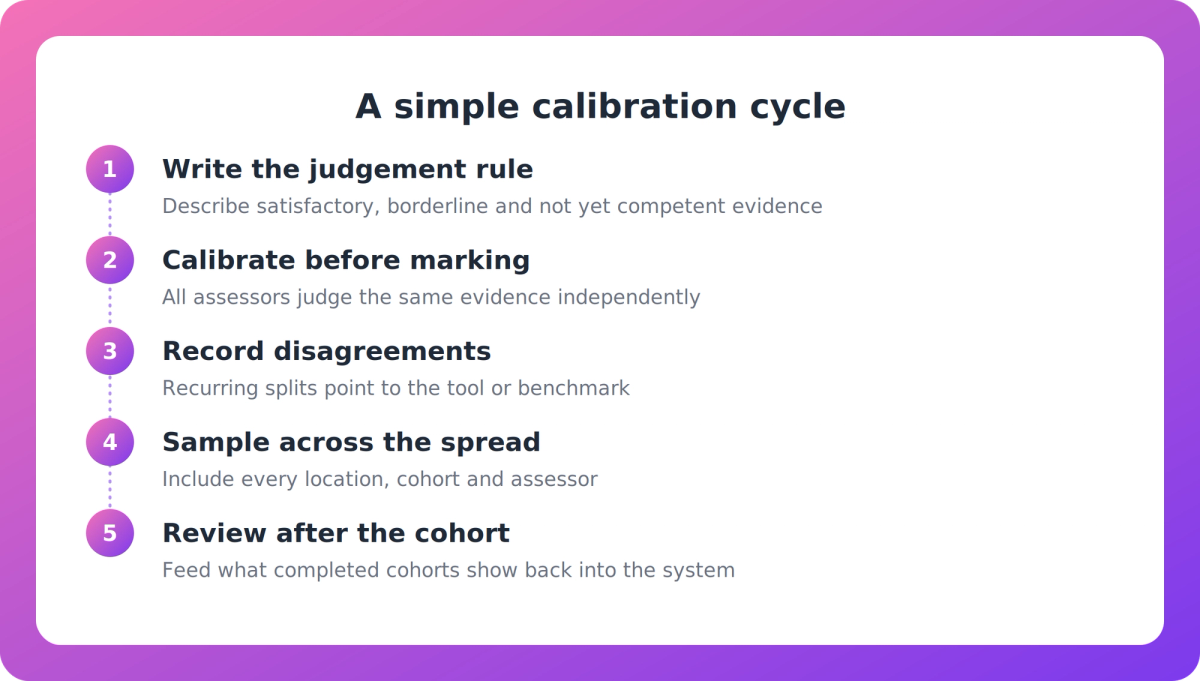
Calibration works when it is small, regular and attached to real evidence. Here is a sequence you can start this quarter.
- Write down the judgement rule. For each high-risk unit of competency, keep a short note describing what a satisfactory response looks like, what a borderline one looks like, and what is clearly not yet competent. Attach de-identified examples.
- Calibrate before marking, not after. Have every assessor on the unit, casuals included, judge the same three or four pieces of evidence independently. Then compare.
- Record the disagreements. A split decision is useful data. If the same split recurs, the problem is usually the tool or the benchmark, not the assessor.
- Sample across the spread. Pull evidence from each location, cohort and assessor so your internal checks mirror what ASQA says a validation sample should reflect.
- Escalate on patterns. Recurring splits, trainer feedback or a product change are your cue to validate early rather than waiting for the five-year mark.
- Review after the cohort. Look at what the completed cohort shows about the assessment system, then feed it back.
*Illustrative example:* three assessors across two campuses each judge the same recorded workplace observation. Two mark it competent and one marks it not yet competent. The useful question isn't who is right. It is which line in the benchmark let two reasonable people read it differently.
Keep validation independent without starving delivery
ASQA says the outcome of an assessment validation must not be determined solely by someone who designed or delivered the training or assessment. Validators should have relevant industry competencies, an understanding of current industry practice, the relevant credentials and independence from design or delivery. The 2025 Standards came into effect on 1 July 2025, and a Credential Policy sits alongside them covering the credentials needed to undertake validation of assessment.
That creates a real tension. Your best-informed people are also your busiest deliverers. A workable split is to have trainers supply the evidence, context and concerns, while independent validators form the judgement.
On assessment tools, ASQA's 2025 Standards FAQs say the Standards don't refer to pre-use validation and refer instead to tools being reviewed. They don't list who must do that review or which credentials they need. So the RTO decides. Setting an internal standard for tool review is a leadership choice, and it's cheaper than finding inconsistency later.
Our take
Most RTOs treat inconsistency as a trainer-quality issue, and it usually isn't. It is a system issue. Capable assessors drift apart when nothing makes them look at the same evidence together.
So protect calibration time before almost any other meeting on the calendar, and pay casual assessors to attend. A five-yearly validation that finds drift has found it five years too late. The better test of your design is whether validation tells you nothing you didn't already know.
FAQ
How often must we validate assessment?
ASQA's Assessment Practice Guide says at least once every 5 years for every training product on scope. You should validate more often when you become aware of risks, product changes or relevant feedback.
Can the trainers who delivered the unit validate it?
They can contribute evidence and context, but the outcome must not be determined solely by someone who designed or delivered the training or assessment. Validators should be independent of design and delivery, and have industry competencies, current industry practice and the relevant credentials.
What should the validation sample look like?
It should reflect the diversity of cohorts, delivery locations and number of assessors, not just your most convenient or experienced group.
Do the 2025 Standards require pre-use validation of tools?
ASQA's FAQs say the Standards don't refer to pre-use validation and refer instead to assessment tools being reviewed. They don't prescribe who must review tools, so the RTO sets its own approach.
One thing to do this week
Pick one unit assessed by three or more people. Pull three completed assessments, strip the names and ask each assessor to judge them separately. Then compare the outcomes and ask where the benchmark let reasonable people disagree.