Improve RTO Completion Rates: A Note for RTO Managers
Most RTOs treat completion as a learner-engagement problem. Part of it may be decided earlier, when assessment is designed, sequenced and checked. No ASQA or NCVER source in the research behind this post proves that link, so treat it as a hypothesis. It is a cheap one to test, because Standard 1.3 already requires you to review tools before use.
Key takeaways
- Standard 1.3 requires assessment tools used after 1 July 2025 to be reviewed before use. Whether that review is a tick-off or a quality gate is your call.
- No ASQA or NCVER source in the research directly links assessment design to completion. Test it in your own unit-level data rather than assuming it.
- Look for units where learners stall, or fail first attempts, before blaming engagement.
- Judge assessment design by learner progress and work outcomes, not final completions alone.
- With trainer and assessor capacity tight, cutting avoidable rework is a practical resourcing lever.
Why this lands on your desk
You answer for two numbers that rarely get discussed together: completions and audit outcomes. Assessment tools sit where both are decided. A tool that misses the unit requirements is a compliance finding. A tool that confuses or overloads learners can cost you completions.
The 2025 Standards took effect on 1 July 2025. They have three enforceable components: the Outcome Standards, the Compliance Requirements (including the Fit and Proper Person Requirements) and the Credential Policy (ASQA, About the Standards; DEWR). ASQA's 2025 Standards FAQ says tools used after that date must be reviewed before use, under Standard 1.3.
So the review is mandatory. What it looks like in your RTO is a management decision, made with limited time and people.
What ASQA is watching
Assessment practice is a stated regulatory concern. ASQA's 2025-26 risk priorities include inadequate assessment practices and a heightened regulatory focus on RPL. Its Corporate Plan calls embedding the 2025 Standards its most significant regulatory priority.
The FAQ also covers a two-year retention rule for assessment evidence. That raises the stakes on tools that are unclear or poorly mapped, because the evidence trail they produce is what you will have to defend.
One caution. Secondary, unofficial notes from an ASQA Brisbane workshop on 11 March 2026 record tools that did not match the required competencies as a finding. They also record ASQA saying AI cannot be used to make assessment decisions. Verify both against ASQA material before relying on them. ASQA's newsroom separately lists new Principles for the Responsible Use of AI in VET, which are worth reading in full.
What the completion data does and doesn't say
NCVER has stated that improving training completion rates is a national priority. A VDC summary of NCVER's 2023 report puts four-year completion for 2019 commencements at 47.3% across all qualifications. By level:
- Diploma and above: 55.9%
- Certificate IV: 52.4%
- Certificate III: 47%
- Certificate II: 41.7%
- Certificate I: 35.6%
That spread is wide. But none of this tells you why learners leave, and the research found no ASQA or NCVER statement tying assessment design to those figures. Anyone who says design explains the gap is guessing. The honest position is that tool quality is plausible, testable and within your control.
Completion is also not the whole story. NCVER's student outcomes work, summarised by CAQA, found 64.4% of qualification completers had an improved employment status. NCVER research also suggests completing all enrolled subjects could sit alongside program completion as an additional measure of success. Learner progress and work outcomes are fairer tests of a tool than the final completion count.
Testing the hypothesis in your own data
You do not need a research project. You need a few unit-level cuts you may already hold in your student management system.
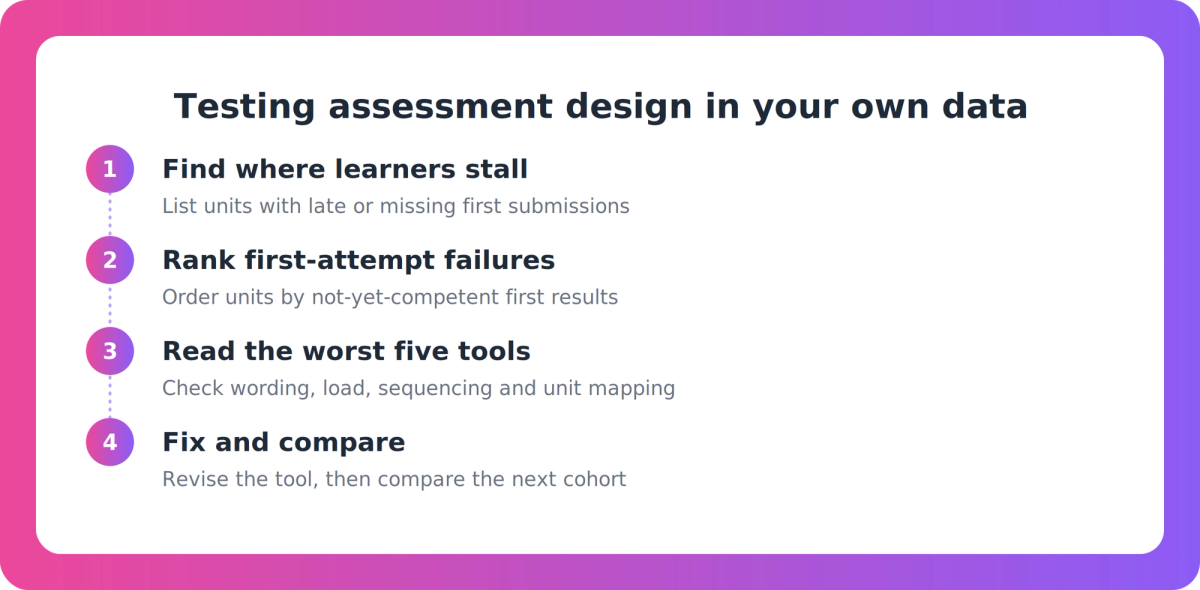
A simple unit-level review
- Find where learners stall. List units by how many learners have not submitted within the expected window.
- Find first-attempt failures. Rank units by not-yet-competent results on the first attempt.
- Read the tools for your worst five. Check task wording, reading load, sequencing, and whether each task maps clearly to the unit requirements.
- Separate causes. Tag each problem as a tool issue, a delivery issue or a learner-support issue.
- Fix, then compare. Revise the tool, run the next cohort and compare against the last.
Here is an illustrative example, not a real case. Suppose one unit has a high first-attempt not-yet-competent rate and a long delay before first submission. On review, the major written task asks for three things in a single question and uses language well above the workplace context. Rewriting it into clear stages is a design fix, not a student-support one. If the next cohort moves, you have evidence. If it doesn't, you have ruled something out.
Making the Standard 1.3 review a real gate
A pre-use review is a compliance step. It is also the cheapest point at which to catch a confusing task, a mapping gap or a mismatch between the tool and the learner cohort. Fixing a tool before it reaches learners costs far less than re-assessing, re-marking and re-explaining afterwards.
That matters because capacity is thin. The JSA VET Workforce Study 2024 found 48.5% of the VET workforce in Teach, Train and Assess roles, with an average age of 47 against 41 for the Australian workforce. A secondary summary from CAQA says JSA's later Pathways to Success report flags trainer and assessor availability as a constraint. Every avoidable resubmission consumes assessor time you may not have. For more on that workload pressure, see this piece on trainer workload and the practice gap.
Our take
We think the sector underrates assessment design as a completion lever and overrates exhortation. Telling trainers to engage learners harder rarely fixes a task that is poorly worded or badly sequenced.
We also think the claim needs discipline. Until your own data shows a link, design is a working hypothesis, not a finding. The good news is that the Standards have already given you the checkpoint. Use it to look for learner friction as well as compliance gaps, and let the unit-level numbers tell you whether you were right.
FAQ
Does ASQA say assessment design affects completion rates?
No. The research behind this post found no ASQA or NCVER statement directly linking assessment design to completion. Treat it as a management hypothesis and test it against your own unit-level data.
What does Standard 1.3 require for assessment tools?
ASQA's 2025 Standards FAQ says assessment tools used after 1 July 2025 must be reviewed before use under Standard 1.3. The FAQ also covers a two-year retention rule for assessment evidence.
Which data should I look at first?
Start with units where learners stall before first submission or fail on the first attempt. Read the tools for those units before assuming the cause is engagement or learner support.
Is completion the only measure worth tracking?
No. NCVER found 64.4% of qualification completers had an improved employment status, and its research suggests completing all enrolled subjects could be an additional measure. Progress and work outcomes round out the picture.
Your next step
This week, pull first-attempt results for your lowest-completing qualification. Pick the one unit with the worst numbers and read its assessment tool the way a learner would. What you find there is your first data point.