NZQA Audit Readiness Checklist for PTE Compliance Managers
With NZQA no longer starting new External Evaluation and Review (EER) processes, no external panel will arrive to force an audit-ready moment. Under the Quality Assurance of Tertiary Education Providers Rules 2026, readiness is something you run all year: named owners, a review calendar and early-warning checks, not a sprint before a visit.
Key takeaways
- NZQA stopped beginning new EER processes on 1 January 2026. Providers now do an annual organisational self-review and send NZQA a summary report (NZQA).
- No visit date means no deadline to pull evidence together. Your own calendar has to supply the pressure.
- Pastoral care Code evidence, rule alignment and self-review content should sit in one cadence with named owners, not in separate scrambles.
- Graded descriptors are expected from around July 2027, so evidence you collect now may later be judged more finely than compliant or not.
- Some details are still unconfirmed, including the quality management system deadline. Check them against NZQA's own text.
Why this lands on your desk
You own the self-review and the summary report. When an external panel set the date, the panel also supplied the early warning. Now that warning has to come from your monitoring, and nobody else is positioned to run it.
The rule changes add to the load. NZQA reissued several rule sets within weeks of each other, including the Quality Assurance of Tertiary Education Providers Rules 2026, the Private Training Establishment Rules 2026 and the Programme Approval, Recognition, and Accreditation Rules 2026. Keeping policies and the quality management system aligned with all of them is your job.
Then there is the bottleneck problem. If every document review routes through you and evidence lives in drives, inboxes and spreadsheets, a single annual submission turns into a retrieval exercise. That is a reporting risk, not just an irritation.
What actually changed
NZQA announced on 15 January 2026 that its integrated Quality Assurance Framework (iQAF) was live. EER processes and consistency reviews already underway would be completed. Providers must now submit an annual self-review summary report and meet NZQA to discuss their improvement plan (NZQA).
The legal basis is the Quality Assurance of Tertiary Education Providers Rules 2026. They require an organisational self-review each calendar year, with extra content for work-based training providers. The PTE Rules 2026 took effect on 19 January 2026. They remove EER references, make the annual financial return biennial unless NZQA tells a PTE otherwise, fold in the enrolment and academic records rules, and require a copy of the quality management system for registration applications.
One trap sits in the old ratings. A provider may quote only its latest EER category, with the year received and a statement that the EER system is no longer in operation. Immigration NZ has said it will keep using current EER category ratings when setting visa conditions in 2026 (NZQA). Audit your website and marketing for stray references.
Build the cadence: a year-round evidence calendar
The calendar below is my suggestion, not an NZQA requirement. NZQA said it would provide templates and talk to providers about scheduling their first submission, so confirm your date first.
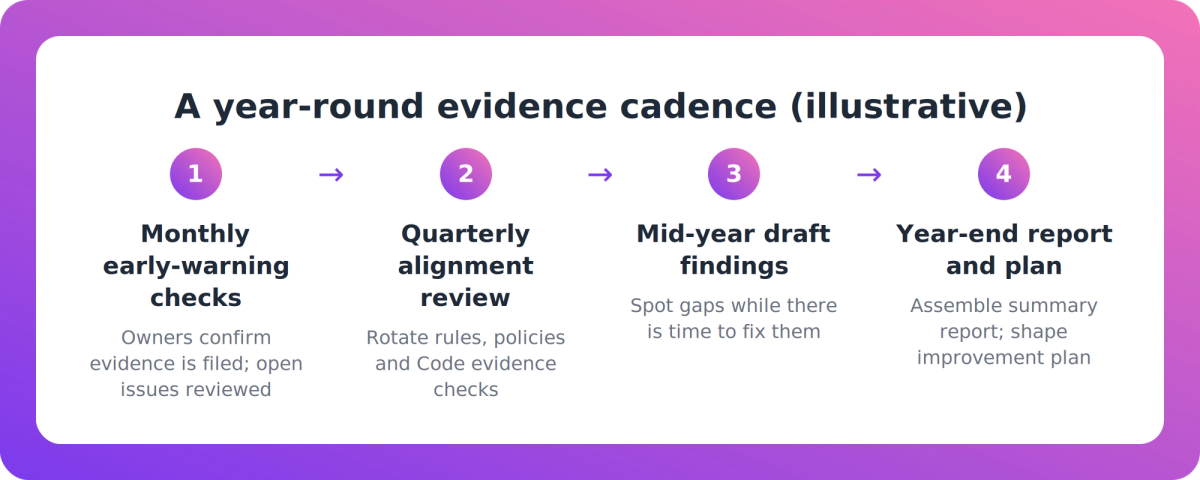
Monthly: early-warning checks
Keep these short and owned by the people who hold the evidence.
- Each owner confirms their evidence is filed where others can find it.
- You review open issues: complaints, pastoral care incidents and overdue corrective actions.
- Anything with no owner or no date goes on a visible list.
Quarterly: alignment review
- Check one rule set or policy cluster against the current text. Rotate through the QA Rules, PTE Rules and programme approval rules.
- Review Code of Practice evidence. A secondary source, Technical Institute, reports that Code self-review is now reported within the annual submission, so it belongs in the same cycle.
- Update terminology. The PTE-related rules already change WDC references to ISBs.
Mid-year: draft your own findings
Write a draft self-review view while there is still time to act on it. Gaps found in June can be fixed. Gaps found in the final weeks before submission can only be reported.
Year-end: report and improvement plan
By now the summary report should be assembly, not discovery. Use what you drafted to shape the improvement plan you will discuss with NZQA.
A short NZQA audit readiness checklist for your PTE
Use this to test whether your cadence is real:
- Does every compliance obligation have one named owner and one review date?
- Can someone other than you find the evidence for any claim in under ten minutes?
- Is Code of Practice evidence filed alongside self-review evidence, not separately?
- Do your policies and quality management system cite the 2026 rules, not the 2022 ones?
- Has anyone checked your public EER references against the Rule 10 conditions?
- Is there a written list of what you have not yet confirmed, with an owner chasing each item?
A "no" on question 2 is the most telling. If you are the only retrieval path, you are the bottleneck. The ownership question is explored further in Compliance Evidence Ownership.
Pastoral care does not pause
Tertiary providers must follow the Education (Pastoral Care of Tertiary and International Learners) Code of Practice 2021, and enrolling international learners requires being a signatory (Ministry of Education). Nothing in the brief suggests those obligations have softened. Treat them as one of the standing monthly and quarterly items, not an annex.
What is still unconfirmed
Be straight with your leadership about the open items:
- Graded descriptors. Per Technical Institute's summary of NZQA consultation, NZQA consulted on three overall descriptors in August 2026, with consultation closing on 7 September 2026. It expects to consult on supporting rules in February or March 2027 and anticipates using the descriptors from July 2027. Treat that as expected, not settled.
- Mechanics. Technical Institute says the report is completed online in the MyNZQA provider portal, with no Word or PDF versions accepted. Verify against NZQA guidance before you build a process around it.
- Other details. The quality management system deadline, standards status labels and whether self-review summaries are published all need checking against NZQA's own text.
The vocational reform backdrop is also moving. Industry Skills Boards are standards-setting bodies only, and all ISB programmes and enrolments must move to polytechnics, PTEs or wānanga by 1 January 2028 (Ministry of Education). Your policy language will need to keep up.
Our take
The end of EER is being read as relief. I think that is the wrong reading. The panel was a forcing function: it made providers tidy their evidence on someone else's timetable. Remove it, and the providers that drift will not notice until the summary report is due.
If graded descriptors arrive on the expected timetable, evidence will be read for quality, not just presence. A folder that merely proves a task was done may not show how well the provider is performing. Start now by asking of each piece of evidence what it shows beyond "done".
FAQ
Has NZQA stopped EER entirely?
NZQA stopped beginning new EER processes and consistency reviews on 1 January 2026. Those already underway would be completed. Providers now complete an annual self-review and submit a summary report.
Can we still quote our EER category?
Only under conditions. You may refer to your latest categorisation only, state the year it was received, and state that the EER system is no longer in operation. Immigration NZ has said it will keep using current EER ratings for visa conditions in 2026.
Where does pastoral care evidence fit?
The Code of Practice 2021 obligations are unchanged. A secondary source, Technical Institute, reports that Code self-review is reported within the annual self-review submission, so keep that evidence in the same yearly cadence.
When will graded descriptors apply?
That is not settled. Per Technical Institute's summary of NZQA consultation, NZQA anticipates using them from July 2027, after further consultation on supporting rules in early 2027. Confirm with NZQA.
Next step
This week, pick the six checklist questions above and answer them honestly for your three highest-risk obligations. Then put your first monthly early-warning check in the diary, with an owner other than you.