Unit standards are being replaced by skill standards, usually with a two-year transition window, so PTEs, ITPs and wānanga face a rolling rebuild, not a single project. The real risk isn't the hours. It's losing years of validated material and the evidence trail moderators rely on.
Key takeaways
- Treat the move from unit standards to skill standards as a continuous upgrade of your library, not a rewrite each time a standard changes.
- Mapping back to the standard is what keeps old material credible. Regenerate it for every converted item and keep a version trail.
- Expect to run two content versions side by side: older unit-standard material for learners partway through, new skill-standard material for new intakes.
- A single source of truth for assessment, study guide and training and assessment strategy means a standard change flows through everything built on it.
- VETos holds both standard types and supports upgrading existing materials. The public material gives no conversion-specific metrics, so judge fit by testing it on your own library.
Why is this a rolling rebuild and not a one-off project?
NZQA is progressively replacing unit standards with skill standards, usually with a two-year transition window. Each replacement lands on its own timeline, so the work doesn't arrive in one batch. It arrives repeatedly, standard by standard.
The context has also shifted. According to VETos's own timeline, the eight Industry Skills Boards took over standard-setting on 1 January 2026, and NZQA's revised rules followed on 19 January 2026. Standard-setting now sits with the boards, and your library has to keep pace with them.
The vendor's site names three things at stake when providers fall behind:
- Workforce readiness: learners finishing against outdated expectations.
- Validation rework: material that has to be re-checked because it no longer lines up.
- Learner completions, and the funding attached to them.
What do you actually lose when you start from scratch?
You lose more than drafting time. A validated assessment carries history: the moderation feedback you acted on, the way tasks were mapped to performance criteria, the changes that came out of real learner results.
Rewrite from a blank page and that history goes with it. You then have to rebuild the evidence that the new material covers the standard, and moderators will want to see it.
The practical question is simple. Can you show, for any assessment, which standard it is mapped to, which version of that standard, and what changed from the last version?
What does a safer conversion process look like?
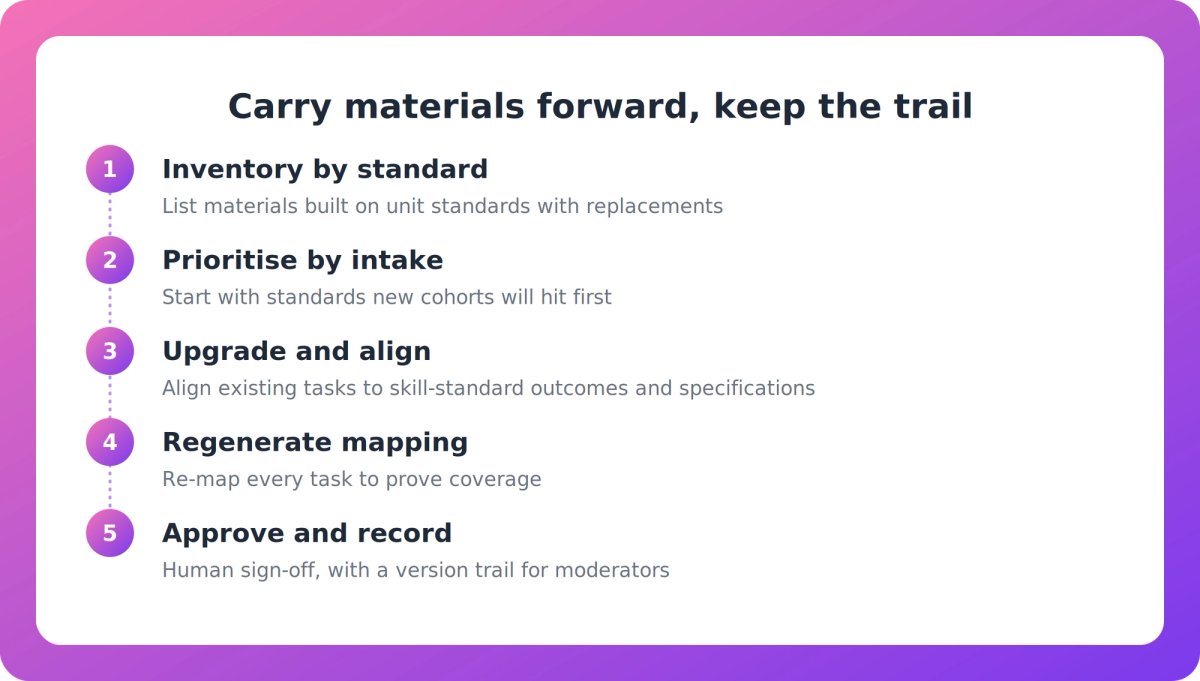
The principle is to carry existing material forward and re-prove coverage, not re-invent the content. A workable process looks like this:
- Inventory by standard. List which unit standards your assessments, study guides and strategies are built on, and which have a skill-standard replacement.
- Prioritise by intake. Start with standards that new cohorts will hit first. Learners partway through stay on the old version.
- Upgrade, don't rewrite. Bring the existing task and context across, then align it to the skill standard's learning outcomes and assessment specifications.
- Regenerate the mapping. Re-map every task to the new standard so coverage is shown, not assumed.
- Keep the trail. Record which version replaced which, so moderators can follow it.
- Approve with a person. A qualified human signs off before anything is used with learners.
An illustrative example: construction
Picture a PTE running a construction programme. Half the cohort is mid-way through unit-standard-aligned assessments. A new intake starts next month and needs skill-standard-aligned ones.
That provider needs both versions live, clearly separated, each mapped to its own standard. Without version control, the risk is a learner getting the wrong paper, or a moderator unable to tell which version a piece of evidence belongs to. (This is a hypothetical scenario, not a customer case.)
How does VETos support the move to skill standards?
VETos holds both unit standards and skill standards in its regulatory graph. Any unit or skill standard can be pulled into your workspace and built against directly.
Two capabilities matter for conversion:
- Upgrade in step. Per the VETos FAQ, existing unit-standard materials can be upgraded to their skill-standard replacements as they convert, with the mapping regenerated and a version trail moderators can follow.
- Draft against the new standard. New assessments and learning content can be drafted directly against a skill standard's learning outcomes and assessment specifications.
Why does a shared source of truth matter?
VETos uses what it calls a centre of record: a live regulatory graph of scope, qualifications, units and standards. It joins the assessment, study guide and training and assessment strategy to the same source of truth and to each other. The FAQ puts it this way: "Change a unit on the register and everything grounded in it knows."
For a rolling transition, that's the point. You aren't chasing the same change across three documents by hand.
Generated assessments are mapped back to the standard's elements and performance criteria. Theory and Practical versions stay mapped to the same standard, which helps when you deliver in more than one mode.
What the evidence does and doesn't show
Be clear-eyed here. The public material doesn't include a conversion-specific case study or metric. It doesn't detail how a moderator sees differences between standard versions, and it doesn't list which skill standards are currently loaded.
So test it. Take one real unit-standard assessment, run it through the upgrade, and check three things: the regenerated mapping, the version trail, and whether your moderator can follow it without a briefing. You can see more on the VETos NZ page.
Our take
Most providers will lose time in this transition not on writing, but on proving. Anyone can draft a new assessment. The harder job is showing a moderator, quickly, that it still covers the standard and descends from something already validated. We think the providers who treat conversion as a standing, traceable process will spend far less effort than those who run a fresh rewrite every time a standard moves.
FAQ
Do unit standards disappear immediately when a skill standard replaces them?
No. NZQA is progressively replacing unit standards, usually with a two-year transition window. That's why many providers will run old and new versions in parallel for a time.
Can we reuse our existing unit-standard assessments?
In principle, yes, and that's the safer route. Carry the content forward, align it to the skill standard's learning outcomes and assessment specifications, and regenerate the mapping. VETos supports upgrading existing materials this way, with a version trail.
Who sets standards now?
The eight Industry Skills Boards took over standard-setting on 1 January 2026. NZQA's revised rules followed on 19 January 2026.
How do we keep moderators confident during the switch?
Keep every assessment mapped to a named standard and version, record what replaced what, and keep a person approving before release. A version trail turns moderation into a check, not an investigation.
Does VETos have conversion metrics we can rely on?
Not publicly. The available material describes the capability but gives no conversion-specific figures, so pilot it on a single standard in your own library first.
Next step
Pick one unit standard with a skill-standard replacement and audit its assessment, study guide and mapping today. If you'd like to see how an upgrade and version trail work on your own material, take a closer look at VETos for NZ or ask for a walkthrough.