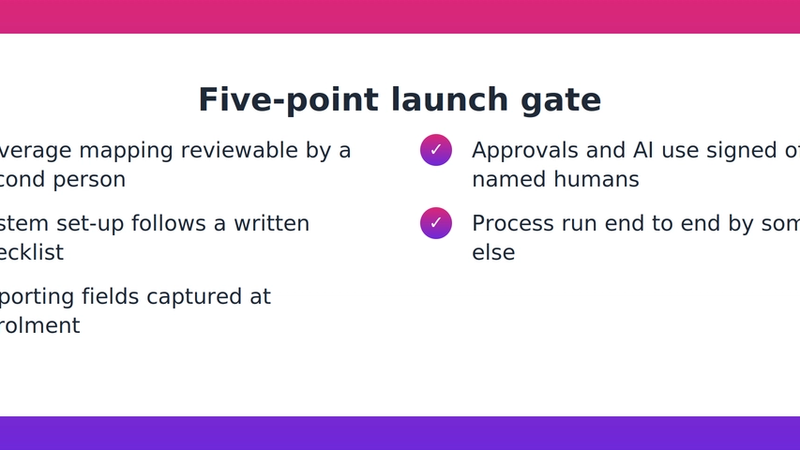
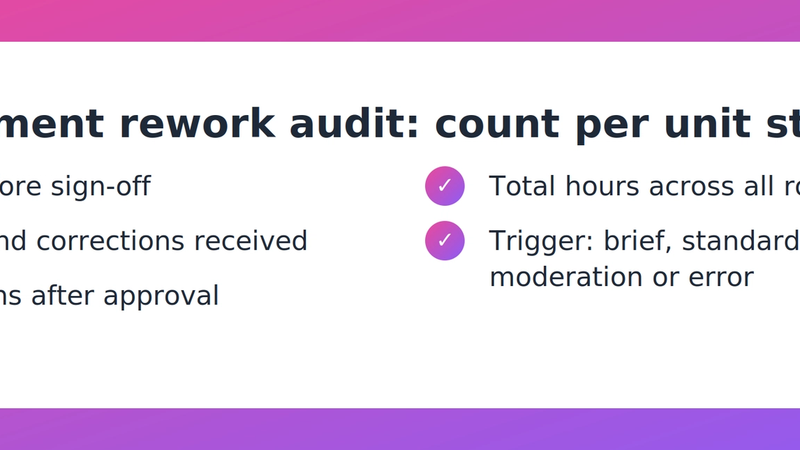
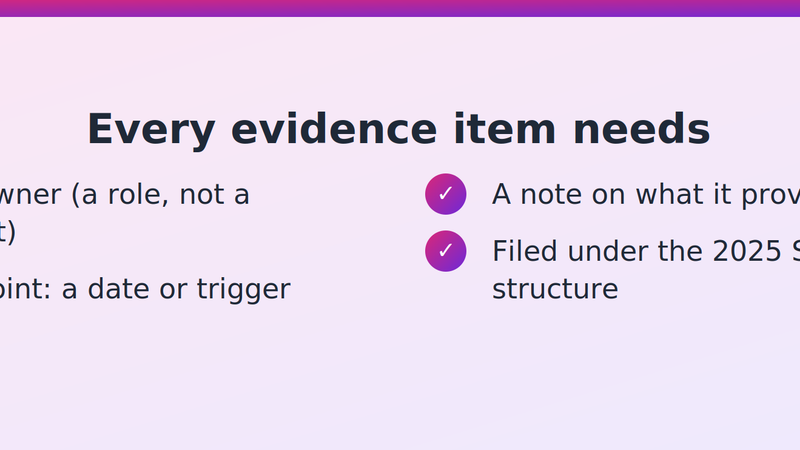
When two trainers mark the same learner differently, the instinct is to retrain or add sign-off. NZQA's own framing points elsewhere: 'fair' means equal opportunity regardless of who does the assessing or when. Inconsistency is usually a task problem that shows up as an assessor problem. Fixing the task is cheaper and lasts longer.
Why this lands on your desk
You own assessment quality across a team of trainers. When two assessors diverge, you are the person asked why.
The pressure is rising. NZQA says internal moderation must be embedded in every TEO's quality management system. From 2026, the Quality Assurance of Tertiary Education Providers Rules 2026 replace the earlier rules that included External Evaluation and Review. They centre on an up-to-date QMS, annual self-review, reporting to NZQA and discussing it with NZQA. Much of the evidence that self-review rests on comes from your area.
Then there is turnover. Consent and Moderation Requirements (CMR) must keep being met when teaching, assessing and moderation staff leave or are replaced. New staff must be told about them before they start. Every departure and every new hire is a consistency risk you manage directly.
What NZQA actually says about consistency
NZQA describes internal moderation in two halves. Pre-assessment moderation covers the assessment materials. Post-assessment moderation covers the learner work. The stated purpose is consistency within your organisation, over time and between assessors.
Most providers invest heavily in the second half: sampling, second-marking, sign-off. That is necessary, but it finds variation after it has happened. The first half is where you can stop variation from being created.
NZQA's moderation principles require assessment to be fair, valid and consistent. Read 'fair' again: the same opportunity whoever assesses and whenever. That is a design requirement for the task as well as a behavioural one for the assessor. If the task allows two reasonable readings, two assessors will take two readings, and neither is at fault.
Why policing assessors does not survive turnover
Consistency that lives in the heads of experienced assessors leaves with them. The workforce context is not reassuring. OIA documents reported by The Spinoff show Te Pūkenga staffing fell by 855, from 10,480 in 2023 to 9,625 in 2024. The Tertiary Education Union's national secretary said about 10% of the vocational workforce had disappeared. That is one institution's picture, not the whole sector, but it shows how quickly institutional knowledge can go.
More sign-off layers add load to the people you can least afford to overload. A clear task needs no veteran to interpret it. It works the same for the new trainer in week two as for the one who has marked it twenty times.
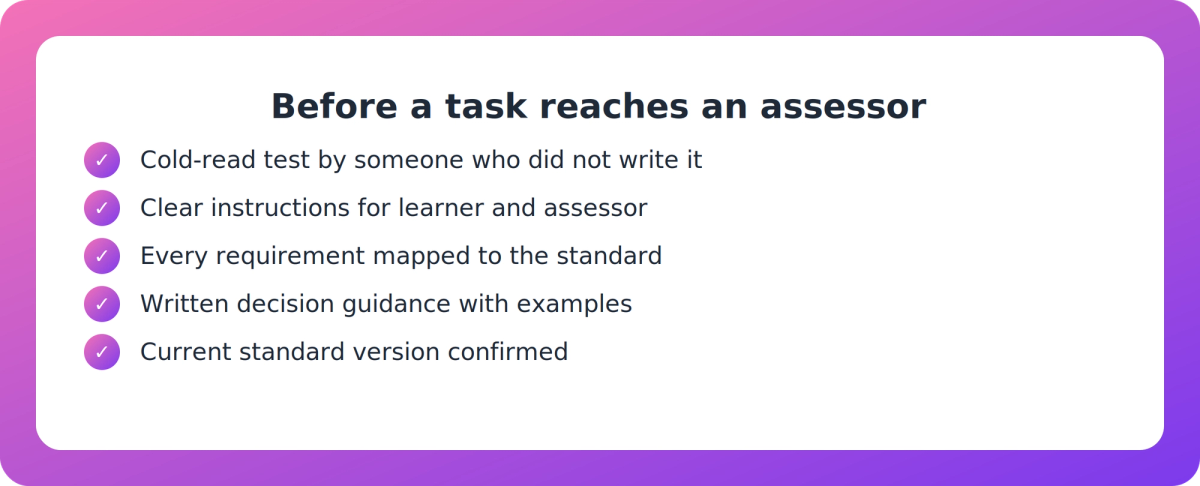
Five checks before a task reaches any assessor
These are practical suggestions, not NZQA requirements. Run them at pre-assessment moderation, and again whenever a task is reused.
- Cold-read test. Give the task to someone who did not write it and ask them to say what a pass looks like. If their answer differs from the author's, the task needs rewriting.
- Instructions for the learner and the assessor. Is it clear what evidence is required, in what form, and under what conditions? Ambiguity about conditions (open book, supervised, workplace-observed) is a common source of different decisions.
- Mapping to the standard. Each task requirement should trace to a specific element of the unit standard, and each element should be covered. Gaps and over-assessment both produce divergent marking.
- Decision guidance. Where judgement is unavoidable, write down what sufficient evidence looks like, with an example of acceptable and unacceptable responses.
- Version check. Confirm the task maps to the current version of the standard, not the one it was written against.
The version problem is now live
Industry Skills Boards were formally established on 1 January 2026, with standard setting as their core role (TEC FAQ). NZQA's ISB rules require arrangements for developing, setting and maintaining skills standards and capstone assessments, and for maintaining unit standards.
I would not assume a task you wrote two years ago still maps cleanly. Checking the current standard version before reusing any material is prudent. A task built against a superseded version can produce consistent marking against the wrong benchmark, which is arguably worse than inconsistency.
There is a calendar angle too. For NZQA-managed standards, TEOs must give NZQA an accurate annual assessment plan, update it during the year if needed and meet moderation deadlines. The plan is due by the end of November. A task inventory that records the standard version for every assessment makes that plan far easier to get right.
Key takeaways
- NZQA defines 'fair' as equal opportunity regardless of who assesses or when. That is a property of the task, not only of the assessor.
- Internal moderation covers materials before use as well as learner work afterwards. Weight your effort towards the first.
- CMR obligations apply when staff leave or are replaced, and new staff must know them before they start assessing.
- The 2026 rules centre on an up-to-date QMS and annual self-review. Moderation evidence is part of that story.
- With Industry Skills Boards maintaining standards, check the current version before any task is reused.
Our take
Policing assessors is the visible response to inconsistency, so it feels like action. But it treats every divergence as a people problem and makes your scarcest resource, experienced trainer time, the control mechanism. We think that is backwards.
The better test of your system is simple: could a competent trainer you hired last month assess this task the way your best assessor would, using only what is on the page? If not, the fix sits upstream, in the wording, the evidence requirements, the decision guidance and the mapping.
This is not an argument for dropping post-assessment moderation. It is an argument for treating what moderation finds as feedback on the task first and the assessor second. A first step for this quarter: pick the three assessments where your trainers disagree most, and run the cold-read test on each.
FAQ
Is inconsistent marking usually a trainer capability issue?
Not necessarily. NZQA's definition of 'fair' is equal opportunity regardless of who assesses or when, which puts weight on task design. If capable assessors diverge on the same task, look first at its instructions, evidence requirements and mapping.
What does NZQA mean by pre-assessment and post-assessment moderation?
Pre-assessment moderation checks assessment materials before they are used. Post-assessment moderation checks learner work after it is assessed. NZQA says internal moderation must be embedded in a TEO's quality management system and covers both.
How should we handle consistency when assessors leave or join?
Providers must make sure CMR requirements continue to be met when teaching, assessing and moderation staff leave or are replaced. New staff must be told of those requirements before they start. Clear tasks with written decision guidance reduce dependence on what departing staff knew.
How do the 2026 rules change moderation for a PTE?
The Quality Assurance of Tertiary Education Providers Rules 2026 replace the earlier rules that included External Evaluation and Review. They centre on an up-to-date QMS, annual self-review, reporting to NZQA and discussing it with NZQA. Well-documented moderation is useful evidence for that review.