RTO Operations Management: Course Launch Debt for COOs
A course launch isn't finished when the first learner enrols. It's finished when the mapping, system set-up, reporting fields and evidence trail behind it can be repeated by someone other than the person who built them. Skip those steps and you haven't saved time. You've borrowed it, and operations repays it.
Why this lands on your desk
Every new product touches enrolment, delivery, reporting and finance. That makes a launch shortcut an operations problem long before it's a product problem.
Two things sharpen it right now. First, ASQA says providers should demonstrate systems for all aspects of the Standards for RTOs 2025, which replaced the 2015 Standards on 1 July 2025. Your CEO signs the Annual Declaration on Compliance. You are the one judged on whether launch processes are repeatable and evidenced, or reconstructed under pressure.
Second, reporting is changing underneath you. More on that below.
One caveat. We found no authoritative public benchmark for what course launches cost, or for "operational debt" in RTOs. Treat the term as a lens for decisions, not a measured statistic. The argument rests on regulatory and reporting changes, not on invented numbers.
What operational debt looks like after launch
The debt rarely shows up on launch day. It shows up three months later, and it usually takes one of four forms:
- Hand-built mapping. Assessment-to-unit coverage was pieced together by one person. When a unit of competency is updated or an assessment is revised, nobody can say with confidence what still holds.
- Improvised system set-up. Course codes, enrolment types and fee structures were configured quickly, then patched. Finance and reporting each work around the gaps in their own way.
- Missing reporting fields. Data wasn't captured at enrolment, so someone chases it later, by email, in a spreadsheet.
- A thin evidence trail. Decisions about content, validation and approvals happened in conversations, not records.
None of these is dramatic alone. Together they are the firefighting that eats your team's week. The tell is process knowledge trapped in individuals' heads: if the person who ran the last launch is on leave, can the next one still go ahead?
The reporting transition raises the interest rate
Reporting is moving from AVETMISS to the VET Information Standard under the VET Data Streamlining Program. The amended Data Provision Requirements Instrument 2020 took effect on 1 October 2026, and version 2.0.0 of the standard was released the same day.
NCVER's comparison describes minimum quarterly reporting, status-based reporting where each change is reported, and a unified national standard with state fields. Submission changes as well. RTOs validate from within their student management system and correct errors there, rather than downloading data, uploading to AVS and repeating until it's clean.
That last point matters for launches. Every new course code, enrolment type and data field you set up feeds a process that is now more continuous and less forgiving of retrospective clean-up.
AVETMISS dates still apply in the meantime. The Q3 2026 collection window runs 1–16 November 2026. The 2026 annual fee-for-service submission window opens 1 January 2027 and closes 28 February 2027, with no extensions. A launch run during the transition is exposed to both sets of rules.
Two cautions. NCVER's software register covers national AVETMISS reporting only and doesn't assure state or territory requirements, so confirm those obligations separately. And rollout is progressive from 2026, so check where your vendor actually sits rather than assuming.
More products, same team
NCVER's *Total VET students and courses 2025* reports more than 5.1 million students in nationally recognised VET. Qualification enrolments fell by more than 5%, and students in qualifications fell by 108,360. Short courses and stand-alone subjects grew.
NCVER doesn't draw an operational conclusion from this. Ours is simple: a portfolio tilting towards short courses and stand-alone subjects means more distinct products to set up, map, report and administer. If each one is hand-built, headcount scales with the number of launches, not just enrolments.
The growth was also concentrated among younger students (including those in school) and among regional and remote, disability and First Nations students. That varies the support and delivery context your processes have to handle.
AI in the launch process
ASQA has asked whether an RTO's use of AI is compliant with the 2025 Standards, and made AI the theme of its 2026 sector workshops. Some consultant commentary goes further about what ASQA has said on AI and assessment decisions, but we couldn't verify it from ASQA directly, so we won't rely on it.
The operational point holds either way. If AI touches your launch process, you need documented, accountable human oversight: who reviewed what, when, and who signed off.
A launch gate you can apply this quarter
Before the next launch goes live, ask for evidence of each of these. If the answer is "it's in [name]'s head", you've found the debt.
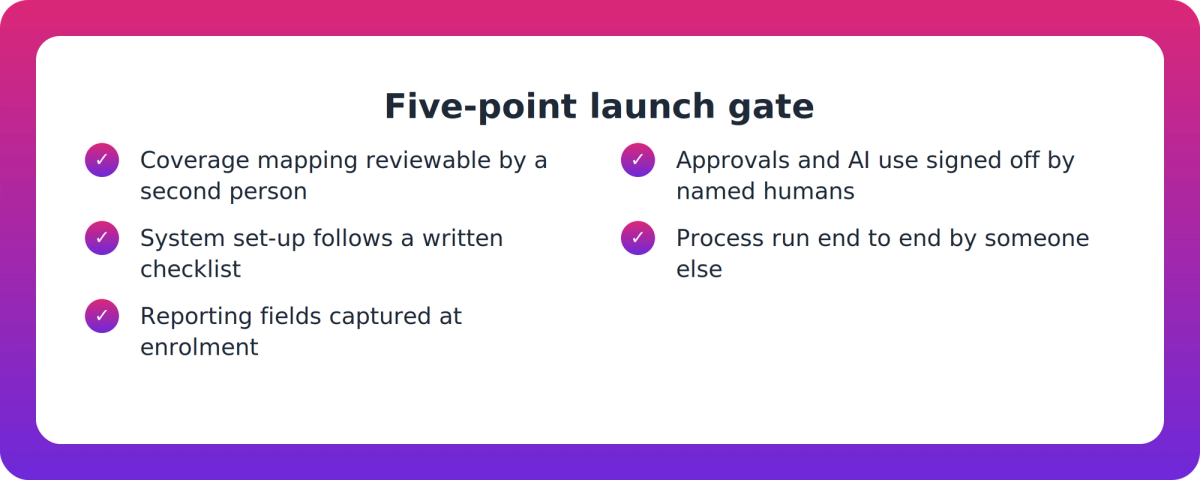
The five-point launch gate
- Coverage mapping to each unit of competency is documented and reviewable by someone other than its author.
- System configuration follows a written checklist, not memory.
- Every reporting field needed for quarterly, status-based reporting is captured at enrolment.
- Validation, approvals and any AI use are recorded with named human sign-off.
- A second person has run the process end to end at least once.
Key takeaways
- A launch isn't complete until mapping, system set-up, reporting fields and evidence are repeatable by someone other than their builder.
- "Operational debt" is a framing lens. No authoritative benchmark exists for its cost, so don't invent one for your board.
- The amended Data Provision Requirements Instrument 2020 took effect on 1 October 2026. Quarterly, status-based reporting makes launch-time data decisions matter more.
- AVETMISS deadlines still apply during the transition, and state or territory obligations need separate confirmation.
- Growth in short courses and stand-alone subjects means more products to administer. That is our reading of NCVER data, not NCVER's.
Our take
Most RTOs treat launch speed as the metric that matters. We think it's the wrong one for operations. The better measure is how much of a launch the second person could run without calling the first.
That's a position, not a proven law. But the direction of travel supports it: outcome-based standards, system-based reporting and a product mix that multiplies the number of launches all reward processes that are written down and shared. A fast launch that only one person understands is a loan, not a win.
A concrete first step: pick your most recent launch and ask your team to reconstruct its mapping, configuration and evidence trail without the person who ran it. What they can't find is your debt list.
FAQ
What is operational debt in an RTO?
It's a framing lens, not a formal or measured term. It describes work skipped or hand-built at launch (mapping, system configuration, reporting fields, evidence) that returns later as rework, reporting scrambles and audit exposure. We found no authoritative benchmark quantifying it.
What changes for reporting under the VET Information Standard?
NCVER describes minimum quarterly reporting, status-based reporting where each change is reported, and a unified national standard with state fields. RTOs validate within their student management system. The amended Data Provision Requirements Instrument 2020 took effect on 1 October 2026.
Do AVETMISS deadlines still matter during the transition?
Yes. The Q3 2026 collection window runs 1–16 November 2026. The 2026 annual fee-for-service window opens 1 January 2027 and closes 28 February 2027, with no extensions. Late submission may trigger follow-up from the VET regulator(s).
How should a COO think about AI in course launches?
ASQA has asked whether an RTO's use of AI complies with the 2025 Standards and made it a 2026 workshop theme. Treat any AI-assisted step as needing documented, accountable human oversight, with clear records of review and sign-off.