Assessment inconsistency doesn't start at validation. It starts on the delivery floor, when two trainers read the same unit of competency and reach different conclusions about the same evidence. Validation only makes the gap visible. If the validation meeting is where you first learn about it, you are learning about it late.
Why this lands on your desk
You own the trainers, and you sign off on how units are assessed. That makes you the person who answers for assessment judgements.
The Standards for RTOs 2025 commenced on 1 July 2025 and replaced the 2015 Standards for ASQA-regulated RTOs. ASQA's 2025 Standards FAQ (version 3, December 2025) says providers must ensure assessment is consistent with the requirements of the training product. They must review assessment tools before use. They must also demonstrate that they have conducted validation of assessment practices and judgements.
Each of those obligations sits with the person who runs the trainer team. Inconsistency between trainers is also the first thing a validation exercise tends to expose.
The regulator's attention is not drifting away either. ASQA's Corporate Plan 2026–27 calls embedding the 2025 Standards its most significant regulatory priority. Its 2025–26 risk priorities flagged high-volume, low-quality RPL assessment models, and short-delivery RTOs whose focus shifts to assessment rather than skill and knowledge development. Both are assessment-quality concerns, and both come down to whether judgements are sound and repeatable.
What validation can and can't do for you
Validation is a check on the assessment system. It is not a substitute for managing it.
Per ASQA's FAQ, validation is done by one or more people who collectively hold the validation credential specified in the Credential Policy. Confirm who holds it in your RTO and how validators are assigned to each training product.
Secondary sources (Knowledge Foundry, which you should check against the Outcome Standards text) add two points:
- Validation outcomes must not be determined solely by the person who designed or delivered the training or assessment.
- The RTO must show how outcomes change the assessment system.
The second point matters most for your role. A validation report that sits in a folder demonstrates very little. A tool revised, a trainer retrained or a TAS amended because of a finding is evidence that the system learns.
Some consultant sources describe a maximum five-year validation cycle per training product, using a risk-based approach. ASQA's own wording wasn't in the material I worked from, so confirm it directly before you plan around it. Whatever the cycle, a gap that sits undetected for years is a long time to carry a quality problem.
Build three checks into ordinary delivery
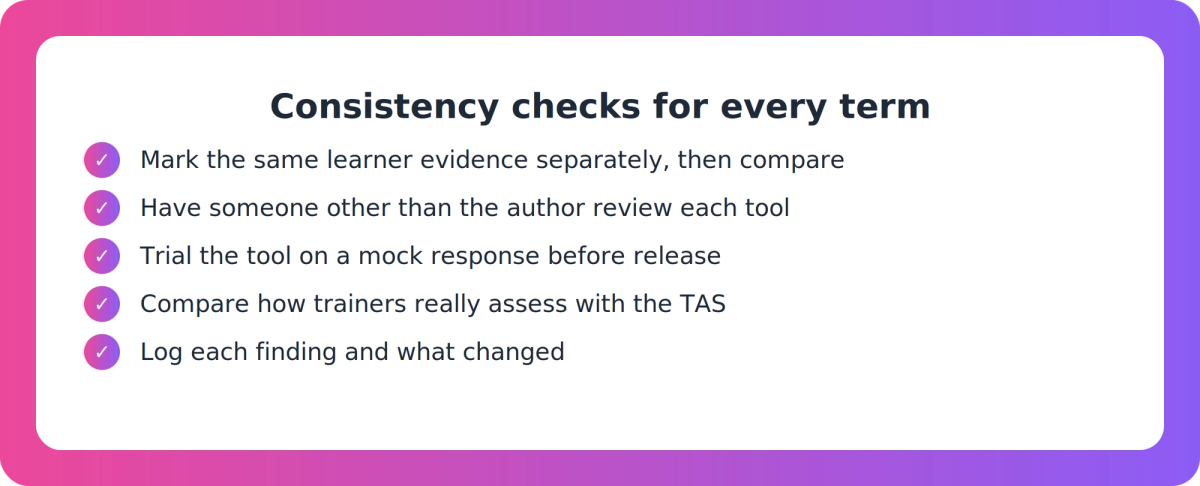
None of this needs a new system. It needs three habits that run every term, not once per validation cycle. These are practical suggestions rather than regulatory requirements.
1. Calibrate judgements together
Pick a unit and a small set of de-identified learner submissions. Have each trainer mark them separately, then compare the calls side by side.
Where trainers disagree, the useful question is which part of the unit requirements or assessment conditions each person relied on. Record the answer and fold it into the marking guide. Thirty minutes in a team meeting will tell you more about consistency than a policy document will.
2. Review tools before they reach learners
The FAQ says tools are reviewed prior to use, so treat that as a gate, not a retrospective. Someone other than the author reads the tool against the unit requirements. Ideally one trainer also tries it on a mock response before release.
Many inconsistencies are built into the tool. A vague question or an unclear benchmark answer produces different judgements however capable your trainers are.
3. Reconcile what trainers do with the TAS
Secondary commentary on ASQA's 2026–27 priorities (eSkills Australia) suggests providers be able to reconcile actual delivery with the TAS. ASQA's own 2026–27 page wasn't among the sources I reviewed, but the logic holds regardless.
Ask two or three trainers to describe how they actually deliver and assess one unit: the sequence, the evidence they collect, where they use observation. Lay that beside the TAS. Differences are not always failures, but each one needs a decision. Either the practice changes or the TAS does.
Treat trainer variation as information
Trainers rarely assess differently out of carelessness. They assess differently because they are busy, because a tool is ambiguous, or because their industry experience colours what "good" looks like. Outcome Standard 3.3 requires training and assessment to be delivered by people with current industry skills and knowledge, so that experience is something you want. It needs a shared benchmark to sit against.
A word of caution on completions. NCVER's latest four-year completion rate I retrieved (2020 commencements) is 49.0%, and NCVER warns that enrolment and completion counts can't be used to calculate completion rates. Don't claim that inconsistent assessment explains completion results. Treat the figure as context for why quality of delivery gets so much scrutiny.
Close the loop visibly
Keep a simple log of consistency findings and what changed because of each. For example: the tool version was updated, the marking guide was clarified, a trainer was supported, or the TAS was amended.
When a validator or auditor asks how findings change the assessment system, that log is your answer.
Key takeaways
- Inconsistency starts in delivery. Validation exposes it, so find it earlier.
- The 2025 Standards, per ASQA's FAQ, require assessment consistent with the training product, tools reviewed before use, and validation of assessment practices and judgements.
- Confirm who holds the validation credential in your RTO and how validators are assigned.
- Calibrate trainer judgements, review tools before release, and reconcile actual practice with the TAS every term.
- Findings that never change anything are a weak position. Log what changed and why.
Our take
Most RTOs treat validation as an event. We think it works better as a by-product of how the trainer team talks about evidence week to week.
If calibration is routine, validation becomes a confirmation of what you already know. If it isn't, validation is an unwelcome discovery, and you are the person explaining it. The cheapest consistency fix is a shared conversation about a real piece of learner work.
FAQ
What does assessment consistency mean under the Standards for RTOs 2025?
Per ASQA's 2025 Standards FAQ, providers must ensure assessment is consistent with the requirements of the training product. They must also review assessment tools before use and demonstrate that they have validated assessment practices and judgements.
Who can conduct validation?
ASQA's FAQ says validation is done by one or more people who collectively hold the validation credential specified in the Credential Policy. Secondary sources add that outcomes shouldn't be determined solely by those who designed or delivered the assessment. Check this against the Outcome Standards text.
How often must we validate?
Consultant sources describe a maximum five-year cycle per training product, with a risk-based approach. ASQA's own wording on this wasn't retrieved for this post, so confirm it with ASQA guidance before setting your schedule.
What should we do with validation findings?
Act on them and keep the evidence. Secondary sources say the RTO must show how outcomes change the assessment system. A log linking each finding to a revised tool, marking guide, TAS or trainer support is the simplest way to show that.
A good first step this week: pick one high-enrolment unit, collect three de-identified learner submissions, and ask your trainers to mark them separately. Then see where the answers differ.