If you have to hunt through shared drives, inboxes and spreadsheets to answer an ASQA question, your audit-readiness depends on heroics, not design. Evidence sprawl isn't a diligence failure. It's a filing design flaw that shows up under pressure, and under the 2025 Standards it's one you can fix without buying anything.
Why this lands on your desk
You're accountable for registration. ASQA says providers must demonstrate compliance against the Standards in effect at the time a decision is made, and that staying informed of changes is the provider's responsibility. Audits that began under the 2015 Standards and ran past 1 July 2025 may need additional evidence against the revised Standards. Your filing has to cope with a moving target.
ASQA can also ask for some items at any time. The 2025 Standards FAQ says that includes conflict of interest disclosures and how they are managed. All governing persons must submit Fit and Proper Person Declarations. That's a retrieval test, not an annual audit-prep exercise.
If every one of those requests routes through you, you're the bottleneck. A good week is one where someone else can find the evidence. A bad week is the one where you're the only person who knows where it lives.
What the numbers do and don't say
In ASQA's 2024–25 data, 221 of 284 performance assessments (78%) found non-compliance. Of those 221, 102 (46%) satisfied ASQA they had returned to compliance. From July 2025 to March 2026, 45 of 116 assessments (39%) found non-compliance.
Don't read those two rates as a trend. They aren't directly comparable, and ASQA hasn't explained the gap. What they do show is that findings are common.
The most common 2024–25 non-compliance areas were training and assessment strategies and practices (clauses 1.1 and 1.2), conducting effective assessment (1.8), and trainer and assessor employment (1.13 and 1.16). Those are 2015 clause numbers. In each area, a document alone doesn't answer the question. You need to show how practice is implemented, monitored and evaluated.
Why evidence filed by clause number goes stale
Many RTOs built their evidence folders around 2015 clause numbers. That structure now points at a superseded framework, so every new question means translating before you can retrieve.
ASQA's Statement of Intent 2026 says it will embed the 2025 Standards by emphasising outcomes over inputs, continuous improvement and timely, tailored feedback. For filing, that points toward evidence of results and improvement cycles. A policy sitting alone in a folder is the weakest item you can hold.
Design the system around the Standards and an owner
ASQA doesn't prescribe a format for evidence filing, and I found no official format for early-warning systems either. The design choices are yours. That's a liberty and a responsibility.
Start with the structure of the 2025 Standards: the Outcome Standards, the Compliance Standards (including the Fit and Proper Person Requirements and the NRT Logo Conditions of Use Policy) and the Credential Policy. One secondary source, trainingservices.com.au rather than the regulator, describes the Outcome Standards as 23 standards in four quality areas: training and assessment, VET student support, VET workforce, and governance. That grouping is a sensible top-level spine for a filing system.
Three fields every evidence item needs
For each standard, record three things beyond the document itself:
- Owner. A named role, not a department. The owner is responsible for the evidence being current, not you.
- Review point. A date or trigger, such as a Standards update, a trainer change or a complaint outcome.
- What it proves. Does this item show a policy exists, or that practice is monitored and has improved?
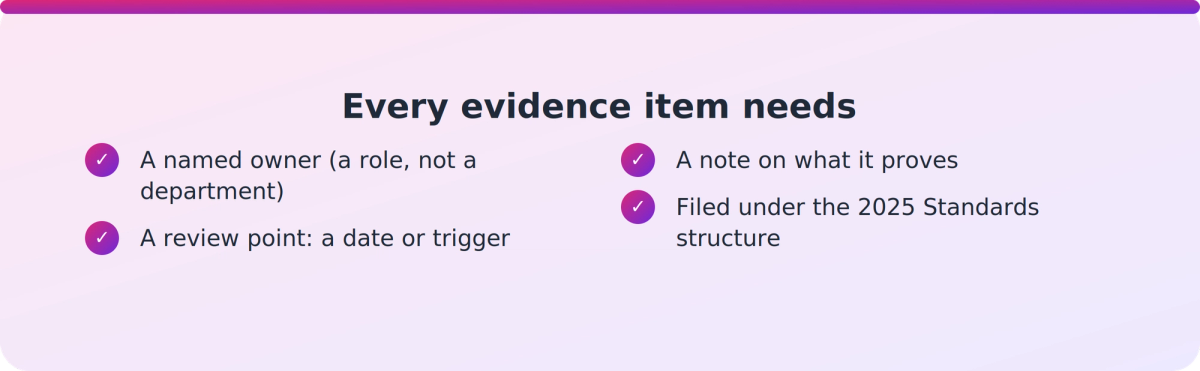
The third field matters most. It stops you filing a policy and calling it evidence, and it exposes gaps in the areas ASQA keeps finding.
Build for the "any time" requests first
Treat the items ASQA can request at any time as your design test. If you can produce these within the hour without asking the person who filed them, the system works.
- Conflict of interest disclosures and management information. The 2025 Standards FAQ says ASQA may request both at any time.
- Fit and Proper Person Declarations for all governing persons.
- Complaints and appeals timeframes. The FAQ removes the fixed 60-day timeframe and requires providers to set reasonable timeframes for responding to and resolving complaints. If you can't show how you set yours and how you monitor against them, you have a traceability gap.
Self-assurance is your design responsibility
ASQA's Annual Declaration on Compliance ran to 31 March 2026. Some consultancies say the pre-2025 self-assessment tools are retired, but I couldn't verify that, so check ASQA directly. One vendor blog also notes ASQA doesn't prescribe self-monitoring metrics. Whatever the official position, the practical point holds: nobody will hand you an early-warning system, so you have to design one.
A simple version is a review-point calendar tied to your owners, plus a monthly look at which items are overdue. For priorities, read ASQA's own risk priorities page rather than a summary. ASQA published its 2026–27 priorities in August 2026, and I haven't characterised them here.
If you use AI tools anywhere in evidence handling, document how. ASQA released Principles for the Responsible Use of AI in VET (ASQA IQ, August 2026). A March 2026 workshop note from Skills Education, which isn't ASQA, says enforcement will cover non-compliant AI use against the 2025 Standards. Traceability applies to your tools as well as your files.
Key takeaways
- Audit-readiness is mostly a design problem. If retrieval depends on you, the system is the weak point.
- Compliance is judged against the Standards in effect at the time of the decision, so evidence filed by superseded clause number goes stale.
- ASQA doesn't prescribe an evidence filing format. Organising by the 2025 Standards, with an owner and review point per item, is a defensible choice.
- Findings are common (78% of 2024–25 performance assessments, 39% from July 2025 to March 2026), but the two rates aren't comparable and aren't a trend.
- Evidence should show implementation, monitoring and improvement, not just that a document exists.
Our take
Most Compliance Managers are good at diligence. That's why the sprawl persists: diligence covers for bad design, and the cover works until the week it doesn't. Heroics feel like competence, but they're a single point of failure with your name on it.
The fix is unglamorous. Pick a spine (the Standards), assign owners, set review points, and require each item to say what it proves. Then test it. Take the any-time requests above and time how long retrieval takes without you.
This week, run that test on one item, such as conflict of interest management. If someone other than you can't find it in minutes, you've found where to start.
FAQ
Does ASQA prescribe how RTOs must file audit evidence? No. The research found no official prescribed format for evidence filing or early-warning systems. How you organise evidence, and who owns each item, is the RTO's design decision.
Should I re-file evidence by the 2025 Standards? It's worth doing. ASQA assesses compliance against the Standards in effect when a decision is made, and audits that began under the 2015 Standards and continued past 1 July 2025 may need additional evidence against the revised Standards. Filing by superseded clause number adds translation work under pressure.
What can ASQA ask for at any time? The 2025 Standards FAQ says ASQA may request conflict of interest disclosure and management information at any time. All governing persons must also submit Fit and Proper Person Declarations. Build your filing so these are immediately retrievable.
Are the 78% and 39% non-compliance figures a trend? No. They cover different periods, 2024–25 and July 2025 to March 2026, and aren't directly comparable. ASQA hasn't explained the gap. Treat them as evidence that findings are common.