Assessment rework is the most expensive thing in your PTE that never appears on a P&L. Every assessment that is drafted, queried, corrected and re-versioned is paid for twice, in team capacity rather than invoices. With EER gone and self-review carrying the weight, auditing that rework is now an operations job, not a compliance chore.
Why this lands on your desk
NZQA's PTE Rules 2026 took effect on 19 January 2026. They require every PTE to run a coherent system to ensure assessment and moderation requirements are met across all accredited programmes, micro-credentials and consents to assess.
That is a systems requirement. It sits with whoever owns how work actually gets done, which is you.
Two other shifts add pressure. External Evaluation and Review has been removed as a quality assurance mechanism and replaced by self-review and monitoring. And Industry Skills Boards (ISBs) took over standard-setting from 1 January 2026, so the standards your materials are built on are still moving while delivery carries on.
No external review cycle is going to prompt you to look for waste. The evidence trail, and the improvement story behind it, is yours to build.
What "coherent" means when you run the place
NZQA's wording is the rule; the operational reading is ours. Here is the test we'd apply: if your lead assessment designer went on leave for a month, would the system still produce current, moderated, traceable assessments?
If the honest answer is "it depends who picks it up", the process lives in people's heads. A system that relies on individuals' memory and manual correction is hard to describe as coherent, however good those individuals are.
"Coherent" translates into three things you can inspect:
- Repeatable: the same steps produce the same quality regardless of who does them.
- Documented: a new team member can follow it without a hallway briefing.
- Traceable: you can show which version of an assessment was tied to which version of a standard, and when it was last checked.
Where assessment work gets done twice
Rework rarely announces itself. It shows up as ordinary busyness. These are the usual places to look:
- Drafting against an unclear brief. The assessor or designer guesses, the reviewer queries, the draft is reworked.
- Standard changes. A standard's version or status changes and the materials need revisiting. The Rules also remove the five-year maximum review period for assessment and skill standards, so you can't rely on a predictable review rhythm.
- Moderation findings. An issue found late sends work back through drafting.
- Format duplication. The same assessment is rebuilt for classroom, workplace and distance delivery.
- Version sprawl. Three copies in three folders, and someone delivers the wrong one.
None of this is unusual. The problem is that none of it is counted.
Run the audit: five counts per unit standard
No public source puts a dollar figure on assessment rework in NZ PTEs. There is no benchmark to borrow, and NZQA's 2026 moderation outcomes under the new framework are not yet published. So the only credible number is one you generate yourself.
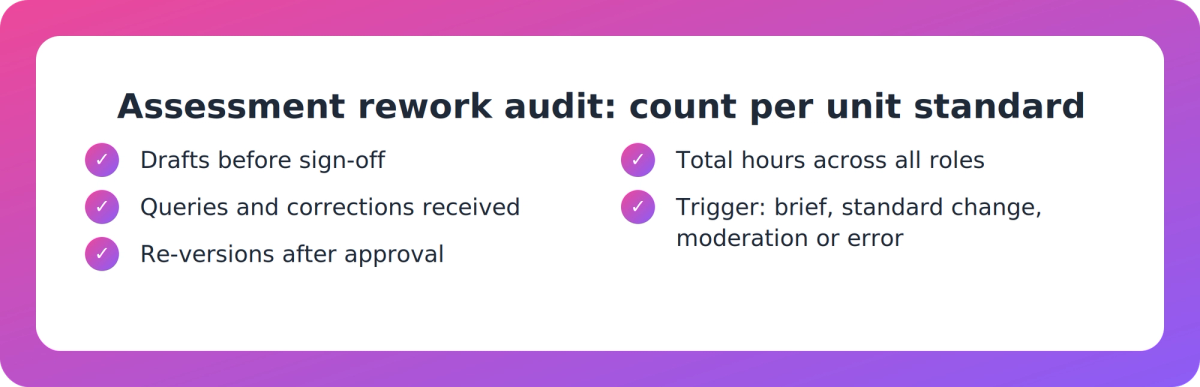
Pick a sample of unit standards across your busiest programmes and, for each, count:
- Drafts: how many versions before sign-off?
- Queries: how many questions or corrections came back, and from whom?
- Re-versions: how many times was it reissued after approval?
- Hours: total time across designers, assessors, reviewers and admin.
- Trigger: was each rework loop caused by an unclear brief, a standard change, a moderation finding or a simple error?
The fifth count matters most. Rework caused by standard changes needs version and status tracking. Rework caused by unclear briefs needs a better intake step. Different causes, different fixes.
Multiply the hours by your own loaded staff rate. That is your first rework figure, and it will be uncomfortable and useful in equal measure.
Rework also reaches your reporting
If you're a funded provider, your Single Data Return goes to TEC through the Data Exchange Platform. TEC describes the SDR as the data items required for funding, monitoring performance and publishing. TEC's schedule lists March IND and April, August and December SDR windows, but the dates carry no year, so confirm them on TEC's current page.
When assessment records are re-versioned or corrected after the fact, someone has to reconcile them before they become reportable. That is rework too, just further downstream. Add a sixth column to your audit: how many corrections touched reported data?
Cost pressure makes the number matter
Budget 2025 enabled providers to raise fees by up to 6% in 2026. That gives some relief, but it is a ceiling on one lever, not a plan for capacity.
ISBs receive $30 million a year in dedicated funding from 1 January 2026, and they will also draw on fees for quality assurance services. Check your ISB's consent and moderation fees. Rework may now carry a direct price as well as an internal one.
There is also possible upside. Connexis says work-based programmes can transition to polytechnics, PTEs or wānanga by 1 January 2028, which could add assessment volume for some PTEs. Te Pūkenga is a transitional entity, due to be disestablished on or before 31 March 2027. If volume grows and your rework rate stays flat, your headcount grows in lockstep. That is the linear-scaling trap.
Our take
Most PTEs treat assessment quality as something to be inspected into the work after it is done. That made a certain sense when an external review cycle did the prompting. It makes less sense now.
Our position: rework is a process-reliability metric, and it belongs on your operations dashboard next to utilisation and reporting turnaround. If you can show a falling rework rate, you have a stronger self-review story than any policy document gives you. If you can't measure it, you're asserting coherence rather than demonstrating it.
We don't know what a good rework rate looks like in your context, and nobody else does either. That's the point of measuring your own.
Key takeaways
- NZQA's PTE Rules 2026 (in force 19 January 2026) require a coherent system for assessment and moderation, and that is an operations responsibility.
- With EER replaced by self-review and monitoring, the evidence that your system works has to come from you.
- No public data quantifies assessment rework for NZ PTEs, so audit your own: drafts, queries, re-versions, hours and trigger per unit standard.
- Standards are still moving under the ISBs, so materials need version and status tracking.
- Rework carries cost on three fronts: staff capacity, reporting corrections and possibly ISB quality assurance fees.
FAQ
What do the PTE Rules 2026 require for assessment and moderation?
They require a PTE to operate a coherent system to ensure assessment and moderation requirements are met across all accredited programmes or micro-credentials and all consents to assess. They took effect on 19 January 2026, replacing the PTE Registration Rules 2025 and the PTE Enrolment and Academic Records Rules 2022.
Has EER been replaced, and what does that mean for operations?
Yes. EER has been removed as a quality assurance mechanism and replaced by self-review and monitoring under NZQA's Te Hono o Te Kahurangi. The Technical Institute reports that providers send NZQA a yearly self-review summary and then discuss their improvement plan. That is secondary-source reporting, so check the Rules for deadlines.
Is there a benchmark for assessment rework cost in NZ PTEs?
No authoritative source quantifies it, nor manual reporting effort or utilisation. Your best evidence is an internal audit counting drafts, queries, re-versions and hours per unit standard, then costing those hours at your own staff rates.
How do I keep assessment materials aligned while standards change?
ISBs took over standard-setting from 1 January 2026, and the Rules removed the five-year maximum review period for assessment and skill standards. Track the version and status of each standard against each assessment, and record when the pairing was last checked.
Your first step this week: choose five unit standards, pull their file histories and count the drafts. What the count shows may change your next capacity conversation.