Assessment Consistency Across RTO Trainers: For Heads of Training
When two trainers judge the same evidence differently, the fault usually sits in the assessment system, not the trainer. Under the Standards for RTOs 2025, you're expected to design consistency in and catch gaps before a tool is used, rather than discover them at a five-yearly validation. That is a workload decision as much as a compliance one.
Key takeaways
- Treat inconsistent judgements as a design and workload signal first, and a trainer capability issue second.
- Five-yearly validation is a minimum. The Standards' "more often where needed" wording supports checking higher-risk units sooner.
- Reviewing an assessment tool before use is a lower-barrier checkpoint. It catches unclear benchmarks before they spread across your trainers.
- Validation findings only count if they change the tool or the practice. Filing them does nothing.
- Auditors reportedly weigh demonstrated consistency across trainers, cohorts and delivery modes. That is commentary, not official ASQA wording.
Why inconsistent judgements land on your desk
You own the trainers and the assessment system they work in. Standards 1.3 to 1.5 cover a fit-for-purpose assessment system, fair and appropriate assessment, and validation by appropriately skilled and credentialled people. The revised Standards came into full regulatory effect on 1 July 2025, and Training Services' guide to the Outcome Standards sets out how those requirements read in the instrument.
So when a unit produces different outcomes depending on who marks it, the question comes to you. You also answer for trainer workload. Standard 3.3 expects trainers and assessors to hold the TAE qualification and industry competencies at least to the level of the product, which is hard to sustain when paperwork eats delivery time. Tired assessors make uneven calls.
What the 2025 Standards actually ask for
Validation is a floor, not a plan
The ASQA Assessment Practice Guide says validation must happen at least once every five years for every training product on scope, or more often where needed. If you wait for the cycle, you find inconsistency late, after it has run through several cohorts.
Independence matters too. As Skills Education's Standard 1.5 summary quotes the instrument, the outcome can't be determined solely by someone who designed or delivered the training or assessment. The outcomes must also inform changes to the assessment system.
For non-TAE products, at least one person on the validation team must hold a specified validation credential, per the ASQA Credential Policy Practice Guide.
Review before use is your cheapest checkpoint
The 2025 Standards refer to assessment tools being reviewed before use, not "pre-use validation". According to the ASQA 2025 Standards FAQs, the reviewer doesn't need specific validation credentials. That makes it a practical gate. A tool with a vague benchmark gets fixed once, instead of being interpreted twelve ways by twelve trainers.
Judgement must trace to a qualified person
The Trainer and Assessor Competencies Practice Guide says that where industry experts are involved, the qualified trainer or assessor directing them must make the assessment judgement. Consistency therefore covers who decided, and on what basis, not only what was delivered.
What auditors may look for
Secondary commentary from Kibbo and RTO Coach suggests auditors place more weight on demonstrated outcomes, and on consistency across cohorts, trainers and delivery modes, than on written policy alone. I couldn't find that wording in an official ASQA document, so treat it as informed expectation rather than rule.
The wider environment isn't relaxing either. The DEWR page on ASQA regulatory action reports $4.8 million in 2026-27 for ASQA enforcement against qualification fraud, building on $4.7 million in 2025-26. Notes from an ASQA workshop in March 2026 report over 33 thousand cancellations executed and 212 serious matters under investigation. That is sector-wide context, not a signal about any one RTO. It does explain why assessment integrity gets attention.
Read inconsistency as a workload signal
It helps to ask where the variation actually comes from. Common sources are:
- A benchmark that says "demonstrates safe work practices" without saying what that looks like.
- Several versions of the same tool in circulation.
- Trainers marking late at night because delivery has crowded out assessment time.
- Different delivery modes quietly producing different evidence.
None of those are character flaws. They are design and capacity problems, and you can fix them.
A practical consistency loop for this quarter
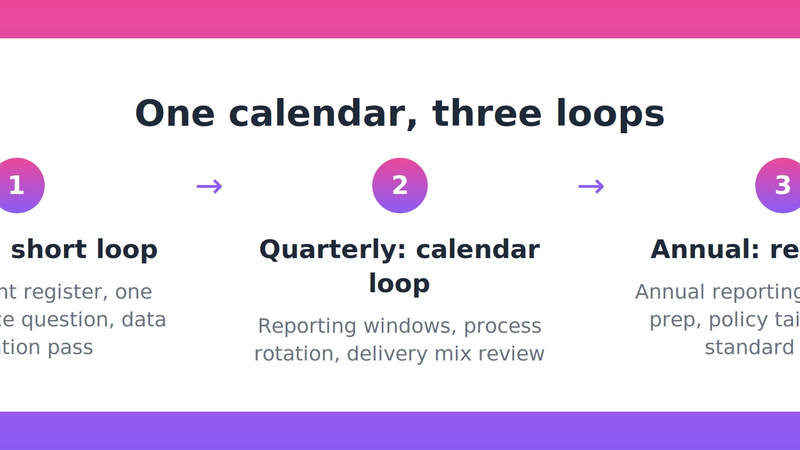
You don't need a new framework. You need a short loop you actually run.
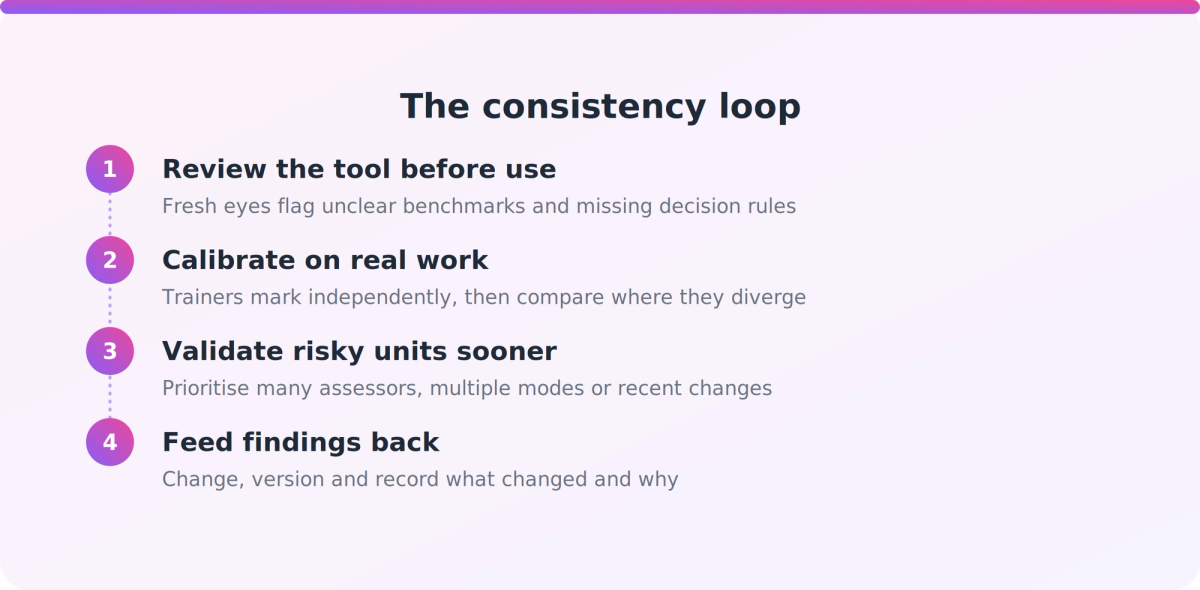
- Review the tool before use. Have someone who didn't write it read it as an assessor would. Flag unclear benchmarks, missing decision rules and ambiguous instructions.
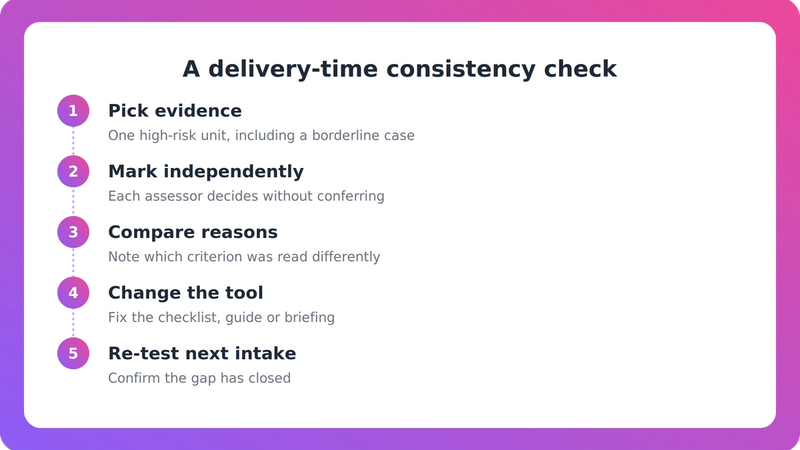
- Calibrate on real student work. Pick a few de-identified samples. Have trainers mark independently, then compare. Where they diverge, the benchmark is usually the culprit.
- Validate higher-risk units sooner. Use the "more often where needed" wording. Start with units that have many assessors, multiple delivery modes or recent changes.
- Feed findings back and record it. Change the tool or guide, version it, and note what changed and why. That record is your evidence of practice.
Here is an illustrative example, not a case study. Three trainers assess the same practical task across classroom, workplace and distance cohorts. In calibration, one passes a learner on a verbal explanation, another asks for a written response, and a third requires direct observation. The fix isn't retraining anyone. It's a clearer benchmark that states acceptable evidence for each mode, issued as one controlled version.
Keep completion data in proportion
You answer for completion, so it's tempting to link inconsistency to drop-out. The evidence doesn't support a causal claim. Future Campus reports 49% completion for 2020 starters, and NCVER data shows personal reasons as the most cited cause of non-completion at 29.5%. Assessment experience is one factor you control, among several you don't.
Our take
Most RTOs treat consistency as something validation proves after the fact. We think that's backwards. Consistency is produced upstream, by clear tools, reasonable workloads and quick feedback from real marking, and validation then confirms it. If your plan relies on a trainer's good judgement and a five-yearly meeting, you're relying on luck. Put the effort where variation starts, and protect the assessment time of the people doing the judging.
FAQ
How often must we validate assessment?
The ASQA Assessment Practice Guide says at least once every five years for every training product on scope, or more often where needed. Treat five years as the floor and bring higher-risk units forward.
Is pre-use review the same as pre-use validation?
No. The 2025 Standards refer to assessment tools being reviewed before use, and ASQA's FAQs say the reviewer doesn't need specific validation credentials. Formal validation still requires appropriately credentialled people.
Can the person who wrote the assessment validate it?
Not on their own. The outcome can't be determined solely by someone who designed or delivered the training or assessment, and the outcomes must be used to inform changes to the assessment system.
Is inconsistent assessment the cause of low completion?
The research here doesn't show that. NCVER data lists personal reasons as the most cited cause of non-completion at 29.5%, so assessment is one factor among several.
Your next step
Pick one unit with several assessors. Have three of them mark the same de-identified piece of work this fortnight, and compare. Whatever differences turn up are your first fix, and the notes you take are your first piece of evidence.