The Standards for RTOs 2025 don't punish providers for being imperfect. They punish providers who only look at compliance when an audit or reporting deadline forces them to. ASQA wants robust systems that monitor ongoing compliance, which makes it an operating rhythm you own, not a project you staff up each audit season.
Key takeaways
- ASQA's stated approach rewards a culture of quality and continuous improvement, so an unmonitored system is an operational failure as well as a compliance one.
- Fixed NCVER reporting windows and the move from AVETMISS to the VET Information Standard make data validation a standing task, not a deadline scramble.
- ASQA's Practice Guides include self-assurance questions. Turn them into a recurring internal review rather than reading them once.
- Process knowledge held by two or three people is a capacity risk in a tight VET workforce. Test it by rotating who runs each task.
- One calendar covering self-assurance, data and workforce is more useful than three separate ones.
Why this hits your desk
The 2025 Standards took effect on 1 July 2025. ASQA describes its approach as encouraging a culture of quality and continuous improvement through robust systems to monitor and evaluate ongoing compliance. Systems and reporting calendars sit with you, so a weak one is your problem.
ASQA has also told providers what it keeps seeing. According to secondary notes from its March 2026 workshop, that includes continuous improvement spreadsheets that are never implemented or monitored, and reactive systems that act only when something goes wrong. If you have ever described your week as firefighting, that is the pattern being named.
The notes also record a caution against buying off-the-shelf policies or systems without tailoring them. That applies to your own templates too.
Where reactive systems break first
Three weak points show up repeatedly in the brief. Each is an operations problem before it is a compliance one.
- The improvement register nobody opens. Actions get logged and then sit. There is no owner, no age, no review.
- Data checked only at the deadline. Errors surface when there is no time to fix them. NCVER did not publish its January–March 2026 government-funded quarterly release because of significant data quality issues in a submission. That is a public example of what late discovery costs.
- Knowledge in a few heads. VET teachers have been in national shortage for two years, according to a secondary recruitment guide citing JSA. Compliance that depends on a few overstretched people is fragile.
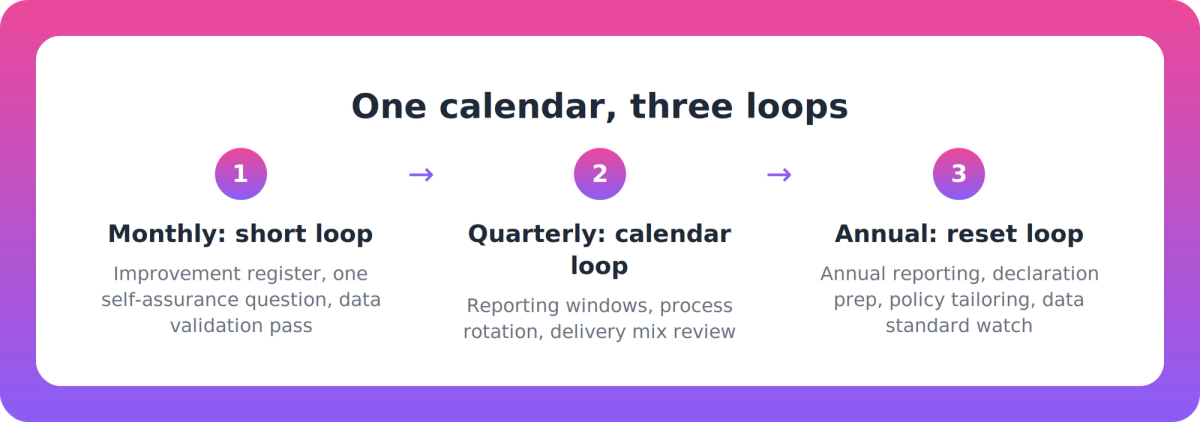
A monthly, quarterly and annual cadence
This is an operating model, not a regulatory requirement. The Standards don't prescribe it, and you should adapt it to your scope and size.
Monthly: the short loop
- Review the continuous improvement register. Check every open action has an owner and an age, and close or escalate anything stale.
- Pick one self-assurance question from the relevant ASQA Practice Guide. The guides are not prescriptive, but they give examples of compliance actions, known risks and self-assurance questions. Ask it of one team and record what you find.
- Run a data validation pass on current enrolment and completion records, using the AVETMISS Validation Software (AVS) where it applies to your submissions. Fix errors while the context is fresh.
- Check capacity. Who is carrying the load this month, and what slips if they are away?
Quarterly: the calendar loop
- Work backwards from fixed reporting windows. NCVER's Data Support Bulletin lists the Q3 2026 fee-for-service window as 1 to 16 November 2026. Confirm every date with NCVER, as secondary summaries can lag.
- Rotate who runs a core process, such as a submission or a records check, and have the primary owner observe. Gaps in documentation show up fast.
- Review the mix of delivery. NCVER's Total VET students and courses 2025 reports qualification enrolments down 11.0% for community education providers, 7.1% for TAFE and 5.5% for private providers, with short courses and stand-alone subjects increasing. That changes workload patterns, not only revenue.
Annual: the reset loop
- Plan around the annual reporting window. The brief gives 1 January to 28 February 2027 with no extensions, but check NCVER's RTO resources before you lock it in.
- Prepare for the Annual Declaration on Compliance. The 2026 period ran 3 to 31 March 2026, so evidence-gathering belongs in the months before.
- Re-read your policies and procedures against how work is actually done. Tailor them, don't just file them.
- Track the move from AVETMISS to the VET Information Standard under the VET Data Streamlining Program. The research did not confirm a firm RTO cutover date, so watch NCVER's pages.
An illustrative example
This is a hypothetical, not a case study. Say your Q3 submission is due 1 November. Under a reactive model, someone starts checking data in the last week of October.
Under this cadence, the monthly pass in August, September and October has already cleared most errors. The quarterly review simply confirms the dates, assigns a backup submitter and signs off. The deadline stops being an event.
Transition: a quiet risk to calendar
Providers must demonstrate compliance against the Standards in effect when a decision is made. If an audit against the 2015 Standards continues after 1 July 2025, you may need to submit additional evidence against the revised Standards. Put any open audit or rectification item on your quarterly review, with a named owner.
Our take
Most advice about the 2025 Standards is written for compliance managers. That's useful, but it leaves a gap. A compliance manager can spot a problem. Only someone who owns the calendar, the systems and the roster can make sure it gets looked at every month.
We think the real test of a COO's compliance model is boring. Could a capable colleague run next month's review if your two most experienced people were away? If not, the risk isn't a missing policy. It's a missing rhythm.
FAQ
Do the Standards for RTOs 2025 require a monthly, quarterly and annual review cycle?
No. The cadence here is an operating approach, not a requirement. It aligns with ASQA's stated preference for robust systems that monitor and evaluate ongoing compliance and with fixed reporting windows.
How should a COO use ASQA's Practice Guides?
Treat them as a source of questions, not a checklist. They aren't prescriptive, but they include examples of compliance actions, known risks and self-assurance questions. Rotating one question a month through an internal review is a practical use.
What reporting dates should operations plan around?
All RTOs must report all Total VET activity to NCVER at least annually. Dates cited in this post come from NCVER material and secondary summaries, so confirm the current windows with NCVER before you lock your calendar.
Is the move to the VET Information Standard something to act on now?
Watch it, but don't guess. The research did not confirm a firm RTO cutover date. Follow NCVER's pages and make sure your data practices are clean regardless of the format.
Your next step this week: open your continuous improvement register and check that every item has an owner and a review date. Then put a recurring monthly slot in your own calendar to look at it.