NZQA standards review changes and PTE compliance: a Compliance Manager's tracker
With EER gone and iQAF live, the biggest compliance risk for a PTE isn't a rule you haven't heard of. It's a change everyone has heard about and nobody owns. The fix is a simple announcement-to-action tracker: log it, classify how certain it is, assign an owner, tie it to evidence, set a review date.
Key takeaways
- The audit moment has been replaced by an ongoing obligation, so change tracking is now part of the Compliance Manager's core job.
- Sort every change into one of three tiers: in force, proposed, or unverified. Each tier earns a different response.
- A change log only works if each item has a named owner, linked evidence and a review date.
- Treat proposed quality descriptors as a watch item, not a compliance deadline. Treat the PTE Rules 2026 as live.
- Verify anything that comes from a secondary source against NZQA, TEC or the Ministry before you build a process on it.
Why this lands on your desk
Under iQAF you own the quality management system and the self-review. The PTE Rules 2026 came into force on 19 January 2026. A Technical Institute summary, citing NZQA, says NZQA stopped starting new EER processes and consistency reviews from 1 January 2026. No external cycle is left to organise around, so nobody else will tell you which changes matter.
The pace is also uncomfortable. Five rule sets were updated on 1 July 2025, then the PTE Rules 2026 and iQAF arrived in January 2026. Each one forced a decision about policies, processes and evidence, and about who does the work.
Then there's the judgement call. Some change is settled and some is still moving. Over-react and you burn your team's time on proposals that may never land. Under-react and you find the gap when someone else does.
Sort change by certainty
Don't file everything under "NZQA changes". Certainty determines the response.
Tier 1: In force
The PTE Rules 2026 replace the PTE Registration Rules 2025 and the PTE Enrolment and Academic Records Rules 2022. They remove the annual fee, and non-funded PTEs now give financial returns every two years unless NZQA says otherwise (NZQA). The rules also require NZQA approval before an ownership change and notification of new material conflicts of interest.
Response: act now. Each is its own log item, with a check on whether your procedures still match.
Tier 2: Proposed or consulted
NZQA consulted on graded quality descriptors (Highly effective, Effective, Not effective), with consultation closing on 7 September 2026. QTI responded that narrow numerical bands leave little room for minor administrative variances, and that public "Not Effective" labels risk reputational harm. Final decisions aren't confirmed. A secondary source suggests supporting rules may be consulted on in February or March 2027, with descriptors used from July 2027.
Response: watch and prepare. Check that the evidence behind each likely measure is current, but don't rewrite policy for a rule that doesn't exist.
Tier 3: Unverified
Some items only appear in secondary sources. One example is a thematic question on generative AI in delivery and assessment for July 2026 to July 2027, which isn't verified on NZQA's site. Another is a claim that an Immigration NZ notice of 11 December 2025 keeps existing EER ratings for 12 months. A consultancy summary also lists four annual duties under the Quality Assurance of Tertiary Education Providers Rules 2026: keep a current quality management system, complete an annual self-review, report on it to NZQA, and discuss the improvement plan with NZQA.
Response: verify at source first. Read the rules text or the notice itself before anyone builds a process on a summary.
The announcement-to-action tracker
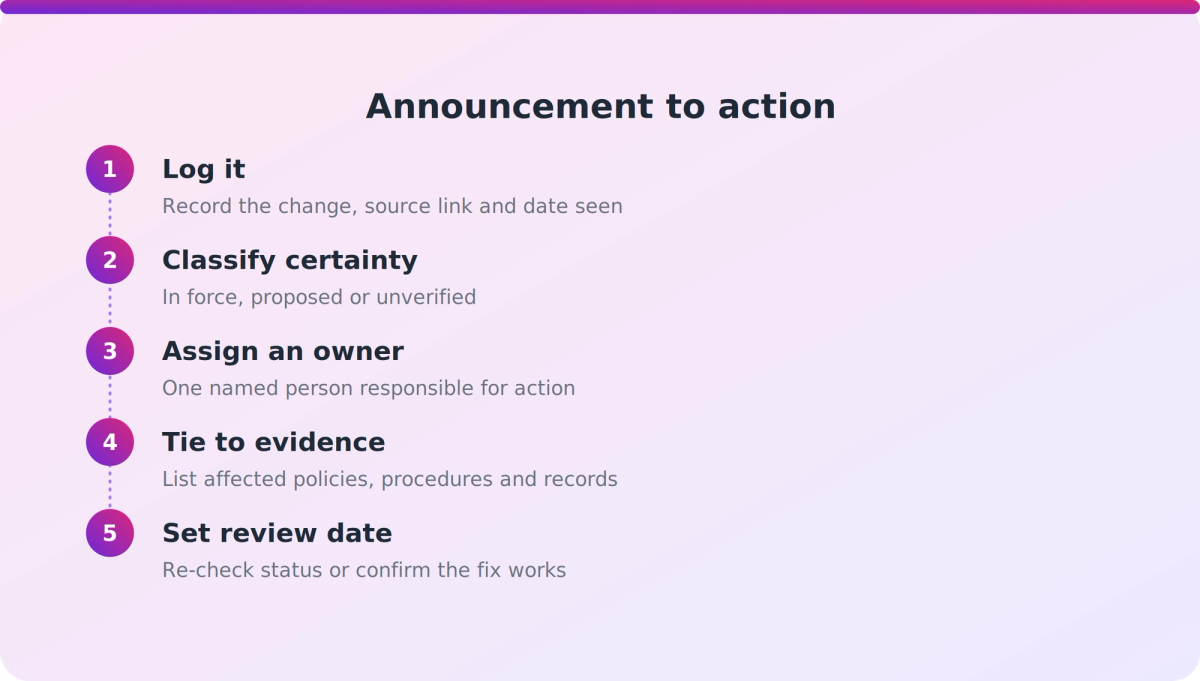
One shared register is enough. It needs five fields per item:
- Log it. Record what was announced, the source link and the date you saw it.
- Classify it. In force, proposed or unverified, with the date you last confirmed that status.
- Assign an owner. One named person, who isn't automatically you. You're the reviewer, not the bottleneck.
- Tie it to evidence. List the policies, procedures and records the change touches.
- Set a review date. Proposed items get a date to re-check status. In-force items get a date to confirm the fix works.
Illustrative example: The PTE Rules 2026 remove the annual fee and move non-funded PTEs to two-yearly financial returns. Your entry is status "in force", owner the finance lead, evidence the finance calendar and any procedure that references the old fee, and a review date shortly after the next reporting point. Nothing exotic. It simply can't go missing now.
Why the review date matters most
A log with no review dates turns into a graveyard of stale "proposed" items. The dates are what make it an early-warning system. NZQA's monitoring is described as risk-informed, shaped by provider capability and maturity and by wider system data. That doesn't tell us precisely what triggers attention, but it does suggest that the gaps visible in your own records are the ones to find first.
Watch the second stream: VET reform, fees and pastoral care
Rules aren't the only source of change. Under the vocational education redesign, eight Industry Skills Boards now lead standard-setting, taking over from the Workforce Development Councils. All ISB programmes and enrolments must move to polytechnics, PTEs or wānanga by 1 January 2028 (Ministry of Education). Sources differ on some Te Pūkenga dates, so confirm with TEC or the Ministry. NZQA qualification review consultations can also change the standards you assess against.
Cost and cross-agency signals belong in the same log. NZQA's Board approved extending the credit reporting fee to qualification completions and a $240 per hour plus GST professional services fee from 1 January 2026, and a further fees consultation proposed more changes whose outcome isn't confirmed. Tertiary providers must also follow the Pastoral Care Code of Practice 2021, and signatory status is required to enrol international learners (Ministry of Education).
Our take
Most PTEs we'd expect to struggle here won't be ignorant of the changes. They'll have read every circular. The failure mode is the gap between "we know" and "someone's doing something about it".
That's why the tracker's value is ownership, not information. If you're the only person who reads NZQA updates and the only person who acts on them, you've rebuilt the old bottleneck with a better spreadsheet. Put the owner field in front of the management team and make them name names.
The descriptors debate is also a useful test. Whatever NZQA decides, scoring on evidence the provider already holds makes stale, scattered records a visible weakness. That risk is worth tackling now, whichever way the bands fall. Our own pieces on evidence ownership and non-compliance risk indicators go deeper on both.
FAQ
How is compliance different now that EER has ended?
The external review moment has gone. NZQA stopped starting new EER processes from 1 January 2026, per a Technical Institute summary. Providers are expected to self-review and maintain their quality management system continuously, under risk-informed monitoring.
Do I need to act on the proposed quality descriptors?
Not as a compliance deadline. Final decisions aren't confirmed, and a secondary source suggests use from July 2027 at the earliest. Log them as proposed, review the status on a set date, and make sure the evidence behind them is current.
What should I verify before relying on a summary?
Anything from a consultancy or provider summary, including the four annual duties under the 2026 quality assurance rules, the AI thematic question and the Immigration NZ notice. Check the rules text or the notice itself first.
Who should own each change?
The person who runs the affected process, not the Compliance Manager by default. Your role is to classify, challenge and review.
Your next step
This week, list every change from the past 18 months that touched your policies. Next to each, write the owner's name and the evidence it affects. Wherever the owner cell is empty, that's your first gap.