Assessment Consistency Across RTO Trainers: Head of Training Guide
Judgement drift is what happens when two trainers read the same evidence and reach different decisions, and nobody notices until validation or audit. It isn't mainly a paperwork failure. It's a workforce one, and a five-yearly validation cycle is too slow to catch it. Your lever is making consistency visible during delivery.
Key takeaways
- Judgement drift is "same evidence, different decision". Assessment consistency across RTO trainers has to be tested while you deliver, not discovered at validation.
- ASQA's five-year validation requirement is a ceiling. Risks, product changes and feedback from students, trainers, assessors or industry all call for earlier validation.
- Workforce conditions (shortage, casualisation, an ageing workforce) make drift more likely, so calibration time needs protecting in the timetable.
- A validation report that is filed but not acted on is the failure to avoid. Findings should change the assessment tool, the marking guide or the trainer briefing.
- Start small: have several assessors mark the same de-identified evidence and compare outcomes before you touch any other process.
Why this lands on your desk
You own the quality of delivery and assessment. When two trainers reach different outcomes on identical evidence, learners are affected first and you answer for it second.
ASQA's Assessment Practice Guide says providers must validate assessment practices and judgements at least once every five years for every training product on scope. They must validate sooner if they become aware of risks, if the training product changes, or if feedback arrives from students, trainers, assessors or industry. Everything between validation points is yours.
Consultant summaries of ASQA's 2026–27 priorities point to delivery quality and the integrity of qualifications and competency outcomes. Those are secondary reads of the Corporate Plan, so check them against ASQA directly. Even so, the direction is plain enough.
Why drift is a workforce problem
Drift rarely comes from carelessness. It comes from capable people working alone, with little time, on their own reading of the criteria.
Jobs and Skills Australia's October 2024 VET workforce study found VET teachers in shortage nationally, and in every state and territory, for the preceding two years. Almost 50% of the VET workforce is over 50, against 30% of the wider workforce, and the workforce is highly casualised. That means more new, part-time or departing assessors, each with less chance to calibrate against colleagues.
Currency competes for the same hours. Industry Skills Australia notes that rapid technological change is increasing the time and cost for trainers and assessors to maintain vocational currency. Trainer hours are finite, so if moderation isn't scheduled, it won't happen.
What the 2025 Standards ask of you
In practice, consistency has to be designed in before delivery and demonstrated afterwards.
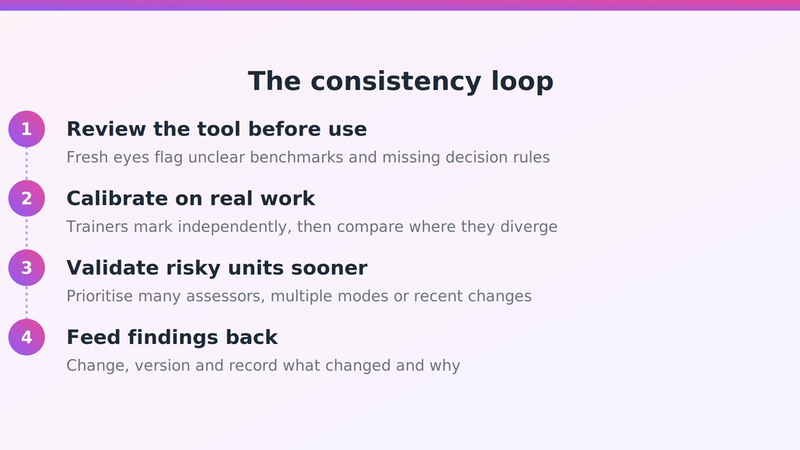
Before delivery, ASQA's 2025 Standards FAQs say providers must review assessment tools before use to confirm assessment can be conducted consistently with the principles of assessment and the rules of evidence.
Afterwards, you need to show the system learns. The practice guide lists common failings that map directly onto drift:
- limited or ineffective validation criteria or sample size
- not using validation to strengthen the assessment system and address risks to students and assessment integrity
Secondary sources add two further points. Knowledge Foundry says a validation outcome must not be determined solely by someone who designed or delivered the training or assessment. It also says the RTO must show how outcomes are used to change the assessment system. Verify both against the Standards before you build a process around them.
The reliability principle is often quoted as requiring that assessors interpret evidence consistently and that outcomes are comparable whichever assessor conducts the assessment. That wording also comes via a secondary source, so confirm it in the Standards before quoting it.
Make consistency visible during delivery
The cheapest way to find drift is to look for it on purpose, on a small scale, and often.
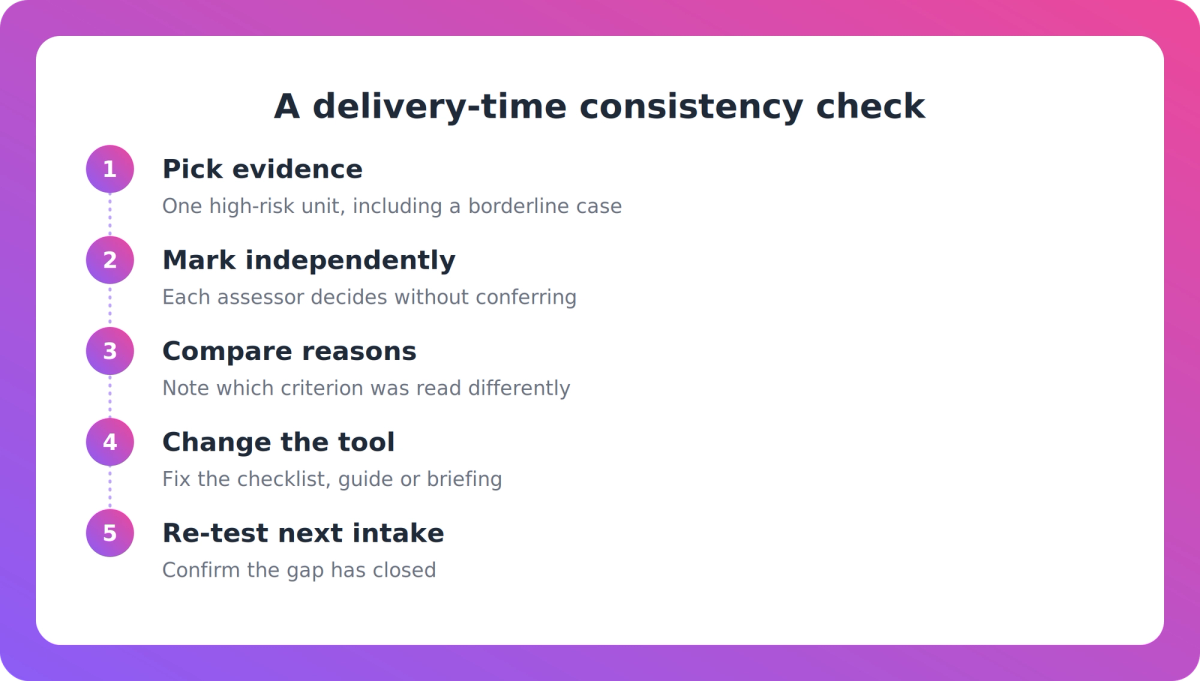
Here is an illustrative approach, not a customer story or a measured result:
- Pick one high-risk unit of competency, such as one with a subjective observation task or a heavy written component.
- Take three to five pieces of de-identified learner evidence, including at least one borderline case.
- Have each assessor mark them independently against the marking guide, without conferring.
- Compare the outcomes and, more importantly, the reasons. Where decisions split, note which criterion was read differently.
- Change something concrete: the benchmark answer, the observation checklist, the wording of the criteria, or the trainer briefing.
- Record the change and the reason, then re-test on the next intake.
Step 5 is where most processes fall down. A spreadsheet of disagreements proves nothing. A revised assessment tool that closes the gap is the evidence that your system acts on what it finds.
Protect the time, and include your casuals
Schedule calibration as paid time and put it in the timetable, not in the margins of someone's weekend. Include casual and new assessors first, because they have the least informal exposure to how colleagues read the criteria.
Keep the sessions short and tied to one task, so they don't compete with currency. Where you can, bring in someone who didn't design or deliver the assessment, in line with the independence point above.
Watch for early signals
You don't need a formal exercise to notice trouble. These are cheap prompts for an earlier look, and each is also a trigger for earlier validation under the practice guide:
- student or trainer feedback that marking "depends on who you get"
- a change to the training product or its training package version
- a cohort result that looks different by assessor
- a new or departing assessor on a unit
Completion data and competency outcomes
Completion data and competency outcomes get read together, but be careful not to link them causally. NCVER reports that 48.9% of VET qualifications commenced in 2021 were completed within four years, down from 49.5% for 2020 commencers, with rates varying significantly across student groups, qualifications and jurisdictions.
That data does not say inconsistent assessment drives completion, and you shouldn't claim it does. What it does mean is that scrutiny of outcomes is real, so you want to be the one who has already looked at how those outcomes were reached.
Our take
Most RTOs treat validation as an event and consistency as its by-product. We think that's backwards. Consistency is a delivery-time property that validation checks, and the Head of Training is the only person with both the authority over trainers and the view of the timetable to build it.
The uncomfortable part is that it costs trainer hours in a sector where trainer hours are scarce. Our view is that this is still cheaper than finding a split decision in front of an auditor, or worse, in front of a learner who was marked differently from the person next to them.
FAQ
How often must an RTO validate assessment?
ASQA's Assessment Practice Guide says at least once every five years for every training product on scope. Validate sooner if you become aware of risks, the training product changes, or you receive feedback from students, trainers, assessors or industry.
What is judgement drift?
It is the gradual divergence in how assessors interpret the same evidence, so the outcome depends on who marks it. It runs against the reliability principle, which expects comparable outcomes whichever assessor conducts the assessment (verify the exact wording in the Standards).
What makes validation ineffective?
The practice guide cites limited or ineffective validation criteria or sample size, and not using validation to strengthen the assessment system and address risks to students and assessment integrity.
Why is this harder now?
Jobs and Skills Australia found national VET teacher shortages, a highly casualised workforce and almost 50% of the workforce over 50. That leaves less capacity for the calibration that keeps assessors aligned.
Your next step
This week, choose one unit of competency and one borderline piece of de-identified evidence. Ask three assessors, including a casual, to mark it independently and explain their reasoning. Whatever the split looks like, you will learn more about your assessment system than another year of waiting for the validation cycle would tell you.