Cultural Competency Training NZ: Role-Play vs Workshops
Awareness workshops can explain what cultural competency is, but they rarely give frontline staff practice at doing it. As expectations reach administrative and home and community support roles, scenario-based role-play grounded in real local situations looks like the stronger option. No NZ study has compared the two directly yet.
Key takeaways
- Cultural competency expectations in NZ now reach non-clinical frontline roles, as ACC's updated guidance shows.
- Knowledge-only training risks stereotyping. Scenarios should practise responding to individuals and whānau, not reciting facts about "a culture".
- The case for role-play rests on general training research and NZ policy direction. The evidence is indicative, not proven for this topic.
- Psychological safety, consent and local grounding are design requirements, not nice-to-haves.
- With public-sector capability support under pressure, PTEs and corporate L&D teams may need to build practice-based training themselves.
What has changed for NZ frontline teams?
Cultural competency is no longer a clinician-only expectation. ACC's cultural safety and competency guidance (last published 31 August 2026) now covers non-clinical staff, including administrative and home and community support roles. It was developed with Mauri Ora Associates, and ACC ran a provider webinar on 10 June 2026.
At the same time, support for public-sector capability is being reshaped. Te Ao Māori News reported on 20 May 2026 that Te Arawhiti's restructure disestablished 49 roles and transferred 44 to Te Puni Kōkiri. Māori public servants fear a loss of Treaty capability.
The Public Service Act 2020 still requires public service leaders to develop and maintain the Public Service's capability to engage with Māori and understand Māori perspectives, as Papa Pounamu explains. The expectation is staying. The central support is moving.
What do current courses and workshops give people?
Most of what's available is course-based, and it's a useful baseline. Waka Toa Ora (25 February 2026) promotes free CALD cultural competency courses for Health NZ, PHO and NGO staff, including "Cultural Competency and Customer Service". ShopCare NZ offers free online modules for retail and supply-chain workers.
eCALD describes interactive activities, varied presentation methods and self-test exercises. Manukau Institute of Technology also runs a Te Tiriti o Waitangi workshop.
These build awareness and shared vocabulary. What they can't easily do is rehearse the moment a stressed whānau member rings a front desk. Role-play can sit on top of them to add that practice.
Why can knowledge-only training backfire?
Because facts about a culture can turn into assumptions about a person. A 2025 paper in the International Journal for Equity in Health notes that cultural competency has often been individualised and focused on acquiring cultural knowledge. It warns that uncritical promotion may increase stereotyping and cultural essentialism.
The Medical Council of NZ definition, quoted by InPractice, makes a similar point: general cultural information may not apply to a specific patient.
So the test for any training is simple. Does it build the habit of asking, listening and adapting? Or does it hand people a cheat sheet?
What should a good scenario practise?
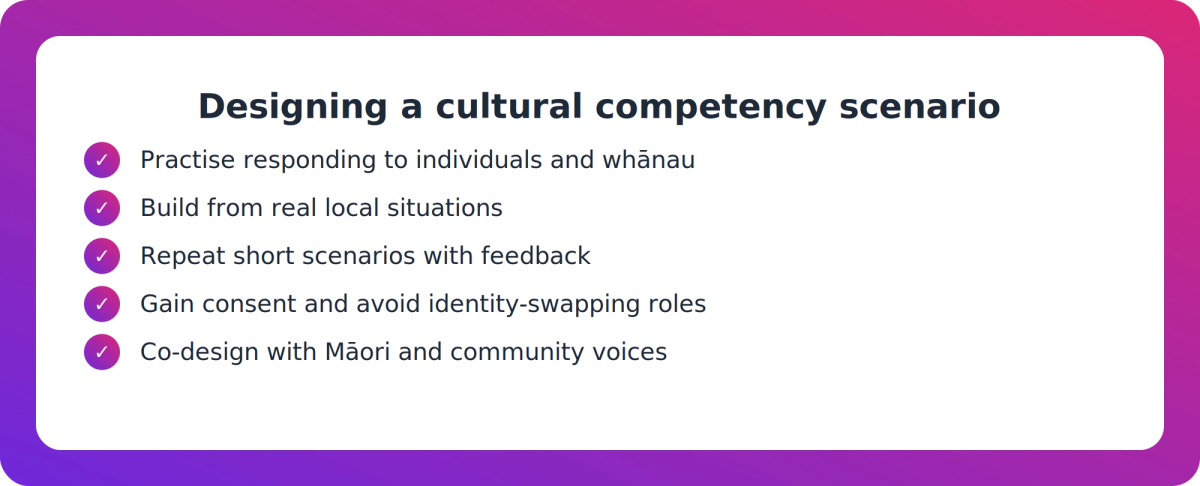
A good scenario puts a learner in a realistic interaction and asks them to respond to the person in front of them. Four design principles follow from the research:
- Individuals and whānau, not categories. Scenarios should reward curiosity and checking, and penalise assuming.
- Local, real situations. The Te Arawhiti Māori Crown Relations Capability Framework recommends tailoring training to an agency's own subject matter, locations and history.
- Repetition. One session isn't deliberate practice. Short, repeated scenarios with feedback are the aim.
- Psychological safety. Participation should be consented to, and facilitation should be considered.
An illustrative example
This is a hypothetical, not a case study. A PTE enrolment administrator takes a call from a learner's whānau member worried about a fee notice. The scenario doesn't test facts about any culture. It tests whether the administrator checks who the caller is to the learner, asks what would help, and explains next steps without assuming how the family makes decisions.
Run it three times with different caller responses and the learner practises adapting, not following a script. Local detail, such as your own region, services and iwi relationships, should come from people who know them.
How strong is the evidence for role-play over workshops?
Indicative at best. Be wary of tidy numbers.
- A vendor blog from Sidestream Consulting claims immersive role-play was about 20% more effective than passive formats for communication skills. It also argues a single role-play isn't deliberate practice.
- QuestWorks argues short weekly scenarios beat quarterly half-day workshops. Neither source is independent, and the meta-analyses QuestWorks cites could not be verified.
- A peer-reviewed study on role plays and process-oriented behaviour found a half-day role-play produced behaviour change that held over two years. That covered workplace process behaviour, not cultural competency.
There's also a caution from NZ. An Asia Pacific Scholar study of a cultural competency workshop used role-play where participants played both doctor and patient. One participant was uncomfortable playing genders and ethnicities different from their own. Design so that nobody is asked to perform someone else's identity.
How can PTEs and L&D teams start?
Start small, local and honest about what you don't know.
- Keep the baseline. Free courses from eCALD, Waka Toa Ora and ShopCare cover awareness at no cost.
- Pick three or four real interactions that frontline staff find hard, drawn from your own complaints, enquiries and staff input.
- Co-design with Māori and community voices. Scenarios built without them risk the essentialism the research warns about.
- Write scenarios around responding, not recalling. Score the questions asked and the adjustments made.
- Make participation safe. Offer opt-outs, avoid identity-swapping roles and debrief every session.
- Repeat and review. Short, regular practice beats one big session, though you should treat that as a working hypothesis and check it in your own context.
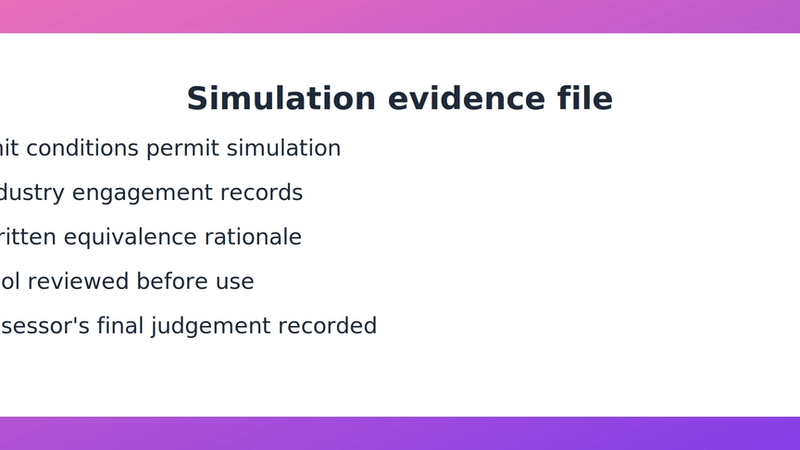
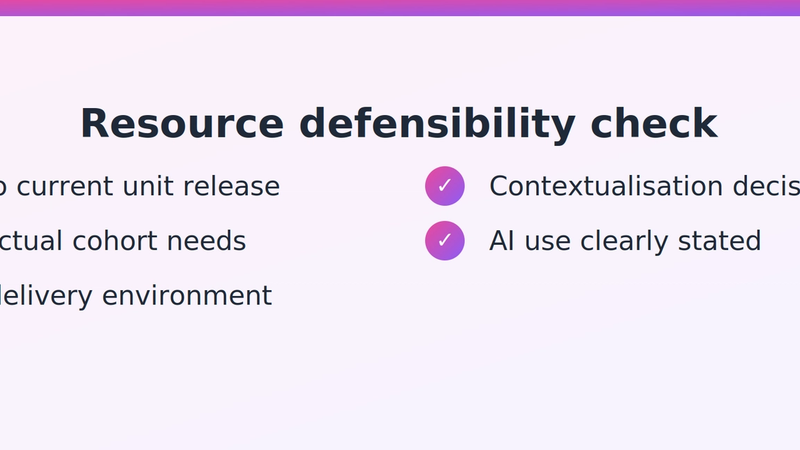
Cost is the usual barrier. Writing varied scenarios, recruiting role-play partners and coaching each learner is slow. AI-generated scenarios and coached practice can lower that cost, but only if people with local and cultural knowledge review the output before it reaches learners.
Our take
The real risk isn't that role-play fails. It's that organisations swap a tick-box workshop for a tick-box simulation. Practice only helps when the scenarios are local, built with the people they represent, and aimed at responding to individuals. With Te Arawhiti's capacity shrinking, the providers who invest in that now will be ahead, and the missing NZ comparison study is a reason to measure your own results, not to wait.
FAQ
Do cultural competency requirements apply to non-clinical staff in NZ?
Increasingly, yes. ACC's cultural safety and competency guidance now covers non-clinical staff, including administrative and home and community support roles. Public service leaders also have obligations under the Public Service Act 2020 to build capability to engage with Māori.
Is role-play proven to work better than workshops for cultural competency?
Not directly. No NZ study compares the two for cultural competency. The supporting figures come mostly from vendor blogs and studies on other skills, so treat them as indicative.
Can cultural competency training increase stereotyping?
It can if it focuses on cultural knowledge alone. A 2025 paper in the International Journal for Equity in Health warns that uncritical promotion may increase stereotyping and cultural essentialism. Scenarios that practise responding to individuals and whānau help counter this.
How do you keep role-play psychologically safe?
Obtain consent, offer opt-outs and avoid asking participants to play identities different from their own. An NZ workshop study found one participant uncomfortable doing exactly that, so build facilitation and debriefs into the design.
Your next step
Pick one frontline interaction your team finds awkward and write it up as a two-minute scenario with a local context. Test it with two colleagues and someone with relevant cultural knowledge, then ask: did it practise responding, or recalling?