A unit of competency is superseded or its performance criteria are reworded on training.gov.au. Your assessment tools, learner guides and training and assessment strategies don't update themselves. Most RTOs find the affected resources by searching folders and spreadsheets, and that slow gap is a quiet compliance risk.
Key takeaways
- The risk sits in the gap between a register change and the resources built on it, not in the change itself.
- Treat training.gov.au as the single source of truth, and link every resource back to the unit it was built on.
- Not every update needs a rebuild. Tracing tells you which elements, criteria or tools actually need review.
- A live link between resources and register data turns impact tracing from a manual hunt into an automatic flag.
- Human review stays essential. Tracing finds the work; educators decide what good looks like.
Why does a register change create a compliance risk?
Because the Standards for RTOs 2025 expect what you deliver and assess to match the current unit requirements. If a unit is superseded or its wording shifts, resources built on the old version can drift out of step without anyone noticing.
The drift is rarely dramatic. A performance criterion gets reworded. A new element appears. A unit is replaced by an equivalent with a different code. Each change is small, but each one can leave an assessment task mapped to something that no longer exists.
The real exposure shows up later. It might be at validation, at an audit, or when a learner is assessed against a tool that no longer covers the unit. For current requirements, check the Standards for RTOs 2025 on the Federal Register of Legislation and unit details on training.gov.au.
What does the manual process look like today?
Most RTOs run some version of the same routine:
- Someone spots a release or supersession, often by chance or via a newsletter.
- They search shared drives for the unit code.
- They open each assessment tool, learner guide and strategy document to check for the old wording.
- They update a spreadsheet of what's affected and who owns it.
- They hope nothing was saved under a slightly different name.
This works with a small portfolio. It breaks down across dozens of units, several qualifications, and multiple trainers who each keep their own copies. The cost is hours of searching before anyone gets to the actual review.
It's also hard to evidence. If an auditor asks how you identified affected resources after a change, a folder search isn't much of an answer.
How should you think about impact tracing?
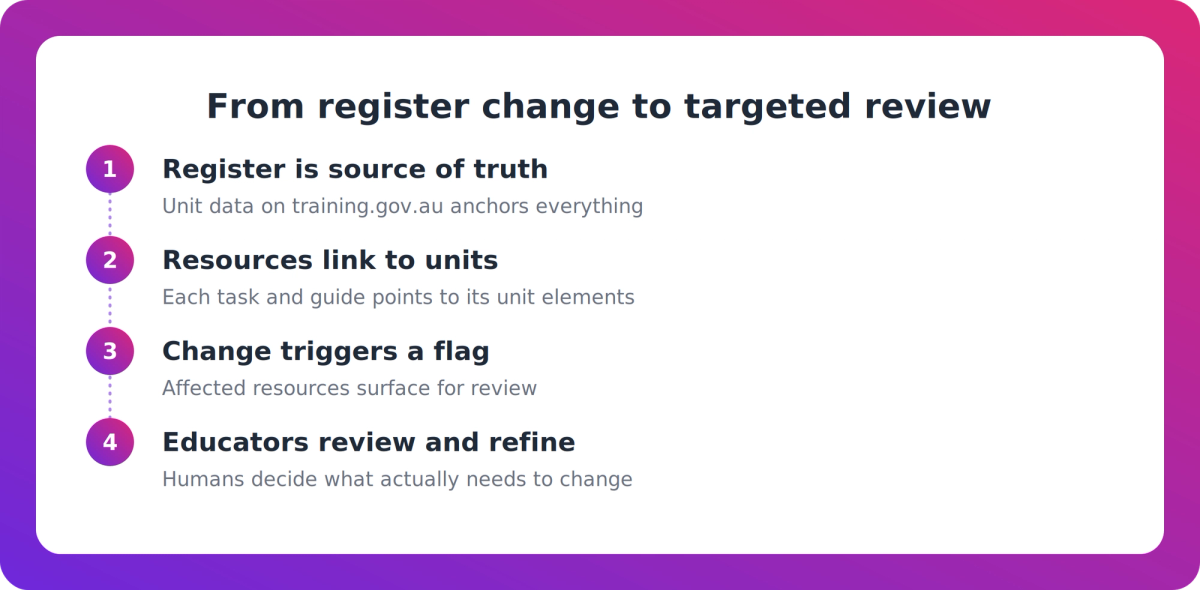
Treat it as a data problem, not a filing problem. Three principles do most of the work.
1. Make the national register the single source of truth
Unit codes, elements, performance criteria, performance evidence and knowledge evidence all live on training.gov.au. Your internal documents should reference that data, not paraphrase it from memory or an old PDF.
2. Link every resource back to the unit
An assessment task, a learner guide chapter and a section of your training and assessment strategy should each point to the specific unit and elements they address. Without that link, you can't ask "what is affected?" and get a reliable answer.
3. Flag for review the moment a unit changes
The aim isn't to rewrite everything. It's to know which resources touch the changed element, so the review is targeted. A reworded performance criterion might affect two tasks and one guide section, not the whole unit.
How does a live regulatory graph make tracing automatic?
It does the linking for you. Supahuman VETos builds a live regulatory graph that ties assessments, study guides and strategies to the same training.gov.au data. When the register changes, the resources connected to the affected unit are already identifiable, because the connection was made when they were created.
In practice, that shifts the update from a search exercise to a review list:
- Which unit changed? The graph points to the register record.
- Which resources were built on it? Assessments, study guides and strategies linked to that unit are surfaced.
- What needs a human decision? Educators review the flagged items, then refine or confirm them.
The human stays in the loop. The graph tells you where to look; your educators and compliance staff judge whether the change alters the assessment, the learner material or the delivery approach. The result is a targeted review rather than a rebuild. You can read more about how the platform is built for Australian VET compliance at vet.supahuman.com.
A quick checklist you can use now
Whatever tools you use, you can test your readiness today. This is an illustrative starting point, not a compliance guarantee.
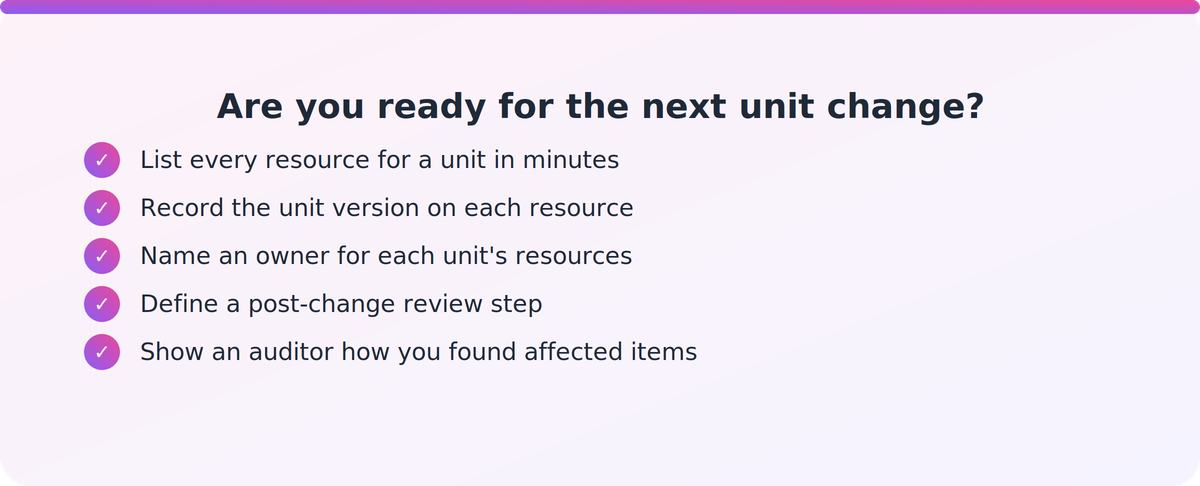
- Can you list every resource built on a given unit within minutes?
- Does each resource record the unit version it was mapped to?
- Do you have a named owner for each unit's resources?
- Is there a defined step for reviewing resources after a register change?
- Can you show an auditor how you identified what was affected?
If you answered no to two or more, the gap is probably already there.
Our take
Most RTOs treat training package updates as an event to react to. We think that's the wrong frame. The change is the easy part; the hard part is that nothing in your resource library knows it happened. Providers who link resources to register data up front turn every future update into a short review, and they can show their working when asked. Automation should find the affected work, but a qualified educator should still own the judgement call.
FAQ
What is a training package update impact assessment for an RTO?
It's the process of identifying which of your assessment tools, learner guides and training and assessment strategies are affected when a unit of competency is superseded or reworded. The goal is a targeted review of the affected resources rather than a rebuild of everything.
Where do RTOs find out about unit changes?
The authoritative source is training.gov.au, which lists current and superseded units and their components. Many RTOs also follow communications from ASQA and their industry skills bodies, but the register is where the actual unit content is confirmed.
Does every unit update mean rewriting assessments?
No. Some changes are minor rewording and may only affect a few tasks or guide sections. The point of impact tracing is to work out which elements and criteria changed, so you review only the resources connected to them.
How does the Standards for RTOs 2025 relate to this?
The Standards for RTOs 2025 expect that training and assessment are consistent with the current requirements of the relevant unit. Resources that still reflect old wording create a risk that your delivery and assessment no longer match.
Can software replace educator review?
No. A linked system can flag affected resources quickly, but educators should review and refine them. Judging whether a change alters an assessment or the learner's experience is a professional decision.
Next step
Pick one unit in your portfolio and time how long it takes to list every resource built on it. That number tells you how exposed you are when the next update lands.