Instructional Design and RTO Training Package Updates: A Guide for Instructional Designers
Your resources probably aren't ageing the way you think. The calendar matters less than distance: how far each resource sits from its current training product, its cohort, and the evidence your RTO uses to show it meets the standards. Ageing is a contextualisation problem, and ASQA's own guidance treats it as one.
Key takeaways
- Measure resources by how defensibly they connect to the current training product, cohort and delivery context, not by build date.
- ASQA's Assessment Practice Guide lists purchased tools not contextualised to your cohort, learning environment and training product as a risk indicator.
- Training package change is uneven. Track it package by package instead of assuming uniform churn.
- AI use now has to be addressed inside assessment design, not bolted on afterwards.
- "Design debt" is a practical lens for prioritising revision, not a measured sector statistic.
Why this lands on your desk
You own the build-and-maintain decision. When a training product changes, you decide what gets revised, what gets rebuilt and what gets left alone. Nobody else sees the full resource library well enough to make that call.
Since 1 July 2025, ASQA-registered RTOs have been measured against the Outcome Standards (instrument F2025L00354 on the Federal Register of Legislation). Secondary guides describe the framework as spanning the Outcome Standards, the Compliance Requirements (F2025L00355) and a Credential Policy. Read the instruments directly before you cite detail to anyone. ASQA is the regulator for the ACT, NSW, the NT, Queensland, SA and Tasmania, while Western Australia and Victoria have their own regulators, so check which applies to you.
The outcome-focused model leans on self-assurance: showing how you meet requirements in your own operational context. That means a design decision has to be explainable as evidence. "It's a good resource" won't do. "It was built against this unit, adapted for this cohort, and reviewed on this date for these reasons" will.
Design debt is a lens, not a statistic
Here's the honest bit. We found no authoritative source on how fast RTO learning resources go out of date, how long package updates take to reach delivery, or what instructional design costs RTOs. Anyone quoting you a number is guessing.
"Design debt" is our framing. It's useful because it shifts the question from "how old is this?" to "what would it cost to defend or fix this today?" A two-year-old resource tightly mapped to a stable unit and your actual learners may carry almost no debt. A six-month-old generic purchase may carry plenty.
What actually moves under your resources
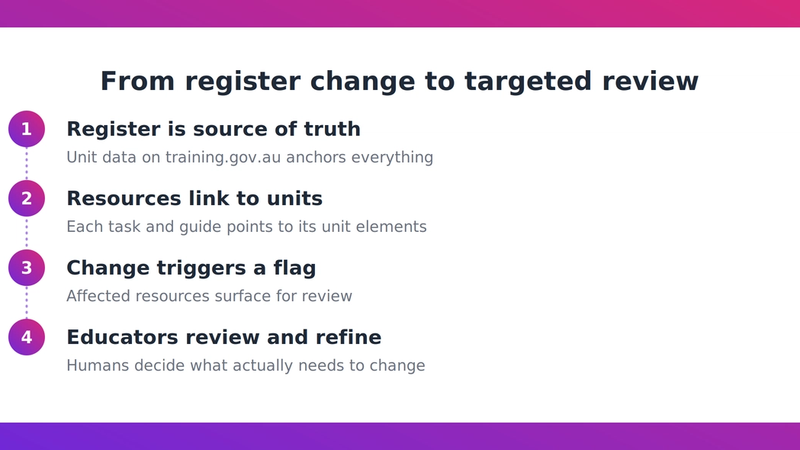
The products you build against keep shifting. The National Skills Plan 2025–26 Update says the updated Training Package Organising Framework came into effect in 2025 with new and revised templates, and Jobs and Skills Councils are leading phased implementation. The Future Skills Organisation's April 2026 quarterly update shows active work on ICT, Transport and Logistics, Aviation and other packages, with completion dates in 2026.
But not everything is moving. DEWR has temporary oversight of the TAE and Foundation Skills (FSK) packages, and its JSC page indicates the TRG is not seeking redevelopment of either. If you maintain resources across several packages, you'll have some in motion and some stable. Treat them differently.
Capacity matters too. JSA describes an older, highly casualised VET workforce, and Industry Skills Australia reports that technological change is raising the time and cost of maintaining vocational currency. A resource that needs heavy trainer rework to stay current pushes that cost onto the people least able to absorb it.
Triage by distance, not by date
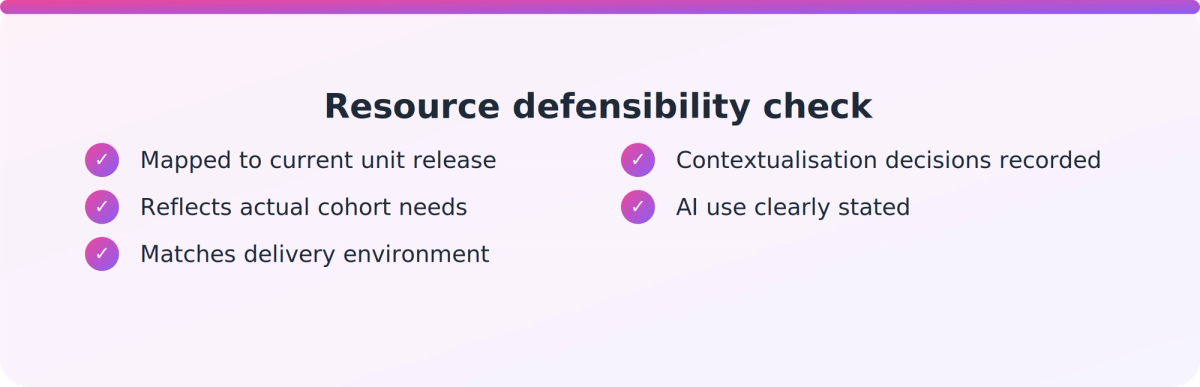
A resource is high-debt when you can't quickly show how it connects to its product, its learners and your evidence. Run each resource through five questions.
- Product: Is it mapped to the current release of the unit, or a superseded one?
- Cohort: Does it reflect who actually enrols, including their prior experience and language, literacy and numeracy needs?
- Environment: Does it match where and how delivery happens, such as workplace, simulated or online?
- Evidence: Could you show a reviewer the contextualisation decisions you made and why?
- AI: Does it state whether and how learners may use AI?
An illustrative example: say you hold two resources for the same unit. One is a purchased assessment tool used unchanged. The other is an in-house scenario adapted to your employer-partner workplaces, with a short change log. The second may be older and still carry far less risk, because you can explain it. Revise the first before you touch the second.
That gives you a revision queue ordered by exposure, with package change status as a tie-breaker.
AI changes the assessment design brief
ASQA's Assessment Practice Guide asks whether instructions clearly state if students can use AI, under what conditions, and how that supports valid and fair assessment. It also points to tasks designed so AI cannot replace the skill being assessed. ASQA's AI case studies include an RTO that reviewed its assessment design after a submission differed significantly from earlier work.
Secondary reporting by The Sector says ASQA's guidance also asks who checks AI-supported material before use and how AI tools collect, use, store and share information. Treat that as indicative and verify against ASQA.
For you, the practical point is that AI instructions are now part of resource quality. Any resource without them has a gap, however recently it was built.
Our take
Most RTOs talk about resource refresh as a content problem: update the slides, swap the images, re-badge the version. We think that's the wrong target. The risk ASQA names is distance from context, and you can refresh content endlessly while that distance stays the same.
So stop reporting "percentage of resources updated this year". Report how many of your resources you could defend today, with the reasons written down. It's a harder number to produce, but it's the one a regulator, a board and your trainers would all recognise as meaningful.
FAQ
Does a resource need rebuilding every time a training package updates?
Not automatically. Check what changed in the specific unit, then decide whether to revise, rebuild or leave it. Some packages, including TAE and FSK, aren't currently slated for redevelopment.
Is using purchased resources a compliance problem?
Not in itself. ASQA's Assessment Practice Guide flags reliance on purchased tools that aren't contextualised to your cohort, learning environment and training product as a risk indicator. Contextualise them and keep a record.
How fast do RTO resources go out of date?
No authoritative data says. Our research found no source quantifying ageing speed, update lag or design costs, so use "design debt" as a prioritisation lens, not a metric.
What should assessment design say about AI?
According to ASQA's guide, instructions should state whether students may use AI, under what conditions, and how that supports valid and fair assessment. Tasks should also be designed so AI can't replace the skill being assessed.
One thing to do this week
Pick one unit in a package currently being updated and run its resources through the five questions. Write down which ones you couldn't answer. That list is your first revision queue, and it may be shorter than you feared.