Simulated Workplace Assessment and the AQF: What Counts
You can assess in a simulated workplace, but only where the unit's assessment conditions allow it and the simulation replicates real workplace conditions. ASQA expects role-players acting as clients, documented industry engagement and a qualified assessor making the final call. Some units, including certain ECEC ones, need a real regulated service and can't be simulated at all.
Key takeaways
- The AQF doesn't set performance criteria. Each unit of competency's performance evidence and assessment conditions do, so start there.
- If a unit requires an actual workplace, simulation alone won't meet it. Some ECEC units are explicit about this.
- Role-players are the direct answer to "we have no real client", but you must show the simulated environment mirrors real conditions.
- The burden is evidence: industry engagement records, an equivalence rationale, tool review before use, and assessor judgement.
- AI-supported simulation is allowed if you can justify it and show it is balanced with human instruction, feedback and assessment.
Does the AQF decide whether you can simulate?
No. The AQF sets qualification levels. What a simulation must elicit comes from the unit of competency in the training package, specifically its performance evidence and assessment conditions.
That's why "is simulation AQF-compliant?" is the wrong question. The useful one is: does this unit's assessment conditions permit simulation, and what must the learner demonstrate if so?
ASQA's Assessment Practice Guide, written for the Standards for RTOs 2025, treats simulation and structured practical activities that replicate workplace tasks as acceptable approaches. It also tells providers to check the training product to see whether simulation is permitted. Where a unit requires skills to be demonstrated in an actual workplace, students must do that in a real one.
What does a compliant simulated workplace look like?
It replicates real workplace conditions closely enough for the learner to demonstrate the performance evidence. ASQA's Practical Training and Assessment guidance says other participants can be engaged as role-players to mirror realistic workplace interactions. That is the most direct answer to having no real client.
ASQA's online training and assessment guidance adds two points:
- Simulated assessment must meet the training package's assessment conditions, including realistic workplace conditions.
- The equipment and resources named in the Assessment Requirements still apply. One example it gives is role-play scenarios in real-time video-based assessment.
In practice, that means a client who behaves like a client. They bring the awkward questions, the time pressure and the information that arrives out of order. A friendly classmate reading a script is a weak stand-in.
Where simulation stops
Some units can't be met by simulation at all. ASQA's guidance on assessing ECEC students in the workplace notes that some ECEC units specify skills must be demonstrated in a regulated education and care service, with no simulation option.
There's also an enforcement backdrop worth noting, with a caveat. Commentary from CAQA and National Tribune reports that ASQA has been seeking information on workplace assessment in Individual Support, Carpentry and ECEC. The concern is whether RTOs genuinely assess in compliant workplace settings rather than substituting classroom simulations.
Those are secondary sources, so verify against ASQA directly. We also found no new ASQA rule on simulation in the last 90 days. The direction of attention is clear. A change in the rules isn't.
What evidence should you keep?
The regulator's test is whether you can prove equivalence, not whether simulation was convenient. VET Advisory Group advises documenting why a simulation is equivalent to a real workplace for the cohort.
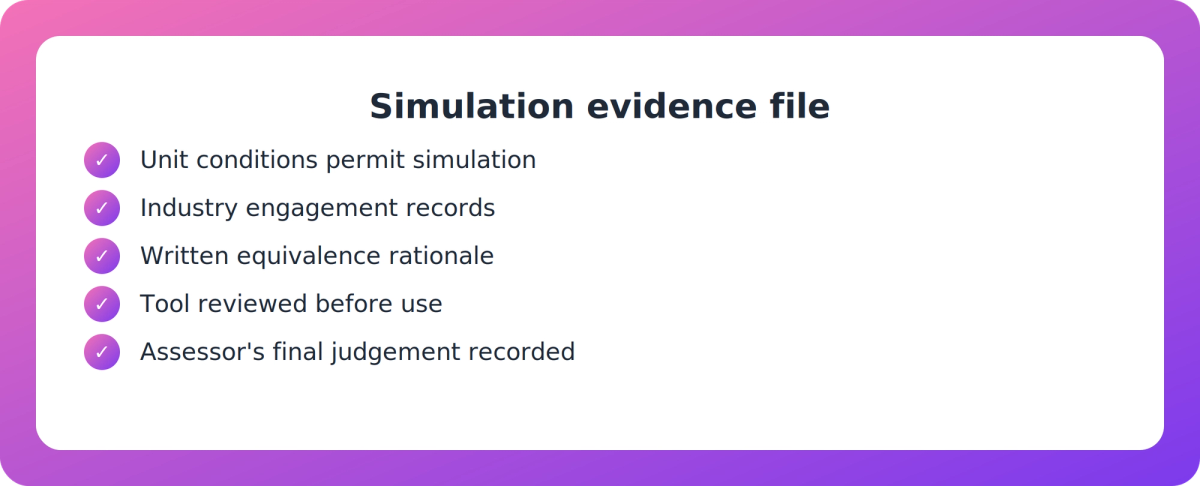
A workable evidence set looks like this:
- Unit check. A record that the assessment conditions permit simulation.
- Industry engagement. Notes from employers or practitioners on what the real workplace involves. ASQA's Practical Training and Assessment guidance says to keep these records.
- Equivalence rationale. A short statement of how the simulated setting, equipment, client behaviour and time pressure match the real thing.
- Tool review before use. The Standards for RTOs 2025 commenced on 1 July 2025, and explainers note assessment tools must be reviewed before use and practices validated regularly.
- Assessor judgement. A qualified assessor makes the final decision, with observation records that show it.
An illustrative example
Imagine an RTO delivering a unit whose assessment conditions permit simulation, for a cohort with limited access to host employers. It writes a client brief with a realistic need, a complication and a clear emotional register. It briefs trained role-players, runs the scenario in a room set up with the named equipment, and records the observation.
The file then holds the unit check, the employer input that shaped the brief, the rationale and the assessor's signed judgement. That's an illustration, not a case study. The point is that each piece answers a question an auditor would ask.
Can AI play the client?
Potentially, with conditions. ASQA's Training Practice Guide says RTOs can use AI-supported e-learning, virtual assistants or simulation tools if they can justify how these let students attain the skills and knowledge. They must also show how the tools are balanced with human instruction, practice, feedback and assessment.
Vendor commentary adds that the qualified assessor retains the final judgement and that RTOs need a review trail. We'd treat that as sensible practice rather than settled regulatory text.
The useful split is between practice and assessment. AI role-play is strong for repeated, coached rehearsal before the assessed attempt. For the assessed attempt, the same questions apply as for any simulation: does the unit allow it, is the environment realistic, and who made the judgement? Our own earlier piece on simulation-based training covers the practice side in more depth.
Our take
Most simulation risk is paperwork risk, not pedagogy risk. Plenty of RTOs run good simulated scenarios and then can't show why they're equivalent to the workplace, which is the first thing a regulator will ask. We think the sector should write the equivalence rationale before building the scenario, not after, and be honest about units where a real workplace is the only answer.
FAQ
Does the AQF say when simulated assessment is allowed?
No. The AQF sets qualification levels. Whether simulation is allowed, and what it must elicit, comes from each unit of competency's performance evidence and assessment conditions in the training package.
Can I use role-players instead of real clients?
Yes, where the unit permits simulation. ASQA's Practical Training and Assessment guidance says other participants can be engaged as role-players to mirror realistic workplace interactions. Keep records of your industry engagement.
Are there units that can't be simulated?
Yes. ASQA's guidance on assessing ECEC students notes that some ECEC units require skills to be demonstrated in a regulated education and care service, with no simulation option.
Can AI-based simulation tools be used for assessment?
ASQA's Training Practice Guide says RTOs can use AI-supported simulation tools if they can justify how the tools help students attain the skills and knowledge. They must also show the balance with human instruction, practice, feedback and assessment. A qualified assessor should make the final judgement.
Next step
Pick your highest-volume qualification and read the assessment conditions of each unit that currently relies on simulation. For every one, check that your file holds a permission record, industry input and a written equivalence rationale. Where any of the three is missing, fix that before the next intake.